
P0420 Jeep Code: Catalyst System Efficiency Fix
 Reading Time: 13 minutes
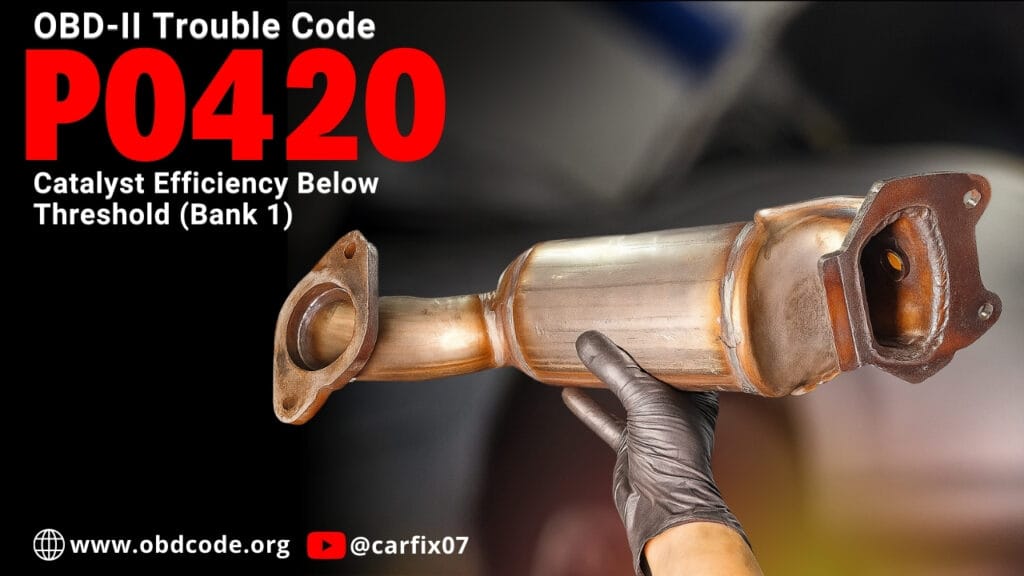
If your Jeep shows the P0420 trouble code, the engine computer has found that the Bank 1 catalytic converter is not cleaning exhaust gases as well as expected. “PO 420” is a common search spelling, but the correct code is P0420.
The best fix is not to replace the catalytic converter at once. First, check for exhaust leaks, misfires, fuel-control problems, and faulty oxygen-sensor readings. A failed catalytic converter is only one possible cause.
This guide applies to Jeep vehicles sold in the United States, including many Wrangler, Grand Cherokee, Cherokee, Compass, Patriot, Renegade, Liberty, and Dodge-based Jeep models. Exact test values and repair steps vary by engine and model year.

What Does the Jeep P0420 Code Mean?
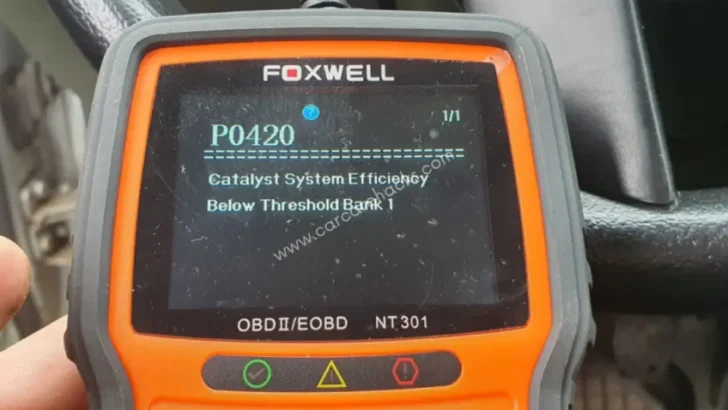
P0420 means “Catalyst System Efficiency Below Threshold, Bank 1.” The powertrain control module, or PCM, compares the signals from oxygen sensors before and after the catalytic converter.
The front oxygen sensor measures exhaust oxygen before the converter. The rear oxygen sensor measures oxygen after the converter.
A working catalytic converter stores and processes harmful exhaust gases. As a result, the rear oxygen-sensor signal should remain more stable than the front sensor signal.
If the rear sensor begins to copy the rapid changes of the front sensor, the PCM may decide that the catalytic converter is not working well enough. It then stores P0420 and may turn on the check engine light.
What “Bank 1” means
Bank 1 is the side of the engine that contains cylinder number one.
- On an inline four-cylinder engine, there is usually only one bank.
- On a V6 engine, Bank 1 is one side of the engine.
- A Jeep with two cylinder banks may set P0430 for Bank 2 instead.
The correct bank depends on the engine design, not the driver’s side or passenger side.
Is P0420 the same as a bad oxygen sensor?
No. P0420 is a catalyst performance code, not a direct oxygen-sensor failure code.
A weak oxygen sensor can cause P0420, but the catalytic converter, exhaust system, fuel system, or engine may also be at fault. Replacing the rear oxygen sensor without testing it may waste money.

Common Symptoms of P0420 on a Jeep
The check engine light is often the only symptom. The Jeep may still drive normally because the code measures emissions performance, not basic engine operation.
Possible symptoms include:
- Check engine light
- Failed emissions inspection
- Lower fuel economy
- A sulfur or rotten-egg smell
- Reduced engine power
- Sluggish acceleration
- Poor idle if another engine problem is present
- Rattling from a damaged catalytic converter
- High underbody heat
A P0420 code by itself does not always cause poor performance. Severe loss of power often points to a restricted or melted catalytic converter or an unresolved engine problem.
Codes that often appear with P0420
Check for other stored, pending, or permanent codes before diagnosing the catalyst. These codes can change the repair path:
| Related code or condition | Why it matters |
|---|---|
| P0300–P0306 misfire codes | Unburned fuel can overheat and damage the converter |
| P0171 or P0174 lean codes | A lean mixture can raise exhaust temperature |
| P0172 or P0175 rich codes | Extra fuel can overheat the converter |
| O2 sensor heater or circuit codes | The sensor may not provide a valid signal |
| EVAP or fuel-trim codes | A fuel-control fault may affect catalyst readings |
| Exhaust leak | Outside air can make the rear sensor report a false problem |
Repair active misfire and fuel-control faults before condemning the catalytic converter.

The Most Likely Causes of P0420 on a Jeep
The most common causes are a worn catalytic converter, an exhaust leak, a false oxygen-sensor reading, or an engine problem that has damaged the converter.
1. Worn or damaged catalytic converter
Catalytic converters lose effectiveness over time. Heat, age, contamination, physical damage, and repeated misfires can reduce their ability to process hydrocarbons, carbon monoxide, and nitrogen oxides.
A melted, broken, or contaminated converter may also rattle or restrict exhaust flow.
2. Exhaust leak near the converter
A leak before or near the downstream oxygen sensor can pull fresh air into the exhaust. The sensor may then detect extra oxygen and cause the PCM to believe the converter is inefficient.
Inspect:
- Exhaust manifold
- Manifold-to-cylinder-head joint
- Manifold-to-converter connection
- Converter welds
- Flanges and gaskets
- Downstream oxygen-sensor bung
- Cracked pipes
A small leak can matter even when it is hard to hear.
3. Faulty downstream oxygen sensor
The rear oxygen sensor monitors the converter’s output. If it responds too slowly, too quickly, or incorrectly, it can contribute to P0420.
The sensor wiring may also be damaged by heat, road debris, water, or contact with the exhaust.
4. Faulty upstream oxygen sensor or air-fuel sensor
The front sensor helps the PCM control the fuel mixture. If it reports the wrong oxygen level, the engine may run too rich or too lean.
That condition can trigger P0420 or damage the converter over time.
5. Engine misfire
A misfire sends unburned fuel into the exhaust. The catalytic converter can burn that fuel and become extremely hot.
Do not ignore a flashing check engine light. A flashing light often indicates an active misfire that can damage the converter and create a fire risk.
6. Incorrect fuel mixture
Vacuum leaks, dirty fuel injectors, low fuel pressure, excessive fuel pressure, intake leaks, and sensor faults can all affect the air-fuel mixture.
The cause may be upstream of the converter. Installing a new converter without fixing the mixture problem can lead to another failure.
7. Oil or coolant entering the exhaust
Worn piston rings, valve seals, or a cylinder-head problem can send oil or coolant into the exhaust. These fluids can contaminate the catalyst.
Blue smoke, white smoke, coolant loss, or oily deposits can support this diagnosis.
How to Diagnose and Fix P0420 on a Jeep
Use this order because it starts with low-cost checks and avoids replacing parts without proof.
1. Scan all codes and review freeze-frame data
Use an OBD-II scan tool to read:
- Stored codes
- Pending codes
- Permanent codes
- Freeze-frame data
- Engine coolant temperature
- Engine speed
- Vehicle speed
- Fuel trims
- Oxygen-sensor data
Write down all codes before clearing anything. Freeze-frame data shows the conditions present when the PCM stored P0420.
If the Jeep also has a misfire, fuel-trim, or oxygen-sensor code, diagnose that problem first.
2. Check for a flashing check engine light
If the check engine light is flashing, stop driving unless moving the Jeep to a safe location. A flashing light can indicate a severe misfire.
Have the misfire diagnosed before testing the catalytic converter. Continuing to drive may turn a small ignition or fuel repair into a costly converter replacement.
3. Inspect the exhaust system when cold
Let the exhaust cool before touching it. Look for:
- Black soot near a joint
- Cracks
- Loose fasteners
- Broken hangers
- Damaged heat shields
- Missing gaskets
- A loose oxygen sensor
- Melted wiring
A shop may use a smoke machine or low-pressure test to locate a leak. Do not force high shop air pressure into a sealed exhaust system.
4. Check fuel trims and engine operation
Fuel trims show how much the PCM is adjusting fuel delivery.
As a general diagnostic rule:
- Large positive fuel trims suggest the PCM is adding fuel, often because of a lean condition.
- Large negative fuel trims suggest the PCM is removing fuel, often because of a rich condition.
The exact acceptable range depends on the Jeep engine, operating temperature, load, and scan tool. Do not use one universal number as a final diagnosis.
Also check:
- Spark plugs
- Ignition coils
- Injector operation
- Intake leaks
- Vacuum hoses
- Fuel pressure
- Engine coolant temperature
- Air intake leaks
- Engine oil and coolant consumption
5. Check live oxygen-sensor data
On many older and conventional gasoline Jeep systems:
- The upstream sensor switches rapidly as the PCM adjusts the mixture.
- The downstream sensor should show a slower and more stable pattern once the engine and converter are fully warm.
A downstream sensor that closely mirrors the upstream sensor may support a weak catalyst diagnosis. However, scan-tool graphs differ by sensor type and vehicle system. Some newer Jeeps use wideband or air-fuel sensors whose data does not look like a traditional narrowband signal.
Do not condemn a converter from one voltage reading alone.
6. Test the oxygen sensors and their wiring
Check the sensor circuit for:
- Broken wires
- Melted insulation
- Corroded terminals
- Poor grounds
- Heater-circuit problems
- Loose connectors
- Exhaust contamination
A sensor may pass a basic electrical test and still respond too slowly. Follow the service information for the exact Jeep engine.
7. Test catalytic-converter temperature correctly
A professional technician may compare exhaust temperature before and after the converter with an infrared thermometer or thermocouples.
This test must be performed under the correct operating conditions. A cold converter, rich mixture, air injection, restricted exhaust, or inaccurate surface reading can mislead the result.
Temperature testing can support a diagnosis, but it is not a complete substitute for checking fuel control, misfire history, exhaust leaks, and sensor operation.
8. Check for a restricted converter
A converter that has melted internally may block exhaust flow.
Possible signs include:
- Power loss at higher engine speed
- Poor acceleration
- Engine stalling
- High exhaust backpressure
- Severe underbody heat
- A converter shell that rattles
A backpressure test or vacuum test under controlled conditions can help identify a restriction. Avoid drilling holes in the exhaust as a test method unless a qualified technician is following an approved repair procedure.
P0420 Jeep Fixes: What Usually Repairs the Problem?
The correct repair depends on the failed part or condition.
Repair an exhaust leak
Replace the failed gasket, pipe, flange, weld, or section of exhaust. The leak must be fixed before judging oxygen-sensor data.
A sealant applied near a hot catalytic converter is not a reliable substitute for a proper exhaust repair.
Replace a failed oxygen sensor
Replace the sensor only when testing shows that it is slow, biased, contaminated, electrically faulty, or outside the Jeep’s service specifications.
Use the correct sensor position:
- Upstream sensor: before the catalytic converter
- Downstream sensor: after the catalytic converter
Sensor connectors may look similar, but they are not always interchangeable.
Repair the engine problem
Fix misfires, fuel-trim faults, vacuum leaks, injector problems, ignition faults, oil burning, or coolant leaks first.
If the original problem damaged the catalytic converter, the converter may still need replacement after the engine repair.
Replace the catalytic converter
Catalytic-converter replacement is appropriate when testing shows that the converter is inefficient, damaged, contaminated, or restricted.
Use a converter that is legal for the vehicle’s emissions configuration and location in the United States. California and other states may require emissions parts that meet stricter standards than federal-only parts.
Do not remove the catalytic converter or install a “test pipe.” That can violate federal emissions law and state inspection rules.
Clear the code and complete a drive cycle
After the repair:
- Clear the code with a scan tool, if appropriate.
- Confirm that the engine runs normally.
- Drive through the conditions required by the Jeep’s readiness monitors.
- Recheck for pending and stored codes.
- Confirm that the catalyst monitor completes.
Disconnecting the battery may erase learned data and readiness monitors. It does not repair the cause.

Can You Drive a Jeep With P0420?
Short trips may be possible if the light is steady and the Jeep has no serious symptoms. Still, the vehicle may fail an emissions inspection, and the underlying problem may worsen.
Stop driving and seek prompt service if you notice:
- Flashing check engine light
- Strong fuel or sulfur smell
- Severe loss of power
- Red-hot exhaust parts
- Smoke
- Engine misfire
- Rattling from the converter
- Stalling
A damaged converter can become a restriction. A misfire can also overheat the exhaust system and damage nearby parts.
Keep flammable materials away from a hot exhaust system. Never work beneath a Jeep supported only by a jack; use properly rated jack stands on a stable surface.

How Much Does a P0420 Jeep Repair Cost?
The cost varies by Jeep model, engine, location, part quality, labor rate, and emissions requirements.
| Repair type | Relative cost | Why the range varies |
|---|---|---|
| Diagnostic testing | Low to moderate | Scan time, smoke testing, and sensor analysis |
| Exhaust leak repair | Low to high | Depends on access and the damaged section |
| Oxygen-sensor replacement | Moderate | Sensor location and wiring access matter |
| Ignition or fuel repair | Low to high | A plug is simple; injector or wiring work is not |
| Catalytic-converter replacement | High | Converter type, labor, and legal emissions rating |
| Restricted exhaust repair | High | A damaged converter may require related repairs |
A very cheap converter may not meet the required emissions standard or may fail again. Ask for the part’s emissions certification and vehicle application before installation.
The least expensive repair is often the one that identifies the root cause first. Replacing several parts by guesswork can cost more than one proper diagnostic session.

Common P0420 Diagnostic Mistakes
Replacing the catalytic converter immediately
P0420 does not prove that the converter is bad. Test for leaks, misfires, fuel problems, and sensor faults first.
Replacing both oxygen sensors automatically
Oxygen sensors are not routine P0420 replacements. Replace them when their operation or wiring is faulty.
Clearing the code before recording data
Clearing codes can erase freeze-frame information and reset readiness monitors. Record the data first.
Using an oxygen-sensor spacer
A spacer may alter the sensor signal without fixing the emissions problem. It may also violate emissions rules and prevent proper catalyst monitoring.
Ignoring other codes
A misfire or fuel-control code may explain why the converter failed. Treating P0420 alone can lead to repeat repairs.
Assuming a new converter will pass immediately
The catalyst monitor may need specific temperature, speed, load, and fuel conditions before it runs. A Jeep can have no new fault while the monitor is still incomplete.

How to Know the P0420 Repair Worked
A successful repair should produce more than a temporary absence of the check engine light.
Look for these signs:
- No active or pending P0420 after the required drive cycle
- Catalyst monitor complete
- No misfire or fuel-trim codes
- Normal fuel-trim behavior
- No exhaust leaks
- No unusual sulfur smell
- No loss of power
- No converter rattle
- Emissions readiness restored
If the code returns after a proper repair, do not keep clearing it. Recheck the exhaust for small leaks, verify sensor data, and look for an engine condition that may be damaging the new converter.
Frequently Asked Questions
Is P0420 serious on a Jeep?
It can be minor if the Jeep runs normally and the light is steady, but it should not be ignored. The code may indicate a worn converter, an exhaust leak, or an engine problem that can cause more damage.
Can bad spark plugs cause P0420?
Yes. Worn spark plugs can cause misfires or poor combustion. Unburned fuel then enters the converter and may overheat or damage it. Check for misfire codes and inspect the plugs before replacing the converter.
Can an exhaust leak cause P0420?
Yes. A leak near the converter or downstream oxygen sensor can allow outside air into the exhaust. That can create a false low-efficiency reading.
Will replacing the downstream oxygen sensor fix P0420?
Sometimes, but only if the sensor is faulty. If the catalytic converter is worn or the engine has a fuel or misfire problem, a new sensor will not solve the code.
Does P0420 reduce Jeep fuel economy?
It can, but not always. P0420 mainly monitors emissions performance. Poor fuel economy suggests that another issue, such as a rich mixture, weak sensor, injector fault, or misfire, may also be present.
Will a Jeep pass emissions testing with P0420?
Usually not if the check engine light is on or the catalyst monitor has failed. Requirements differ by state and inspection program, so check the rules where the Jeep is registered.
Can I reset P0420 by disconnecting the battery?
Disconnecting the battery may erase the stored code, but it does not repair the cause. It also resets readiness monitors, which can cause an emissions inspection failure until the monitors complete.
Final Recommendation
For a Jeep P0420 catalyst system efficiency below threshold code, begin with a full scan and an exhaust inspection. Repair misfires, fuel-control problems, and leaks before testing or replacing the catalytic converter.
If the engine runs correctly, the exhaust is sealed, the oxygen sensors work properly, and the catalyst monitor still fails, catalytic-converter replacement may be the correct fix. Use an emissions-compliant part for the Jeep’s exact engine and U.S. application.
Reference points
- EPA, Clean Air Act emissions information: https://www.epa.gov/clean-air-act-overview
- EPA, vehicle and engine compliance information: https://www.epa.gov/vehicle-and-engine-certification
- SAE J1979, emissions-related diagnostic data: https://www.sae.org/standards/content/j1979/
- Jeep owner and service information: https://www.mopar.com/en-us/my-vehicle/vehicle-information.html