
Best And Worst Years For Jeep Gladiator JT Pickup: Ranked
 Reading Time: 12 minutes
For U.S. used-truck buyers, a 2022 or 2023 Jeep Gladiator JT with the 3.6-liter gas V6 and eight-speed automatic is a sensible starting point. These trucks avoid the first model year and the manual-transmission clutch recall issue. The 2020 Gladiator deserves the most scrutiny, especially if its steering repair history is unclear.
That is a buying recommendation, not proof that one year has the lowest failure rate. Engine choice, transmission, recall status, rust, and off-road use can change the answer. A well-kept 2020 can be a better buy than a lifted, hard-used 2023.
This guide focuses on U.S.-market Gladiators. It uses documented model changes and known recall issues, but live recall databases and current competitor pages were not accessible for this article. Check every candidate’s VIN before making a purchase.

Jeep Gladiator Years Ranked: A Practical Buying Guide
Shop by year and powertrain together, rather than treating every Gladiator from one year as the same truck. A gas automatic and an EcoDiesel from the same year have different repair risks and maintenance needs.
The table below separates useful buying choices from claims that the evidence cannot support.
| Model year | Buying assessment | Best fit | Main checks before buying |
|---|---|---|---|
| 2020 | Highest-scrutiny year | Buyers who find a well-documented truck at a price that accounts for its condition | Steering behavior, repair history, VIN-specific recalls, clutch status if manual |
| 2021 | Conditional choice | Buyers comparing a clean example against a similar 2020 | Gas versus diesel maintenance needs, recalls, steering and suspension condition |
| 2022 | Preferred used-shopping starting point in gas/automatic form | Buyers seeking a later pre-refresh truck | Service records, accident history, modifications, open recalls |
| 2023 | Preferred used-shopping starting point in gas/automatic form | Buyers seeking a newer pre-refresh truck | Manual clutch recall status; diesel fuel-system and emissions history |
| 2024 | Stronger choice for updated equipment | Buyers who value side-curtain airbags and the revised cabin | Exact equipment, condition, recalls, and purchase price |
| 2025 and later | Not ranked here for long-term dependability | Buyers comparing newer vehicles | Current specifications, warranty terms, recalls, and emerging service history |
Why not name one proven “best year”? Public complaints and recall records do not provide a complete, mileage-adjusted failure rate for every Gladiator year. Older trucks have had more time to develop faults, while newer trucks have had less time to reveal them.
The useful conclusion is narrower: start with 2022–2023 gas automatics, inspect 2020 trucks more closely, and judge diesel and manual versions on their own risks.

What Counts as a Jeep Gladiator JT?
JT is the model code for the modern Jeep Gladiator pickup, which began with the 2020 model year in the United States. It is not a trim level. Sport, Overland, Mojave, and Rubicon are examples of trims within the JT line.
This matters because some “best Gladiator years” lists mix the modern truck with much older Jeep pickups. A supposed 2018 or 2019 U.S. Gladiator JT model year is a warning sign that a guide has confused calendar dates with model years.
Three powertrain distinctions matter most:
- 3.6-liter Pentastar gas V6: Available with a six-speed manual or eight-speed automatic in the earlier JT years covered here.
- 3.0-liter EcoDiesel V6: Offered in U.S. Gladiators for model years 2021–2023 with an eight-speed automatic.
- Manual versus automatic: The manual has a clutch-related recall history that does not apply to the automatic transmission.
A model year is only the first filter. The truck’s exact build and service history should make the final decision.
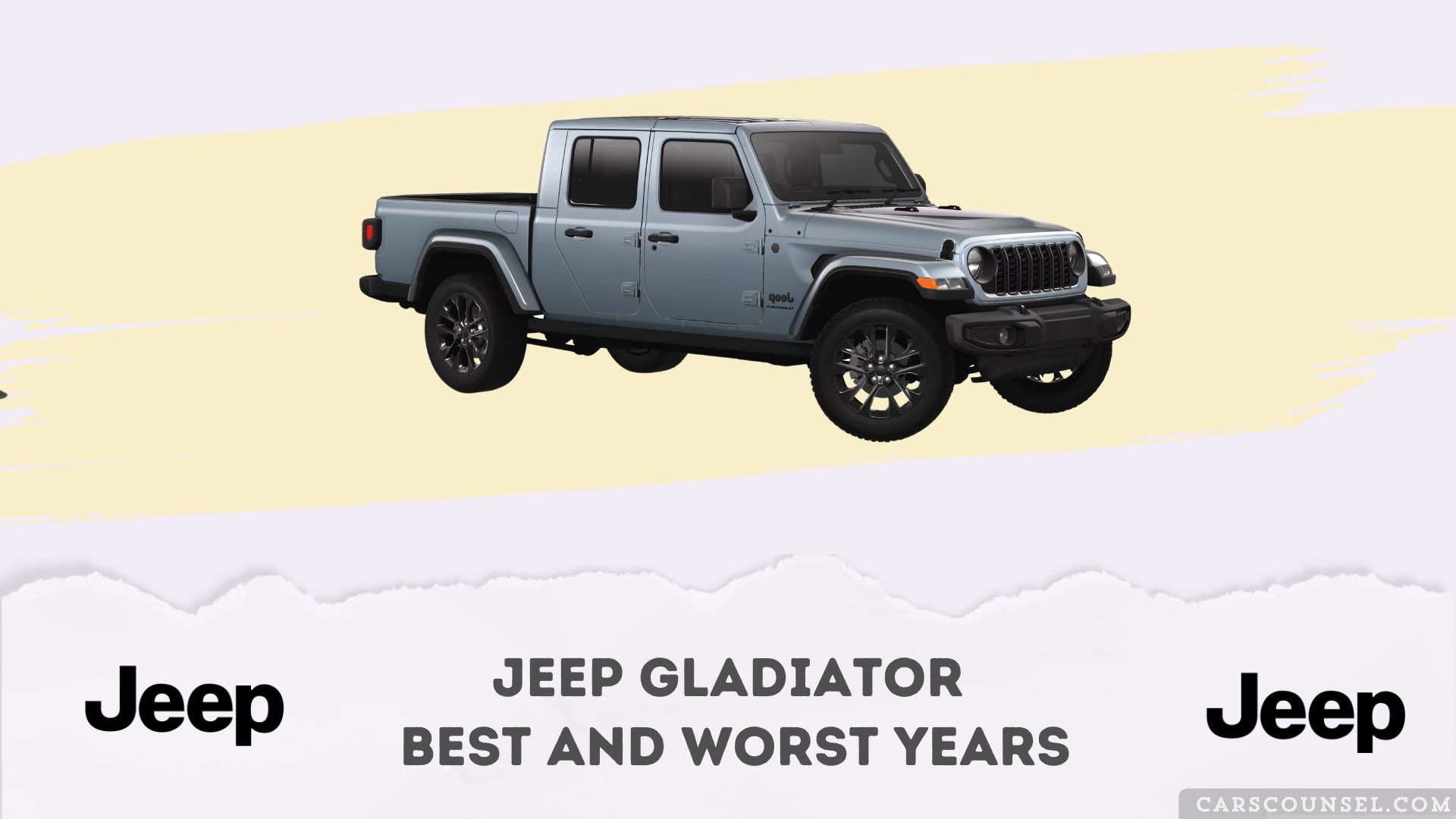
Best Jeep Gladiator Years to Consider
2022–2023 Gas Automatic: The Most Useful Starting Point
A stock or lightly modified 2022–2023 Gladiator with the gas V6 and eight-speed automatic is a practical used-buying target. It combines a later build within the original JT run with a powertrain that avoids diesel-specific emissions equipment and the manual clutch recall.
That does not establish that these years are free of engine, electrical, or suspension faults. Nor does it prove that Jeep corrected every earlier concern. The recommendation rests on the combination of model age, equipment, and fewer powertrain-specific complications—not a verified reliability league table.
Favor trucks with:
- Oil-change records that match the owner’s manual requirements.
- No unexplained coolant loss, warning lights, or persistent engine noise.
- Stock suspension, or documented, well-executed modifications.
- Recall completion records and a clean independent inspection.
Between two similar trucks, condition should outweigh a one-year age gap. A clean 2022 with complete records is usually the more defensible choice than a neglected 2023.
2024: Better for Updated Equipment, Not Proven Long-Term Reliability
The 2024 Gladiator is worth considering if cabin updates and side-curtain airbags matter to you. Jeep added standard first- and second-row side-curtain airbags and a standard 12.3-inch touchscreen for the U.S. refresh.
Those are meaningful feature changes. They do not, by themselves, prove better crash-test performance in every type of collision or greater mechanical durability.
Choose a 2024 because its equipment meets your needs and its price makes sense. Do not assume a refreshed dashboard means a redesigned engine or a clean slate for reliability.

Worst Jeep Gladiator Years and Configurations to Approach Carefully
2020: The Year That Needs the Closest Inspection
The 2020 Gladiator is the clearest caution year, but it is not an automatic rejection. As the first JT model year, it deserves extra attention to early-build concerns and documented repairs.
Steering is a key example. Jeep issued service bulletin 08-074-20, with revisions, addressing steering concerns on applicable vehicles. The repair procedure included a revised steering gear and related work; applicability depends on the vehicle and bulletin version.
A service bulletin is not a recall. It also does not mean every 2020 truck has the defect or that every owner qualifies for free work.
For a 2020 candidate, ask:
- Was the steering gear replaced or updated?
- Is there an invoice showing the repair?
- Does the truck track straight on a safe road test?
- Are the tires, alignment, and suspension close to stock?
Some early 2020 Gladiators were also subject to a rear-driveshaft recall. Check the VIN rather than assuming the recall applied to every truck.
Buy a 2020 only when its records, inspection, and price support the decision. A seller’s claim that “they all drive like that” is not a substitute for diagnosis.
2020–2023 Manuals: Verify the Clutch Recall
Any affected manual-transmission Gladiator needs a careful recall-status check. NHTSA recall 23V116 covers certain 2020–2023 Gladiators with manual transmissions, along with certain Wrangler vehicles.
The documented concern involves clutch pressure-plate overheating and fracture, which can create a fire risk and affect nearby components. Earlier recall work should not be treated as proof that all later campaigns are complete.
Before buying a manual:
- Run the VIN through the U.S. recall lookup.
- Ask a Jeep dealer to confirm all applicable campaign work.
- Obtain repair records, including dates and repair details.
- Have a qualified mechanic assess clutch operation.
If the truck has a burning smell, smoke, abnormal clutch behavior, or a related warning, stop the test drive and arrange professional help. Do not try to reproduce the fault.
The manual is not automatically a bad purchase. An unresolved safety recall, however, should not be brushed aside as a routine maintenance item.
2021–2023 EcoDiesels: More Specialized, Not Universally Bad
The EcoDiesel suits some buyers, but it brings costs and systems that a year-only ranking can hide. These include diesel exhaust fluid, a particulate filter, emissions controls, and a high-pressure fuel system.
Certain diesel Gladiators have been included in high-pressure fuel-pump recall campaigns. Applicability and repair status must be checked by VIN.
An EcoDiesel deserves extra scrutiny if it has:
- Gaps in oil or fuel-filter service records.
- Repeated emissions warnings.
- A history of mostly short trips.
- Hard starting, stalling, or unresolved fuel-system faults.
- Removed or altered emissions equipment.
Short trips can make the conditions needed for particulate-filter regeneration harder to achieve. That does not mean every short trip causes damage, but it makes driving pattern an important part of the purchase decision.
For a buyer who wants the simplest ownership path, the gas automatic is the more straightforward starting point. A diesel may still fit someone who understands its service needs and has access to a qualified diesel shop.

How to Check a Used Gladiator Before You Buy
A pre-purchase inspection is more valuable than moving up one place on a model-year list. Use a shop familiar with Jeep steering, four-wheel-drive systems, and aftermarket suspension parts.
1. Check the VIN and Service Records
Start with NHTSA’s recall lookup and Mopar’s recall lookup. Then ask a dealer for help confirming campaign completion and repair history.
A “zero open recalls” result is useful, but it is not a full health report. It does not establish that the truck has no worn parts, crash damage, or past faults.
Match the records to the truck’s mileage. Look for repeated complaints that were never clearly resolved.
2. Inspect It Cold
Ask the seller not to warm the truck before the appointment. A cold start can reveal rough running, unusual noise, smoke, and warning messages that may be less obvious later.
Check for fluid leaks and coolant residue. Let the mechanic decide whether a noise needs further tests; a brief listen cannot prove that an engine is healthy.
3. Assess Steering and Suspension Safely
During a safe road test, check for pulling, excess correction, vibration, and unusual steering play. Avoid deliberate maneuvers meant to provoke a wobble.
Persistent front-end oscillation is often called “death wobble.” That phrase describes a symptom, not one failed part. Tire balance, loose or worn joints, track-bar issues, alignment, and lift geometry can all need assessment.
A new steering damper alone is not proof that the root cause was fixed. If the truck shakes severely, slow down safely and have it inspected before further use.
4. Inspect for Rust and Off-Road Damage
For U.S. trucks used in road-salt regions or near salt water, check the frame, suspension mounts, brake lines, and fasteners. Fresh coating can hide corrosion as well as protect metal.
Inspect skid plates, axle housings, wheels, and underbody seams for hard impacts. Scratches are not always serious; bent parts, cracked mounts, or poor repairs are.
5. Test Four-Wheel Drive Correctly
Use the procedure in the exact truck’s owner’s manual. Test four-wheel-drive functions only where the surface and conditions suit the system.
Do not force a part-time four-wheel-drive truck through tight turns on dry pavement. Driveline binding can make a healthy system feel faulty and can stress parts.
6. Get a Written Repair Estimate
Ask the shop to separate safety faults, overdue maintenance, and optional improvements. Price the truck using those findings, not the seller’s estimate that a fault is “cheap to fix.”
Walk away if the seller refuses an independent inspection or cannot explain major modifications.

What Can Change the Best-Year Recommendation?
Use, modifications, and the truck’s actual load limits can matter more than its model year. A newer badge cannot undo a poor lift installation or years of missed maintenance.
Towing: Check the Exact Truck, Not the Advertisement
A Gladiator’s maximum advertised tow rating does not apply to every trim and powertrain. Axle ratio, transmission, tow equipment, payload, and other limits all matter.
Read the door-jamb payload label and the matching towing guide. Passengers, cargo, accessories, and trailer tongue weight all consume payload.
For a hypothetical example, a truck with a 1,200-pound payload allowance carrying 450 pounds of people and 200 pounds of cargo has 550 pounds left for tongue weight and other added load. The actual truck must also meet all applicable trailer, axle, hitch, and combined-weight limits.
That calculation can rule out a truck even when its advertised tow rating looks sufficient.
Modifications: Documentation Matters More Than Appearance
A lift and large tires can change steering feel, braking demands, gearing, and component wear. A tidy-looking truck may still need expensive corrective work.
Ask for the lift’s brand, installation invoice, alignment report, and a list of supporting changes. Have the inspector check clearances, joints, driveline angles, and signs of tire rubbing.
Price: Compare the Cost to Make It Right
A cheaper truck is not always the better value. Add needed tires, repairs, overdue service, and any work required to correct modifications.
Do not use a fixed “bad-year discount.” Local prices change, and two trucks from the same year can differ greatly in condition.

Evidence, Limits, and Questions Worth Resolving
The strongest evidence supports specific checks, not a universal reliability ranking. Recall documents establish defined safety defects in covered vehicles. Owner manuals establish operating procedures and limits. Neither proves how often every owner will face a major repair.
Useful primary resources include:
- NHTSA recall records, including campaign 23V116.
- Mopar owner manuals for operation, maintenance, and towing instructions.
- Mopar recall information for VIN-specific checks.
- Stellantis North America’s media site for original U.S. model-year announcements.
Raw complaint totals need care. Sales volume, vehicle age, mileage, and owners’ reporting habits affect the numbers. Fewer complaints do not automatically mean fewer failures.
Next-Question Gap Map
These are inferred buying needs, not verified search-demand findings. Competitor coverage is not checked, because live competitor pages were unavailable.
| Question | Reader stage and basis | Competitor coverage | Reader benefit and evidence | Priority and placement |
|---|---|---|---|---|
| Does the transmission change which year to buy? | Before shopping; inferred from the manual recall | Not checked | Avoids grouping recalled manuals with automatics; NHTSA records | High; year rankings and caution section |
| Can a repaired 2020 still be worth buying? | Comparing listings; inferred from steering concerns | Not checked | Prevents rejecting a sound truck solely by year; repair records and inspection | High; 2020 section |
| Does the truck’s payload fit the trailer? | Before purchase; inferred from pickup use | Not checked | Prevents buying an unsuitable configuration; labels and towing guide | High; towing section |
| Is a steering damper replacement enough? | Inspection; inferred from steering symptoms | Not checked | Encourages root-cause diagnosis rather than parts swapping | High; inspection section |
The next step is VIN-level verification and a professional inspection—not a more confident-sounding year list.

FAQs
Does Rubicon trim make a Gladiator more reliable?
No. Rubicon adds off-road hardware, but it does not establish better overall reliability. Its value depends on whether you need that hardware and how the truck has been used.
Is a Mojave better than a Rubicon for daily driving?
That depends on road conditions, tires, setup, and personal preference. The Mojave and Rubicon target different off-road uses. Test-drive both, and do not confuse trim purpose with mechanical condition.
Is high mileage an automatic reason to pass?
No. Mileage must be read alongside age, service records, corrosion, load history, and inspection results. There is no universal mileage cutoff that makes every Gladiator a bad buy.
Does an aftermarket warranty make a risky truck safe to buy?
No. Coverage can exclude preexisting faults, wear items, modifications, and some diagnostic costs. Read the actual contract before paying, and do not use a warranty in place of an inspection.
Should I buy a truck with deleted diesel emissions equipment?
It is generally a poor choice for a U.S. road-going purchase. Emissions tampering can violate federal law and create registration, repair, and resale problems. The EPA’s enforcement guidance explains the federal framework; local inspection rules may add further constraints.
Conclusion
Start with a 2022–2023 gas automatic if you want a practical used Jeep Gladiator shortlist. Consider a 2024 for its updated equipment, but do not treat newer features as proof of long-term reliability.
Give 2020 trucks the closest steering and repair-history review. Check manual-transmission and EcoDiesel trucks for their specific recall and maintenance needs.
Before leaving a deposit, get the VIN, confirm recall status, check the truck’s load limits, and book an independent inspection. The best Gladiator year is a useful filter; the best individual truck is the one whose condition and records stand up to scrutiny.