

Where Is Jeep Cherokee Auxiliary Battery: Under-Seat Guide
 Reading Time: 10 minutes
On many U.S.-market Jeep Grand Cherokee models with engine stop-start (ESS), the auxiliary battery is located under the front passenger seat. On several WK2 models, it sits below or beside the main 12-volt battery. Access may require removing the passenger seat, battery cover, and sometimes the main battery.
The exact layout depends on the model year, engine, trim, and electrical system. Not every Grand Cherokee has a separate auxiliary battery. Some models use one main battery, while newer Grand Cherokee versions may use a different 12-volt or 48-volt battery system.

Which Jeep Grand Cherokee Models Have an Auxiliary Battery?
The auxiliary battery is most often found on Grand Cherokee models equipped with ESS, also called stop-start technology. ESS temporarily shuts off the engine at a stop and restarts it when the driver releases the brake or presses the accelerator.
The system may use a small auxiliary battery to support vehicle electronics during engine restarts. Jeep used different battery designs across the Grand Cherokee range, so the battery location should always be checked against the vehicle’s manual or VIN-specific service information.
| Grand Cherokee version | Common battery arrangement | Typical location |
|---|---|---|
| WK2 models with ESS | Main and auxiliary 12-volt batteries | Under the front passenger seat |
| WK2 models without ESS | Usually one main 12-volt battery | Under the front passenger seat |
| Grand Cherokee 4xe | High-voltage hybrid battery plus 12-volt system | High-voltage battery location differs from the auxiliary 12-volt battery |
| Newer WL models | Layout varies by engine and electrical system | Confirm with the owner’s manual |
| Grand Cherokee L | Battery arrangement may differ from two-row models | Check the exact model and engine |
The most common search result for “Grand Cherokee auxiliary battery under seat” refers to the WK2 generation, sold in the United States from roughly 2011 through 2022. Even within that generation, the battery setup can vary.
How to confirm that your Jeep has an auxiliary battery
Look for one or more of these signs:
- An ESS warning or “Stop/Start Unavailable” message.
- A battery listed as an auxiliary battery in the parts catalog.
- Two battery cables or two battery cases beneath the passenger seat.
- A vehicle build sheet that lists stop-start equipment.
- A battery replacement procedure that requires removing the main battery first.
A small battery under the hood is not the normal arrangement for most WK2 Grand Cherokee models. The main 12-volt battery is generally installed inside the vehicle, under the passenger seat.
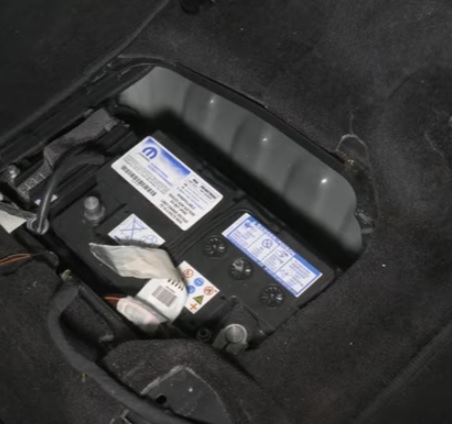
Exact Location of the Auxiliary Battery
On a typical U.S.-market WK2 Jeep Grand Cherokee with ESS, the auxiliary battery is located:
Under the front passenger seat, beneath the main 12-volt battery or in the lower section of the battery tray.
The passenger seat is on the right side of the vehicle in the United States. Do not confuse it with the second-row seat or the driver’s seat.
The visible battery may be the main battery. The auxiliary battery can be hidden underneath it, behind a separator, or inside the same battery carrier. This is why a quick look under the seat may show only one battery even when the Jeep has two.
What you may see under the seat
depending on the year and equipment, the area may include:
- A large main 12-volt battery.
- A smaller auxiliary 12-volt battery.
- Battery hold-down brackets.
- Positive and negative cables.
- A battery tray or plastic cover.
- Seat wiring and airbag connectors.
- Power seat wiring.
- A battery monitoring sensor.
The auxiliary battery is not normally located in the engine compartment on the common WK2 layout. The battery under the passenger seat is also not the vehicle’s high-voltage hybrid battery. Those are separate systems.
How to Access the Auxiliary Battery
Battery access is a repair procedure, not just an inspection task. The passenger seat contains wiring for the power seat, occupancy sensor, and supplemental restraint system. Moving or removing the seat incorrectly can trigger an airbag warning or damage a connector.
Before beginning, gather:
- The correct replacement battery for the exact vehicle.
- A socket set with the correct metric sizes.
- A trim tool.
- Safety glasses and gloves.
- A memory-saving method only if approved for the vehicle.
- The owner’s manual or factory service procedure.
- A scan tool if battery or ESS faults need to be cleared.
Basic access sequence
The general sequence on many WK2 models is as follows:
- Park on a level surface. Turn off the ignition and remove the key or keep the key fob away from the vehicle.
- Open the windows or doors if needed. This helps prevent lockout while power is disconnected.
- Disconnect the negative battery cable according to the factory procedure.
- Wait several minutes before working near seat airbag connectors.
- Move or remove the front passenger seat only as directed by the service manual.
- Remove the seat trim or battery cover.
- Identify the main and auxiliary batteries.
- Disconnect the negative terminal before the positive terminal.
- Remove the battery hold-down hardware.
- Lift out the battery carefully. If the auxiliary battery is below the main battery, the main battery may need to come out first.
- Install the replacement battery with the correct polarity and hold-down.
- Reconnect the cables in the specified order.
- Reinstall the cover, trim, and seat.
- Check for warning messages and test the ESS system.
This sequence is general. The exact disconnection order and seat procedure can differ. Use the factory instructions for the specific model year.
Why the seat should not be unplugged casually
The passenger seat may contain connectors for:
- The occupant classification system.
- Seat-mounted side airbags.
- Seat belt sensors.
- Power seat motors.
- Heated or ventilated seat equipment.
Never probe an airbag connector with a test light or multimeter. Do not turn the ignition on while a restraint connector is disconnected. If an airbag light appears after the repair, the system may require a proper scan tool and a qualified technician.
How to Tell Which Battery Is Bad
A weak auxiliary battery can cause ESS warnings, but the same message can result from other problems. Replacing the small battery without testing the rest of the system may not fix the fault.
Possible causes include:
- A weak main battery.
- A weak auxiliary battery.
- A low state of charge.
- A charging-system problem.
- A battery sensor fault.
- A bad ground connection.
- Extreme temperature.
- An ESS system fault.
- A hood switch or brake-pedal signal problem.
- A software or control-module issue.
Common symptoms
A failing auxiliary battery may be associated with:
- “Stop/Start Not Ready.”
- “Stop/Start Unavailable.”
- “Battery Charging.”
- A battery warning light.
- Slow cranking.
- Multiple warning messages after a cold start.
- ESS working sometimes but not at other times.
- A low-voltage code stored in one or more control modules.
These symptoms do not prove that the auxiliary battery is defective. The battery should be tested under the correct load, and the main battery should be tested as well.
A practical diagnostic order
Use this order to reduce unnecessary parts replacement:
- Check the battery age. Batteries near the end of their service life deserve close testing.
- Inspect both battery terminals. Look for corrosion, looseness, or damaged cables.
- Check the vehicle’s charging voltage. A charging problem can drain both batteries.
- Test the main battery.
- Test the auxiliary battery separately.
- Scan for stored fault codes.
- Check whether ESS is disabled by normal operating conditions.
ESS may remain off even when the vehicle has no fault. The system can disable itself when the battery charge is low, the cabin needs heating or cooling, the engine is cold, or other conditions are not met.
Do not judge the battery by voltage alone
A battery can show a normal resting voltage and still fail under load. A conductance test or approved battery load test gives more useful information than a voltage reading by itself.
Also, do not install a battery based only on physical size. Verify:
- Battery type.
- Cold-cranking rating.
- Reserve capacity.
- Terminal position.
- Case dimensions.
- Venting requirements.
- ESS compatibility.
Do You Have to Remove the Passenger Seat?
Often, yes. The battery is positioned below the passenger seat, so proper access may require the seat to be moved or removed. Some owners can expose the battery cover by moving the seat fully rearward or forward, but this does not guarantee enough room to remove the battery safely.
Seat removal is more involved when the vehicle has:
- Power seats.
- Heated or ventilated seats.
- Seat-mounted side airbags.
- Occupant detection equipment.
- Power seat memory wiring.
If the factory procedure requires disconnecting seat wiring, a repair shop may be the safer choice. A technician can protect the restraint system and clear any related fault codes after the repair.
Can You Drive With a Bad Auxiliary Battery?
A Jeep may continue to drive with a weak auxiliary battery, but this is not a condition to ignore. The engine may still start, while ESS remains disabled. In some cases, a failing battery can place extra demand on the main battery and charging system.
Avoid driving farther than necessary if you also notice:
- Slow engine cranking.
- A battery warning light.
- Repeated no-start events.
- Burning smells.
- Hot battery cables.
- Swollen or leaking battery cases.
- Several electrical warning messages.
A damaged, swollen, or leaking battery should not be handled casually. Have the Jeep inspected by a qualified technician.
Main Battery vs. Auxiliary Battery
The two batteries serve related but different roles.
| Battery | Main purpose | What happens when it is weak |
|---|---|---|
| Main 12-volt battery | Starts the engine and supplies most vehicle power | Slow crank, no-start, broad electrical symptoms |
| Auxiliary 12-volt battery | Supports ESS and selected electrical loads | ESS unavailable, warning messages, possible low-voltage faults |
| High-voltage hybrid battery | Propels and supports the 4xe hybrid system | Hybrid-system warnings; requires specialized service |
The auxiliary battery is not a substitute for the main battery. Replacing only the auxiliary battery may not correct a no-start problem if the main battery is also weak.
A Grand Cherokee 4xe adds another level of complexity. Its high-voltage battery must not be opened, disconnected, or serviced by an unqualified person. A 4xe owner should use Jeep-approved service information and a qualified hybrid technician.
Common Mistakes to Avoid
Assuming every Grand Cherokee has two batteries
Some Grand Cherokee models use one 12-volt battery. Confirm the equipment before ordering an auxiliary battery.
Looking only under the hood
On many WK2 models, the main battery and auxiliary battery are under the front passenger seat, not in the engine compartment.
Replacing the wrong battery
The battery that is easiest to see may be the main battery. Identify the battery part number and position before removal.
Disconnecting seat wiring with the ignition on
This can create restraint-system faults. Follow the power-down procedure and wait the required time before touching connectors.
Using a battery with the wrong specifications
A physically similar battery may have the wrong capacity, terminal layout, or venting design.
Blaming every ESS warning on the auxiliary battery
Low charge, cold weather, climate-control demand, and other normal conditions can disable ESS. Test the system instead of replacing parts by guesswork.
When to Use a Professional Technician
Professional service is the better choice when:
- The exact battery layout is unclear.
- The passenger seat must be removed.
- Airbag or occupant-sensor connectors are involved.
- The vehicle is a Grand Cherokee 4xe.
- The battery is swollen, leaking, or hot.
- Several control modules show fault codes.
- The new battery does not restore ESS operation.
- The vehicle will not start after battery replacement.
A qualified technician can identify the correct battery, protect the restraint system, test both batteries, and check charging performance.
Frequently Asked Questions
Is the auxiliary battery always under the passenger seat on a Jeep Grand Cherokee?
No. The under-seat location is common on WK2 Grand Cherokee models with ESS, but battery layouts vary by model year, engine, trim, and hybrid system. Check the owner’s manual or VIN-specific parts information.
Is the battery under the passenger seat the main battery or the auxiliary battery?
It may be either, depending on what is visible. On many WK2 models, the main battery is above or beside the smaller auxiliary battery. The auxiliary unit may be hidden from view until the main battery or tray is removed.
Can I replace only the auxiliary battery?
Sometimes, yes. First test the main battery, auxiliary battery, cables, and charging system. Replacing one battery will not repair a weak second battery or a charging fault.
Will a bad auxiliary battery stop the Jeep from starting?
It can contribute to starting and low-voltage problems, but a no-start condition often involves the main battery, terminals, starter, or charging system. Test the complete system before replacing parts.
Does a new auxiliary battery make ESS work right away?
It may, but ESS can remain disabled until the batteries reach the required charge level and all operating conditions are met. Stored faults may also need to be diagnosed and cleared.
Bottom Line
For many U.S.-market Jeep Grand Cherokee WK2 models with engine stop-start, the auxiliary battery is under the front passenger seat, usually below or near the main 12-volt battery. Access may require seat removal and careful handling of airbag and occupant-sensor wiring.
Before buying a battery, confirm the Grand Cherokee’s model year, engine, trim, and battery system. Test both batteries and the charging system, and use a professional technician when seat wiring, high-voltage components, or warning lights are involved.
Official information to check
Use the vehicle-specific:
- Jeep owner’s manual.
- Mopar parts catalog.
- Factory service manual.
- VIN-based dealer service information.
These sources provide the final authority for battery specifications, seat-removal steps, cable sequence, and post-repair procedures.


