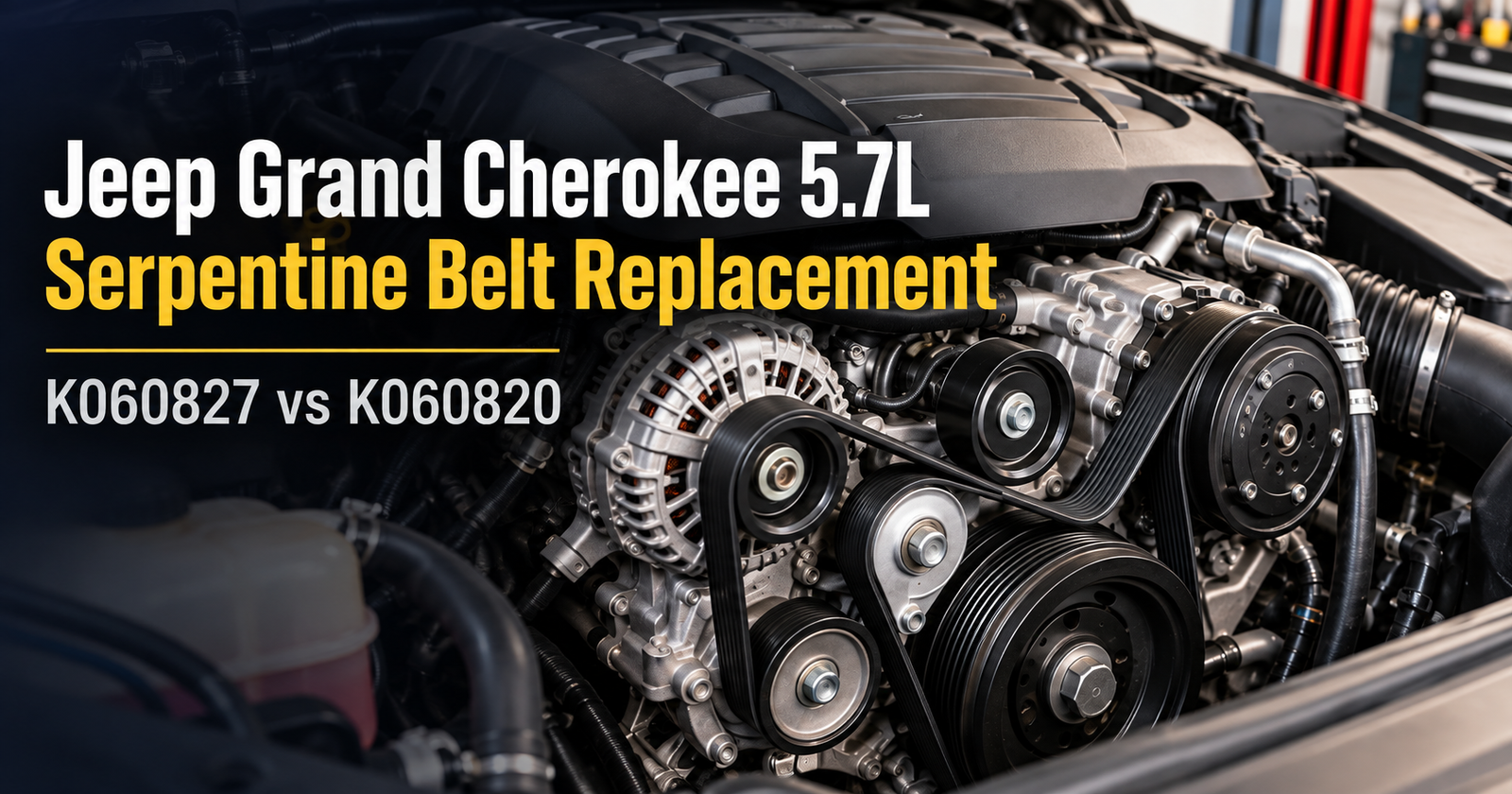
Jeep Grand Cherokee 5.7L Serpentine Belt Replacement: K060827 vs K060820
 Reading Time: 7 minutes
 A serpentine belt is one of those parts most drivers rarely think about until it starts making noise.
Under normal conditions, it quietly transfers engine power to important accessories. But as the belt ages, stretches, becomes glazed, or develops damaged ribs, you may start hearing squealing or noticing other accessory-drive problems.
For owners and technicians working on a Jeep Grand Cherokee with the 5.7L V8, there is another important consideration: choosing the correct belt for the model year.
Two commonly referenced belt numbers are K060827 and K060820.
At first glance, they appear almost identical. Both are six-rib serpentine belts, and their lengths differ by less than an inch. However, they are intended for different Grand Cherokee applications covered in this guide.
The basic distinction is:
- K060827: 2011–2015 Jeep Grand Cherokee 5.7L
- K060820: 2016–2021 Jeep Grand Cherokee 5.7L
That small difference matters more than you might expect.
K060827 vs K060820 at a Glance
Here is the quickest way to compare the two belts.
| Specification | K060827 | K060820 |
|---|---|---|
| Grand Cherokee application covered here | 2011–2015 5.7L | 2016–2021 5.7L |
| Belt profile | K-profile multi-rib | K-profile multi-rib |
| Number of ribs | 6 | 6 |
| Metric designation | 6PK2101 | 6PK2082 |
| Effective length | 2101 mm | 2082 mm |
| Approx. effective length | 82.72 in | 81.96 in |
| Approx. difference | 19 mm longer | 19 mm shorter |
| Construction listed by supplier | EPDM + aramid reinforcement | EPDM + aramid reinforcement |
The K060827 product is listed as a six-rib 6PK2101 belt measuring 2101 mm (82.72 inches), while K060820 is listed as 6PK2082 at 2082 mm (81.96 inches).
That makes K060827 approximately 19 mm, or 0.76 inch, longer.
It does not sound like a large difference, but accessory-drive systems are designed around a specific belt length and tensioner operating range.
K060827: 2011–2015 Jeep Grand Cherokee 5.7L
For the model-year application requested here, owners of a 2011 through 2015 Jeep Grand Cherokee with the 5.7L engine should look at the K060827 specification.
The belt is identified as 6PK2101, meaning six ribs and an effective length of approximately 2101 mm. The supplier also lists K060827 and several OE/interchange references for confirming fitment.
You can view the corresponding belt here:
Jeep Grand Cherokee 2011-2015 5.7L Serpentine Belt
This model-year range includes the beginning of the WK2 Grand Cherokee generation, so owners dealing with an older vehicle may also want to review JeepCorner’s guide to common issues with the 2011 Jeep Grand Cherokee.
That can help distinguish an accessory-drive concern from other age-related problems.
K060820: 2016–2021 Jeep Grand Cherokee 5.7L
For 2016 through 2021 5.7L Grand Cherokee applications covered by this article, the relevant belt is K060820.
Its metric designation is 6PK2082, with an effective length of approximately 2082 mm or 81.96 inches. The supplier specifically identifies 2016–2021 among the applicable Grand Cherokee 5.7L model years.
You can find the corresponding product here:
Jeep Grand Cherokee 2016-2021 5.7L Serpentine Belt
If you’re maintaining one of these later WK2 models, JeepCorner also has a useful overview covering Jeep Grand Cherokee reliability.
Why Does a 19 mm Belt-Length Difference Matter?
Less than an inch sounds insignificant until you consider how a serpentine belt actually operates.
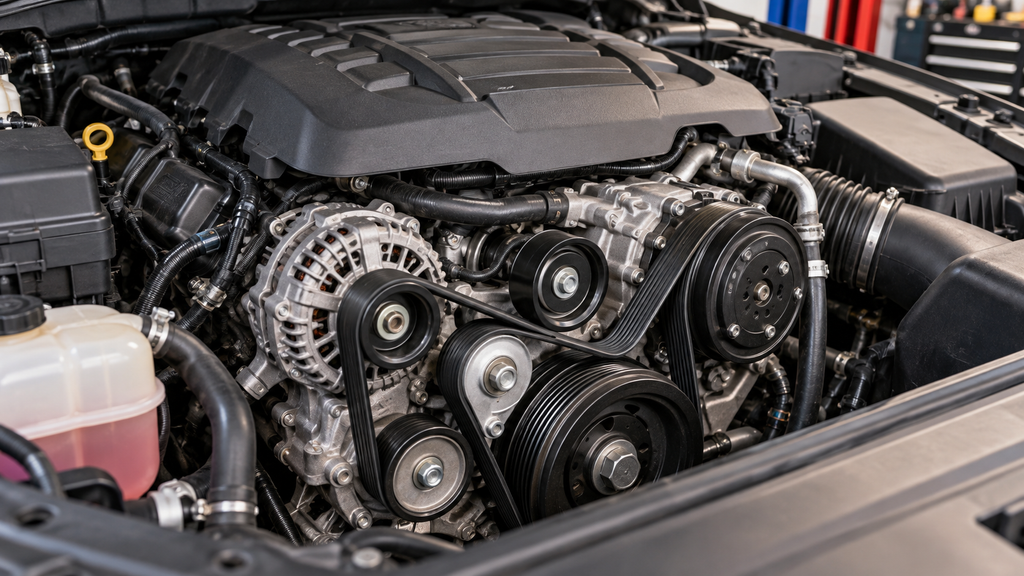
The belt follows a carefully designed route around multiple pulleys. An automatic tensioner maintains enough force to keep the belt seated and transmitting power without excessive slack.
Install a belt that is too long, and the tensioner may not maintain its intended operating position.
Install one that is too short, and the system may be placed under unnecessary load or the belt may be difficult to fit correctly.
Either situation can potentially contribute to:
- Belt squeal
- Slippage
- Poor pulley engagement
- Unusual tensioner movement
- Premature rib wear
- Edge wear
- Accessory-bearing stress
- Belt-tracking problems
This is why two belts should not be considered interchangeable simply because they have the same number of ribs.
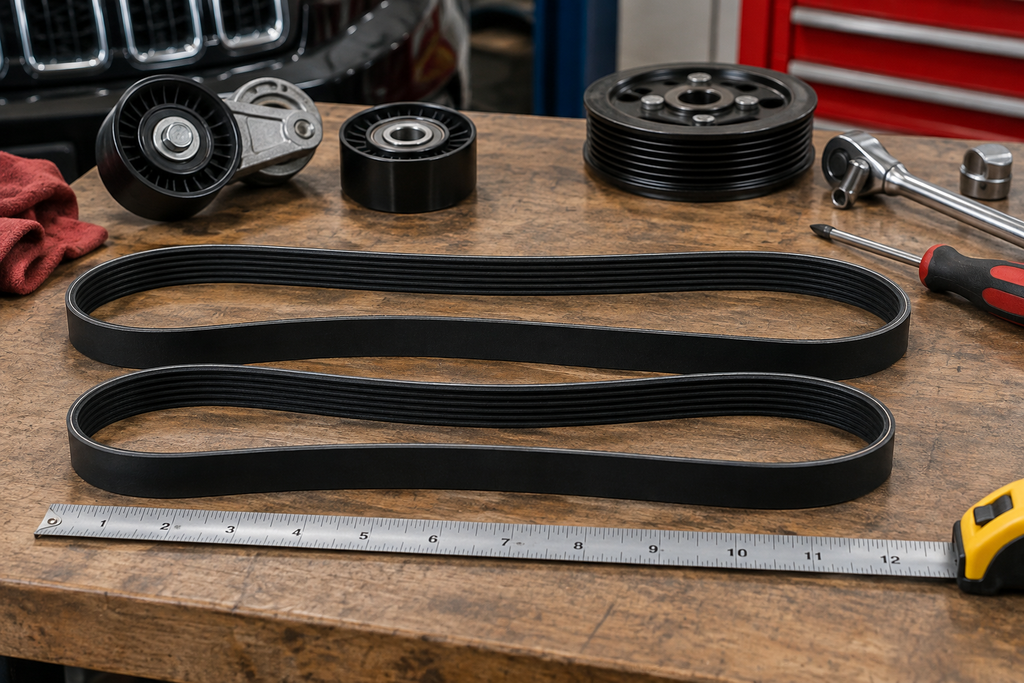
What is Serpentine Belt Numbers?
The numbers themselves provide useful information.
Take 6PK2101 as an example:
6 indicates the number of ribs.
PK refers to the multi-rib belt profile.
2101 represents the approximate belt length in millimeters.
The same logic applies to 6PK2082.
That immediately explains the core difference between the two belts.
| Belt | Rib count | Approx. metric length |
|---|---|---|
| 6PK2101 / K060827 | 6 | 2101 mm |
| 6PK2082 / K060820 | 6 | 2082 mm |
| Difference | — | 19 mm |
For repair shops that stock many visually similar belts, these markings are worth checking before installation.
Don’t Choose a Belt by Model Year Alone
The year range is a useful starting point, but experienced mechanics know that vehicle parts should never be selected solely because a catalog says “2015 Jeep Grand Cherokee” or “2018 Jeep Grand Cherokee.”
Grand Cherokees were offered with multiple engines and configurations.
Before purchasing a belt, verify:
- Model year
- 5.7L engine
- Existing belt number where readable
- OE or cross-reference number
- Number of ribs
- Effective belt length
- Accessory-drive configuration
Both supplier listings specifically recommend confirming the rib count, effective length, OE reference, and engine configuration before purchasing.
That extra check is particularly worthwhile when crossing between aftermarket manufacturers, because small dimensional tolerances can vary.
Signs a Serpentine Belt May Be Wearing Out
Modern EPDM belts often do not fail in the dramatic way older belts did.
A belt may look acceptable at a quick glance while its ribs are already worn.
Common signs worth investigating include:
| Symptom | Possible cause |
|---|---|
| Squealing when starting | Belt slip, tension problem, contamination |
| Chirping sound | Pulley alignment or rib-tracking issue |
| Frayed outer edge | Misalignment or belt contact |
| Glazed/shiny surface | Heat or repeated slipping |
| Missing pieces from ribs | Advanced belt deterioration |
| Longitudinal rib damage | Belt deterioration |
| Belt wandering on pulley | Alignment, tensioner, or pulley issue |
Noise alone does not automatically prove the belt is bad.
A new belt fitted to a damaged tensioner or misaligned pulley can start making noise again fairly quickly.
Inspect the Tensioner and Idler Pulleys Too
One of the most common mistakes during serpentine belt service is treating the belt as an isolated component.
It isn’t.
The belt, tensioner, idler pulleys, accessory pulleys, and bearings all operate as one system.
Both K060827 and K060820 supplier specifications advise inspecting the tensioner and pulleys during belt service, and neither package includes those components.
When inspecting the system, technicians generally look for things such as unusual pulley play, rough bearings, contamination, visible alignment issues, or abnormal tensioner movement.
A belt with one edge badly worn may be telling you more about pulley alignment than about belt quality.
Belt Maintenance Fits Into a Bigger Maintenance Routine
A serpentine belt inspection makes sense alongside routine engine maintenance.
For example, when performing regular fluid and under-hood inspections, taking a few extra moments to visually check the accessory belt can help catch obvious wear before it becomes a roadside problem.
If the vehicle begins showing high-temperature symptoms, don’t automatically assume the belt is responsible. Check the rest of the cooling system as well; JeepCorner has a separate guide explaining how to check the coolant level on a Jeep Grand Cherokee.
Before Replacing the Belt
For DIY owners, the most useful preparation happens before touching the belt.
First, identify the existing routing.
Many accessory drives use several smooth and grooved pulleys, so remembering which side of the belt contacts each pulley is important.
Next, compare the old and replacement belt markings.
If you’re replacing a K060827 application, you should not accidentally end up with the shorter K060820 simply because both are six-rib belts.
Also inspect the area for contamination. Oil, coolant, or other fluids reaching the belt can shorten its useful life and should prompt investigation of the leak rather than simply installing another belt.
For safety, belt inspection and service should be performed with the engine switched off and cooled. Never inspect or reach into an accessory-drive system while the engine is operating.
If the routing is unclear or the tensioner/pulleys appear damaged, factory service information or a qualified technician is the safer approach.
Quick Fitment Checklist for DIY Mechanics
Before ordering, work through this checklist:
| Check | K060827 | K060820 |
|---|---|---|
| Vehicle | Grand Cherokee | Grand Cherokee |
| Engine | 5.7L | 5.7L |
| Years covered by this article | 2011–2015 | 2016–2021 |
| Ribs | 6 | 6 |
| Belt code | 6PK2101 | 6PK2082 |
| Effective length | 2101 mm | 2082 mm |
| Verify existing/OE number | Yes | Yes |
| Inspect tensioner/pulleys | Yes | Yes |
If any of those details do not match the vehicle in front of you, confirm the application before ordering.
Advice for Repair Shops
For a repair shop, the main challenge with belts like K060827 and K060820 is not installation—it is avoiding a parts mix-up.
Place both on the same shelf and they can look nearly identical.
A simple inventory note can help:
K060827 = 2011–2015 5.7L application covered here
K060820 = 2016–2021 5.7L application covered here
The supplier also states that application information is printed on its belt body, which may make visual identification easier in a busy workshop.
Still, technicians should verify the actual vehicle instead of relying on shelf labels alone.
K060827 vs K060820: The Key Difference
If you remember only one thing from this guide, make it this:
K060827 and K060820 are both six-rib belts, but they are not the same length.
K060827 measures approximately 2101 mm / 82.72 inches.
K060820 measures approximately 2082 mm / 81.96 inches.
That’s a difference of approximately 19 mm, or 0.76 inch.
For the Grand Cherokee 5.7L applications specified in this article, that translates to:
2011–2015 → K060827
2016–2021 → K060820
Choosing the correct belt—and checking the tensioner and pulleys while you’re there—can help prevent unnecessary noise, premature wear, and repeat repairs.
Frequently Asked Questions
1. What serpentine belt fits a 2011–2015 Jeep Grand Cherokee 5.7L?
For the application covered here, K060827 / 6PK2101 is specified for the 2011–2015 Jeep Grand Cherokee 5.7L. It is a six-rib belt with an effective length of approximately 2101 mm or 82.72 inches.
2. What serpentine belt fits a 2016–2021 Jeep Grand Cherokee 5.7L?
For the later application covered in this guide, K060820 / 6PK2082 is specified for 2016–2021 Grand Cherokee 5.7L models. Its effective length is approximately 2082 mm or 81.96 inches.
3. Are K060827 and K060820 interchangeable?
They should not be treated as interchangeable simply because both have six ribs. K060827 is approximately 19 mm longer than K060820. Always verify the exact vehicle, engine, OE/reference number, rib count, and belt dimensions.
4. Can a worn tensioner cause serpentine belt noise?
Yes. Belt noise can originate from the belt, tensioner, pulley alignment, bearings, or contamination. That is why the tensioner and pulleys should be inspected whenever a serpentine belt is replaced.
5. Should I replace a serpentine belt just because it squeals?
Not automatically. Squealing deserves inspection, but replacing the belt without identifying the cause can lead to the same noise returning. Check belt condition and the surrounding accessory-drive system before deciding which component requires replacement.