USB Autoscope IV Automotive Diagnostic Kit for Diesel Engine Diagnostics: Accessories and Methods
 Reading Time: 6 minutes
 A proper oscilloscope-based kit changes everything in diesel engine diagnostics. The USB Autoscope IV automotive diagnostic kit gives you real waveforms, real data, and real answers.
What Is a USB Autoscope IV Automotive Diagnostic Kit
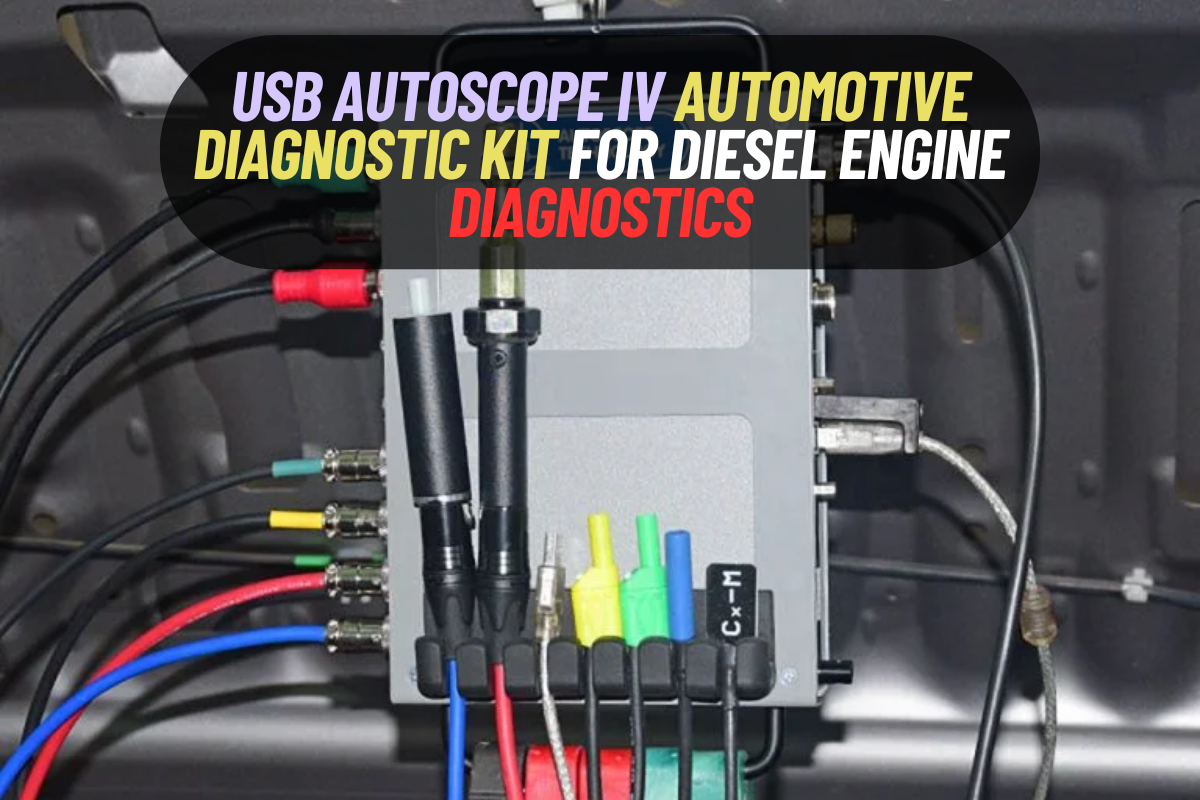
The USB Autoscope IV is a PC-based automotive oscilloscope that connects to your laptop via USB and captures signals directly from engine sensors and actuators. It comes with dedicated software that includes built-in diagnostic scripts – CSS, Px, and ElPower – that automatically interpret the captured waveforms and flag problems.
For diesel work specifically, the real power comes from the accessories.
CTi-50 Small Current Transducer – clamp sensor for measuring low current signals (e.g. injector pulses) without cutting wires.
CTi-1000 Large Current Transducer – clamp sensor for high current circuits like battery, starter, alternator, and glow plugs.
PSG200 Pressure Transducer – in-cylinder pressure sensor (up to 200 bar) installed instead of a glow plug for engine analysis.
PSGAmp Amplifier – signal amplifier for PSG200 that reduces noise and improves waveform clarity.
Glow Plug Adapters for installing the pressure sensor into the cylinder, different lengths for various engines.
Connecting the device itself takes minutes – USB cable to laptop, power cable to the battery, probes to wherever you need them. The software launches with preset modes, so you’re not starting from scratch every time.
Basics of Diesel Engine Diagnostics
Diesel engine diagnostics covers everything from fuel injection timing and injector condition to compression, valve timing, and crankshaft sensor signals. And it’s fundamentally different from gasoline diagnostics.
Diesels have no spark plugs, so there’s no ignition system to test. Instead, combustion depends entirely on compression heat – if compression drops even slightly below threshold, the fuel simply won’t ignite reliably. This makes compression-related faults particularly nasty: they’re hard to spot with a basic scanner and they can disguise themselves as fueling problems, injector faults, or sensor issues.
The key systems to evaluate on any diesel are: the high-pressure fuel injection system (injector output current, duration, corrections), the crankshaft and camshaft sensors and their synchronization, the compression in each cylinder (both relative and absolute), and the in-cylinder pressure profile during combustion. The USB Autoscope IV touches all of these – in a single session.
Common Diesel Engine Problems and Symptoms
Most diesel problems announce themselves in predictable ways. Hard cold starts are usually the first complaint – the engine cranks but takes too long to fire, or fires rough before settling. By itself that’s not enough to point at a cause; low compression, a failing glow plug circuit, degraded injectors, and incorrect CKP-CMP synchronization can all cause the same symptom.
Smoke color is one of the most useful visual clues. Black smoke almost always means too much fuel or not enough air – a blocked EGR, worn injectors spraying too much fuel, or a turbo not building boost fast enough. White smoke on a cold start that clears when the engine warms up often points to poor combustion, which in diesel engine diagnosis means one thing: look at compression and injection timing first. Blue smoke is oil burning, a different story.
Power loss without smoke is trickier. Sometimes a single cylinder drops out of the cylinder balance and the engine just feels lazy, especially under load. The driver notices it, but no fault code appears because the ECU correction stays within limits. Unstable idle – that characteristic diesel shake that shouldn’t be there – often means one cylinder is contributing less than the others.
Increased fuel consumption without obvious reasons or a fault code is one of the most frustrating complaints to diagnose. The CSS script for diesel engine diagnosis is specifically useful here: it maps the power contribution of each cylinder across idle, acceleration, at different engine loads, and a cylinder that’s burning fuel inefficiently stands out immediately.
Diagnosing Diesel Engine Using a USB Autoscope IV Diagnostic Kit
Here’s how a full diesel engine diagnosis actually unfolds.
Step 1 – Connect the device
Connect USB Autoscope IV to a laptop and power it from 12V vehicle battery. Use two channels: CKP sensor signal and injector pulse on cylinder #1 using the CTi-50 current clamp.
Step 2 – Run the CSS script (Cylinder balance test)
Capture the signal from CKP sensor and injector pulse (from cyl. #1). Start the engine and wait for idle speed to stabilize. Then in the USB Oscilloscope program window, start recording signals after a few seconds, smoothly increase engine speed to 3000 RPM, then release the accelerator pedal sharply and wait for idle speed to stabilize. After that press the accelerator pedal sharply again, and upon reaching 3000–4000 RPM, shut off the engine by turning off the ignition. At this point, the throttle valve will automatically block air intake to the manifold stop recording signals.
The system tracks crankshaft speed variations to evaluate each cylinder power contribution.
Step 3 – Run the ElPower script
Clamp the CTi-1000 current clamps to embrace all the wires emanating from one of the battery terminals. Turn the high beam headlights on for 3…5 seconds, then turn them off. Then turn on the ignition and wait a few seconds for the fuel pump to shut back off and wait for the glow plugs to shut off. Start the engine (If the engine does not start, continue cranking for 5 to 10 seconds). After 5 to 10 seconds, turn the high beam headlights back on for 3 to 5 seconds. After another 3 to 5 seconds, turn off the ignition.
Then remove the current clamp from the power wires and bring the jaws directly to the power wire from the battery terminal. Place the clamp in a position close to the one in which the measurements were taken.
You can run ElPower script and the analysis results about condition of Battery, Glow plugs, Compression, Starter and Alternator will be generated.
Step 4 – In-cylinder pressure analysis (PSG200)
Install PSG200 instead of a glow plug using the correct adapter. With PSGAmp, the system records in-cylinder pressure graph. Such a graph contains information that can be used to search for complex faults in a diesel engine.
Step 6 – Verify CKP–CMP synchronization
Compare CKP and CMP signals to confirm correct timing. Deviations may indicate timing belt issues or assembly errors, causing unstable engine behavior.
Advantages of USB Autoscope IV Automotive Diagnostic Kits
The kit covers everything a diesel technician actually needs without requiring a fleet of separate tools. The accessories handle signal capture across all major diagnostic areas: electrical current, in-cylinder pressure, and sensor waveforms.
The scripted analysis is what separates this from a generic oscilloscope. CSS, ElPower, and Px scripts don’t just display data – they interpret it. For those who want to go deeper, there’s an active technical forum with a large library of reference waveforms for CKP and CMP signals from hundreds of engines.
The library at usbautoscope.eu includes documented case studies – all with captured waveforms you can compare against your own.
When to Use Professional Diagnostics
The USB Autoscope IV automotive diagnostic kit handles most of what a diesel workshop encounters daily. But there are situations where it isn’t enough.
For example, when the PSG200 pressure graph indicates abnormal injection timing but the CKP-CMP synchronization checks out, you’re likely looking at an injector that needs bench testing. A fuel injection test stand measures flow rates, spray pattern, and return volume in a way no oscilloscope can. Common rail injectors especially – the correction values from the ECU give you a starting point, but actual bench figures decide whether you replace or repair.
For fuel system problems upstream of the injectors – HPFP wear, pressure regulator issues, fuel supply restriction – the Autoscope gives you the symptoms (pressure trace behavior, injection duration corrections) but a pressure gauge on the fuel rail or a dedicated fuel system tester is what closes the diagnosis.
Conclusion
The USB Autoscope IV automotive diagnostic kit brings real data into diesel diagnostics – not assumptions, but measurable signals from every key system.
Regular diesel engine diagnostics helps catch issues early, before they turn into expensive failures or hidden performance loss.
And when the problem goes beyond what signals can confirm – injectors, fuel system, or mechanical wear – it’s time to involve specialized equipment or a professional.
Read Also: Best Brake Fluid for Jeep Wrangler 2026: Top Picks Reviewed
FAQ
What is a USB Autoscope IV automotive diagnostic kit used for?
It’s used to capture and analyze real engine signals – current, pressure, and sensor waveforms – for accurate diesel diagnostics.
How to start diagnosing diesel engine?
Start with basic signals: CKP, injector pulse, and relative compression using ElPower and CSS scripts.
Is diesel engine diagnosis possible without professional tools?
Only at a basic level. Most faults – especially compression and injector issues – require oscilloscope data.
How accurate are USB Autoscope IV automotive diagnostic kits?
They provide highly accurate, real-time data and allow direct comparison between cylinders and reference waveforms.