Is A Jeep Gladiator Good For Towing & Off-Road: Guide
 Reading Time: 11 minutes
Yes. The Jeep Gladiator is a good truck for off-road driving and light-to-medium towing in the United States. Its four-wheel-drive system, solid axles, high ground clearance, and available trail hardware make it one of the most capable midsize trucks on rough ground.
Its towing ability depends on the model, engine, axle ratio, equipment, and trailer setup. Some U.S.-market Gladiator models can tow up to about 7,700 pounds, while off-road-focused versions often have lower limits. A Gladiator is a strong choice for towing a small camper, boat, utility trailer, or off-road toys. It is less suitable for frequent heavy towing, long highway trips with large trailers, or buyers who need maximum payload and comfort.

How Much Can a Jeep Gladiator Tow?
A Jeep Gladiator can tow roughly 4,000 to 7,700 pounds, depending on the model year and configuration. The maximum figure does not apply to every Gladiator.
The exact rating depends on:
- Model and trim
- Engine
- Transmission
- Axle ratio
- Cab and bed configuration
- Factory tow equipment
- Payload
- Trailer brakes
- Hitch and wiring equipment
- Model year
The most reliable number is the towing rating for the exact vehicle. Check the driver-door label, factory window sticker, owner’s manual, and Jeep’s official towing information. Do not rely only on a dealer listing or a general maximum figure.
Typical Gladiator towing ranges
| Gladiator configuration | General towing position |
|---|---|
| Sport and Sport S | Often among the strongest towing choices |
| Willys | Good balance of towing and trail ability |
| Overland | Comfortable road use, but equipment can affect capacity |
| Mojave | Built for high-speed desert travel; towing may be lower |
| Rubicon | Excellent for technical trails; usually not the top towing model |
| Four-wheel-drive models | Better traction, but added equipment can reduce payload |
These are broad comparisons, not exact ratings. Jeep can change specifications by model year. The 2024 and 2025 Gladiator, for example, should not be assumed to have the same ratings as earlier trucks.
A high tow rating also does not mean the truck can carry a heavy trailer in every condition. The trailer, passengers, cargo, tongue weight, and accessories all load the Gladiator.
Towing capacity versus payload
Towing capacity is the maximum trailer weight the truck may pull under specified conditions. Payload is the weight the truck can carry inside the cab and bed, plus the trailer’s tongue weight.
For example, consider this hypothetical setup:
- Trailer weight: 6,000 pounds
- Tongue weight at 12 percent: 720 pounds
- Passengers and luggage: 500 pounds
- Bed cargo and accessories: 150 pounds
The truck carries a total of 1,370 pounds before adding other items. If the door label lists a payload rating below that amount, the setup is overloaded even if the trailer is below the advertised tow rating.
Tongue weight commonly falls near 10 to 15 percent of loaded trailer weight for a conventional bumper-pull trailer. The correct value depends on the trailer and must remain within the vehicle, hitch, and trailer limits.
Can a Gladiator tow a camper?
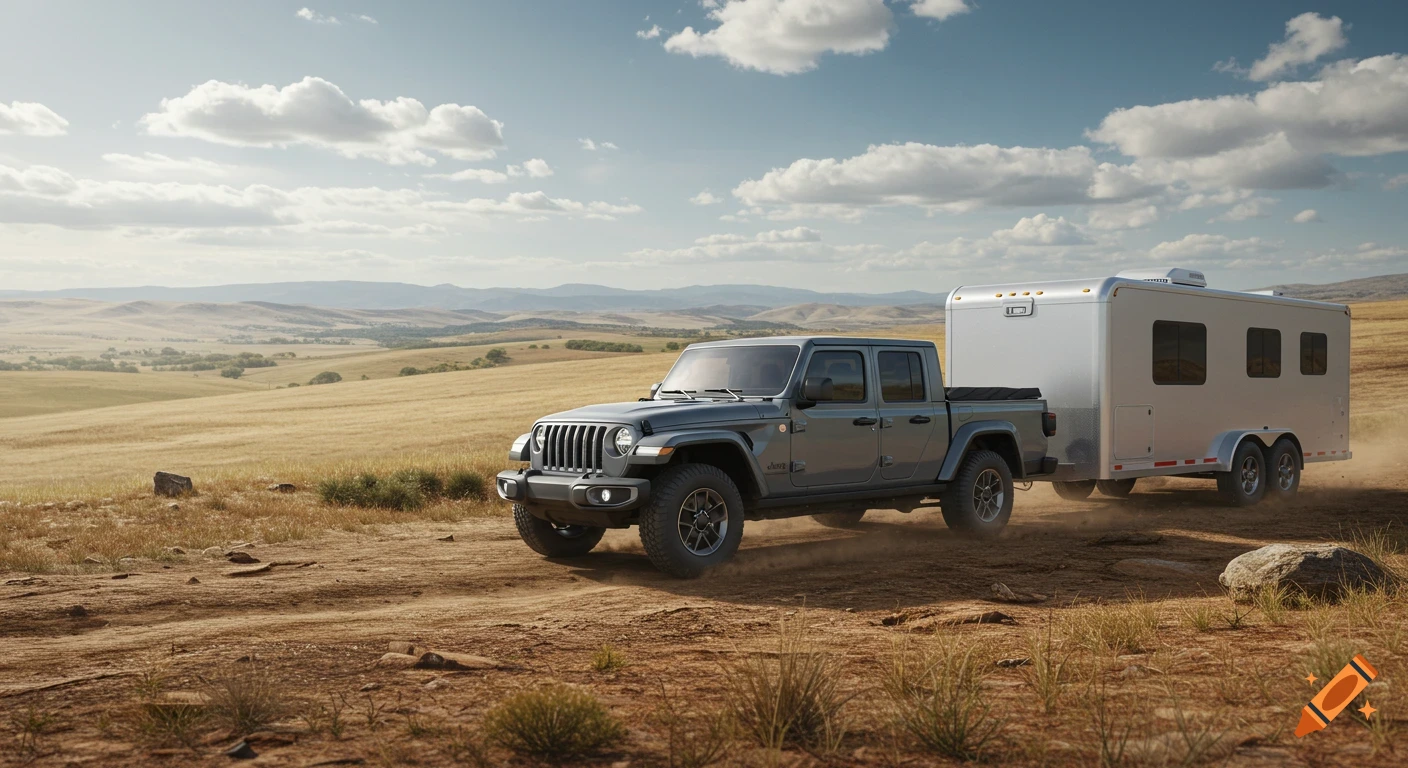
Yes, a Gladiator can tow many small and medium campers. A lightweight pop-up camper or compact travel trailer is usually a better match than a large, tall trailer.
Trailer size is not the only concern. A tall camper creates more wind drag, and a long trailer can be harder to control. A trailer weighing 5,500 pounds may feel more demanding than its number suggests if it has a large frontal area or poor weight balance.
For regular camper use, choose a trailer with:
- A loaded weight well below the truck’s maximum rating
- Proper electric brakes
- A working breakaway system
- Correct tongue weight
- A suitable hitch
- Tires rated for the load
- A weight-distribution system if permitted and required by the vehicle and hitch instructions

Is the Jeep Gladiator Good for Off-Road Driving?
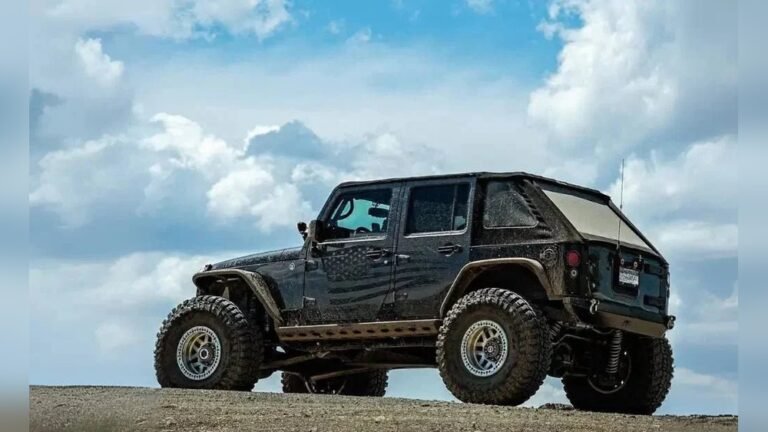
The Jeep Gladiator is one of the strongest off-road trucks in the U.S. midsize class. Its design gives it useful advantages on rocks, mud, sand, steep trails, and uneven ground.
Important off-road features include:
- A body-on-frame design
- Solid front and rear axles
- Available four-wheel drive
- Low-range gearing
- High ground clearance
- Short front and rear overhangs
- Strong approach and departure angles
- Available locking differentials
- Available electronic front sway-bar disconnect
- Skid plates on off-road trims
- High-clearance fenders
- Available all-terrain or mud-terrain tires
The Rubicon is usually the best Gladiator for slow, technical trails. It can include front and rear locking differentials, a disconnecting front stabilizer bar, low-range gearing, and trail-focused tires.
The Mojave is designed for a different type of off-road driving. It focuses more on fast desert terrain, with suspension hardware suited to repeated bumps and jumps. It is not automatically the best choice for rock crawling.
The Willys trim can offer a useful middle ground. It adds trail-focused equipment without making the truck as specialized as a Rubicon or Mojave.
Why the Gladiator works well on trails
Solid axles help keep the tires planted when the trail becomes uneven. Low-range gearing lets the truck move slowly with more control. A locking differential helps send power to both wheels on an axle when one tire loses grip.
The removable doors and roof also improve the open-air experience. However, they do not improve towing performance. Removing body panels may also expose occupants to more dust, weather, and trail hazards.
The Gladiator’s long wheelbase helps stability but can hurt it in tight terrain. The truck may drag its center section on sharp ridges or high rocks. A two-door Wrangler can be easier to place on very narrow trails.
Important off-road limits
Off-road ability does not remove the need for careful driving. The Gladiator can still:
- Lose traction on wet rock
- Tip on a steep side slope
- Damage the underbody
- Overheat during slow, difficult climbs
- Puncture a tire
- Exceed its axle or payload rating
- Lose control when towing on loose ground
Use the correct four-wheel-drive mode for the surface. Follow the owner’s manual for shifting into low range, using axle locks, and engaging the sway-bar disconnect. Some systems should not be used at high speed or on dry pavement.
After difficult trail use, inspect the tires, steering, suspension, driveshafts, skid plates, fluids, and tow hardware.

Is a Gladiator Better for Towing or Off-Roading?
The Gladiator is usually better at off-roading than at heavy towing. This is not a criticism. It reflects its design priorities.
A typical full-size truck offers:
- More stable highway towing
- Greater payload
- More interior space
- A longer wheelbase
- More engine choices
- Better trailer visibility
- Greater comfort under heavy loads
The Gladiator offers:
- Better trail maneuverability than most full-size trucks
- Removable doors and roof
- Strong four-wheel-drive hardware
- Compact exterior dimensions
- A usable pickup bed
- Strong approach and departure geometry
Towing and off-road trade-offs
Some features that help off-road performance can reduce towing comfort or capacity.
Large all-terrain tires can improve grip but may produce more noise and less precise steering. Lift kits can increase ground clearance but may change suspension geometry, braking behavior, and trailer stability. A Rubicon’s trail equipment adds capability but also weight.
The Mojave and Rubicon are not automatically the best towing trims. Extra equipment raises curb weight, which can reduce available payload. Their suspension and tire choices may also feel less settled with a heavy trailer than a road-focused configuration.
For buyers who tow first and explore trails second, a lower or mid-level trim with the proper factory tow equipment may be the better choice. For buyers who off-road first and tow only occasionally, the Rubicon or Mojave may make more sense.
Best use cases
The Gladiator fits well when you need to:
- Tow a small camper to a public campground
- Carry an ATV or dirt bike trailer
- Pull a boat within the exact rating
- Haul landscaping equipment
- Reach remote trailheads
- Drive technical trails on weekends
- Use one vehicle for work, recreation, and trail travel
It is a weaker fit when you need to:
- Tow near the maximum rating every week
- Pull a large enclosed trailer long distances
- Carry a large crew and heavy cargo
- Maximize fuel economy
- Have a quiet, spacious back seat
- Make long highway trips with a heavy trailer
What Should You Check Before Towing With a Jeep Gladiator?
Before towing, verify every rating instead of using the truck’s maximum headline number.
1. Find the exact truck ratings
Check:
- Gross vehicle weight rating, or GVWR
- Gross combined weight rating, or GCWR
- Front and rear axle ratings
- Maximum trailer weight
- Maximum tongue weight
- Payload rating
- Hitch rating
- Tire load rating
The door-jamb label provides important vehicle limits. The owner’s manual explains model-specific towing rules and equipment.
2. Weigh the complete setup
A public truck scale can help confirm the real weights. Weigh the truck with passengers, fuel, cargo, and the trailer connected. If possible, measure:
- Total combined weight
- Truck axle weights
- Trailer axle weight
- Tongue weight
Keep each value below its limit. A truck can be under its total GVWR while exceeding a rear-axle or tire rating.
3. Use trailer brakes
A heavy trailer should have properly adjusted electric brakes. Many states require trailer brakes above a specified weight, but laws differ by state. Even when a state does not require them at a lower weight, trailer brakes can improve control and reduce stress on the truck’s brakes.
A trailer with electric brakes also needs:
- A compatible brake controller
- Correct wiring
- A working breakaway battery and switch
- Proper brake adjustment
4. Set up the hitch correctly
Use a hitch and ball mount rated for the load. Match the ball size to the trailer coupler. Confirm that the ball is tightened to the correct torque and that safety chains cross under the coupler.
A weight-distribution hitch may help with some trailers, but it must be compatible with the Gladiator, hitch receiver, trailer, and manufacturer instructions. Do not assume every weight-distribution setup is approved or needed.
5. Load the trailer for stable handling
Place heavy cargo low and near the trailer axle group. Keep the center of mass balanced from side to side. Too little tongue weight can cause sway. Too much tongue weight can overload the rear axle and reduce front-tire grip.
Before leaving, check:
- Tire pressure
- Trailer lights
- Safety chains
- Hitch pin
- Coupler lock
- Breakaway cable
- Brake function
- Load straps
- Mirrors
- Spare tires
Drive more slowly in rain, wind, traffic, and downhill sections. Use a lower gear when needed, but follow the owner’s manual for transmission and engine-braking guidance.

Common Problems With Gladiator Towing and Off-Road Use
The most common mistake is treating the maximum tow rating as a normal working load. A rating is a limit under stated conditions, not a promise of comfortable handling.
Trailer sway
Sway can result from poor loading, crosswinds, excessive speed, worn trailer components, or insufficient tongue weight. Do not steer sharply against the trailer. Ease off the accelerator and follow the trailer-brake controller instructions. Stop in a safe place and correct the cause.
Reduced highway comfort
The Gladiator’s upright shape, solid axles, short rear overhang, and off-road tires can make it feel less smooth than a full-size towing truck. Crosswinds and passing trucks may require more steering correction.
This does not prove that the truck is unsafe. It means the driver must choose a sensible trailer size and speed.
Low payload after modifications
A steel bumper, winch, roof rack, larger tires, lift kit, bed rack, and recovery gear can remove a large part of the truck’s payload before passengers or trailer tongue weight are added.
Record the weight of modifications. Recheck the vehicle after installation rather than assuming the original factory rating still describes the modified truck.
Cooling and maintenance demands
Towing in hot weather, climbing steep grades, driving slowly off-road, or carrying heavy loads increases heat and mechanical stress. Follow the maintenance schedule for severe service when it applies.
Inspect the cooling system, transmission fluid, engine oil, brakes, tires, and wheel bearings. If a warning light appears or the vehicle overheats, stop safely and let it cool. Do not continue simply because the truck still moves.
Large trailers and long trips
A Gladiator may pull a trailer that is technically within its limit but still be a poor match for frequent travel. A large trailer catches more wind and leaves less margin for emergency maneuvers.
For regular long-distance towing, a longer-wheelbase full-size truck may provide better stability, capacity, and comfort.

Jeep Gladiator Towing and Off-Road FAQ
Is the Jeep Gladiator reliable for towing?
It can be reliable when the trailer is correctly matched, loaded, and maintained. Reliability depends on the exact vehicle, service history, trailer weight, terrain, climate, and driving habits. Frequent towing near the limit creates more heat and wear than occasional light towing.
Can a Jeep Gladiator tow a 5,000-pound trailer?
Some Gladiator configurations can tow a 5,000-pound trailer, but the full setup must also meet payload, tongue-weight, axle, tire, hitch, and combined-weight limits. Check the exact truck’s factory rating before buying or renting the trailer.
Is the Gladiator Rubicon good for towing?
The Rubicon is excellent for technical off-road use and can tow, but it is not always the best Gladiator for maximum towing. Its added trail equipment and tires may reduce payload or towing capacity compared with a less specialized trim.
Is the Mojave good for towing?
The Mojave can tow within its published limits, but it is designed mainly for fast desert-style off-road driving. Buyers who tow often should compare its payload and trailer rating with a Sport, Sport S, Willys, or Overland configuration.
Can a Gladiator tow a travel trailer safely?
Yes, if the trailer is within the exact ratings and has proper brakes, tongue weight, hitch equipment, and load balance. A smaller, lighter trailer usually provides more control and comfort than one near the truck’s limit.
Final Verdict
The Jeep Gladiator is a very good off-road truck and a capable light-duty tow vehicle. It is especially well suited to buyers who want to tow a small camper, boat, utility trailer, or recreational equipment while also driving trails.
Its main weaknesses are payload limits, highway comfort, wind sensitivity, cabin space, and the lower practical margin of some off-road trims. Choose the Gladiator when off-road ability and open-air driving matter as much as towing.
Before purchase, compare the exact door-label ratings with the trailer’s loaded weight. If heavy towing is your main task, consider a full-size truck. If trail use is the priority and towing is occasional, the Gladiator remains one of the most distinctive and capable choices in the U.S. market.
Sources for verifying a specific Gladiator
- Jeep Gladiator official capability information
- Jeep Gladiator official vehicle information
- Mopar owner’s manual search
- National Highway Traffic Safety Administration trailer safety guidance