
Is A Jeep Cherokee Trailhawk Good Off-Road: Honest Review
 Reading Time: 13 minutes
For drivers in the United States, the Jeep Cherokee Trailhawk is a good off-road SUV for trail rides, snow, dirt roads, mud, and moderate rocks. It has real four-wheel-drive hardware, useful ground clearance, all-terrain tires, tow hooks, skid plates, and a low-range setting.
It is not as capable or easy to modify as a Jeep Wrangler. Its independent suspension and unibody body make it more comfortable on pavement, but they limit wheel travel and extreme rock-crawling ability. The best answer is simple: the Cherokee Trailhawk is a strong choice for mixed road and trail use, but a Wrangler is better for serious off-road driving.
This review focuses on U.S.-market Jeep Cherokee Trailhawk models, mainly from 2014 through 2023. Jeep discontinued the Cherokee in the United States after the 2023 model year, so used examples now make up most of the market.

Quick answer: Is the Cherokee Trailhawk good off road?
Yes. The Jeep Cherokee Trailhawk is one of the more capable crossover SUVs for off-road use.
Its strengths include:
- A true four-wheel-drive system
- A two-speed power transfer unit with low-range gearing
- Jeep’s Selec-Terrain traction system
- A Rock driving mode
- Standard all-terrain tires
- Increased ground clearance
- Underbody skid plates
- Red recovery tow hooks
- Hill-descent control
- Good traction in snow, mud, sand, and loose dirt
The Trailhawk works best for drivers who want one vehicle for daily commuting and weekend trails. It can handle many Forest Service roads, desert tracks, rocky access roads, and mild-to-moderate technical trails.
Its main limits are just as important:
- Less suspension articulation than a Wrangler
- More vulnerable body panels on narrow trails
- Less aftermarket support
- A lower seating position and less approach visibility than a Wrangler
- Higher repair costs if the independent suspension or electronic four-wheel-drive system is damaged
- No removable doors or roof
For most buyers, the Cherokee Trailhawk is a capable all-weather crossover with real trail ability, not a dedicated rock-crawling vehicle.
What makes a Cherokee Trailhawk different?
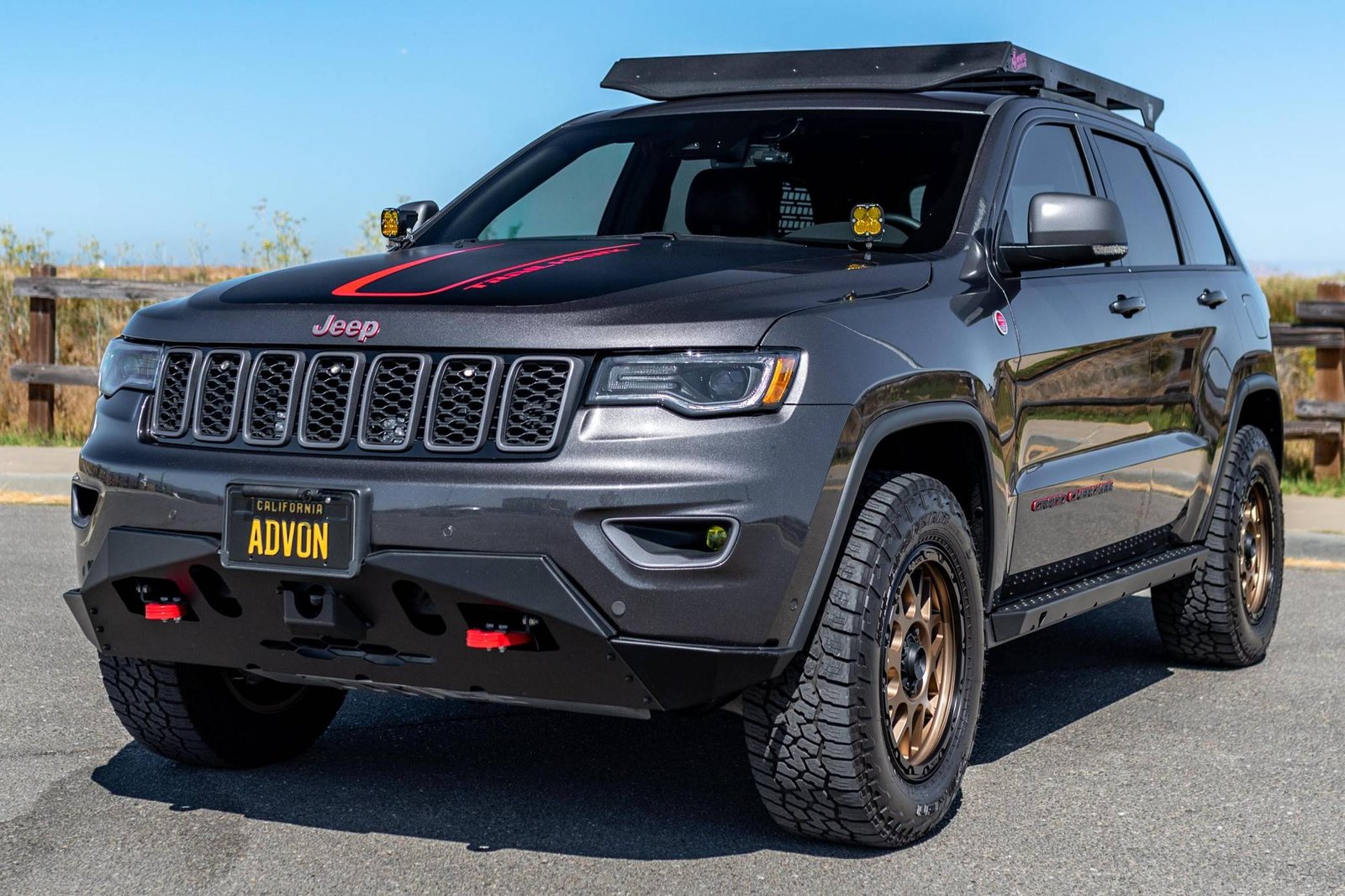
The Trailhawk is the off-road-focused version of the Jeep Cherokee. It is not the same vehicle as the larger Jeep Grand Cherokee Trailhawk.
The standard Cherokee is built as a unibody crossover. Its body and frame form one structure, much like the Honda Passport, Subaru Outback, or Toyota RAV4. A Wrangler uses a body-on-frame design with solid axles, which better supports extreme articulation and heavy off-road modifications.
Jeep added several hardware and software features to make the Cherokee Trailhawk more capable than other Cherokee trims.
Trailhawk off-road equipment
Depending on the model year, the Cherokee Trailhawk includes or offers:
- Active Drive Lock four-wheel drive
- A rear-drive disconnect system
- Low-range gearing
- Selec-Terrain with Rock mode
- Hill-descent control
- All-terrain tires
- Front and rear tow hooks
- Skid plates for key underbody parts
- A higher ride height
- A revised front fascia for better approach clearance
- Trail-rated suspension tuning
The exact equipment changed over time. Buyers should check the vehicle identification number, window sticker, owner’s manual, and build sheet before assuming that a used Cherokee has a certain feature.
What “Trail Rated” means
Jeep’s Trail Rated badge refers to testing in areas such as traction, water fording, maneuverability, articulation, and ground clearance. It does not mean every Trail Rated Jeep performs the same way on every trail.
A Trailhawk badge is useful evidence that the vehicle has extra off-road hardware. It is not a promise that the SUV can safely follow a modified Wrangler through deep rocks, steep ledges, or deep water.

Cherokee Trailhawk off-road performance
The Cherokee Trailhawk performs best when it can use traction control, low-range gearing, and careful tire placement. Its computer-controlled four-wheel-drive system can direct power to the wheels with the most grip, while Rock mode changes throttle and transmission behavior for slow terrain.
Traction on loose surfaces
The Trailhawk is well suited to:
- Loose gravel
- Sand
- Snow
- Mud
- Wet grass
- Rocky dirt roads
- Forest trails
- Steep unpaved climbs
The all-terrain tires provide more grip than the highway tires found on many standard crossovers. Still, tire condition matters. A worn tire can reduce performance more than a small difference in engine output.
On snow and ice, four-wheel drive helps the vehicle move forward. It does not shorten stopping distance. Winter tires may offer better braking and cornering on packed snow than all-terrain tires, depending on the tire design and conditions.
Rocks and steep trails
The low-range setting gives the Trailhawk better control at low speed. It also reduces the need to rely on the brakes during climbs and descents.
The Trailhawk can handle moderate rocky trails when the driver uses slow speeds and chooses a careful line. Its independent suspension offers a smoother ride than a solid-axle vehicle on many uneven roads.
However, the wheels do not move as freely as those on a Wrangler with solid axles. When one wheel lifts off the ground, the electronic traction system must work harder to maintain forward motion. The Trailhawk can get through difficult sections, but it has less margin for error.
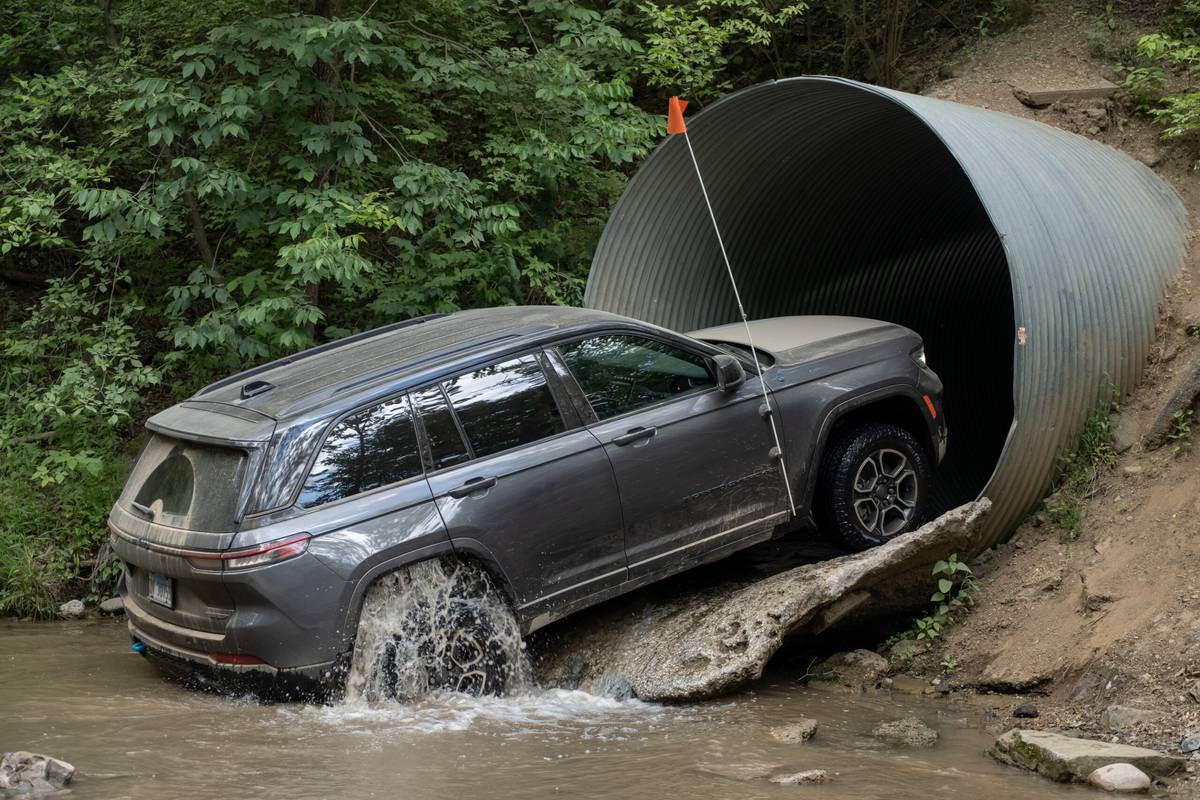
Water crossings
Some Cherokee Trailhawk models have a documented water-fording capability of up to about 20 inches under specified conditions. That figure is not a general permission to drive through any water that reaches 20 inches.
Water depth can change quickly. A crossing may hide holes, rocks, a damaged road surface, or a strong current. Water can also enter the engine, transmission, differentials, or electrical parts.
Before attempting a crossing:
- Check the depth and current on foot when it is safe.
- Confirm that the trail allows vehicle access.
- Avoid moving water that could push the vehicle sideways.
- Enter slowly and maintain a steady speed.
- Test the brakes after leaving the water.
- Inspect the vehicle if it has been submerged beyond its rated limits.
When in doubt, turn around. Recovery costs can be far higher than the value of completing one crossing.

Cherokee Trailhawk ground clearance and approach angles
The Cherokee Trailhawk has more clearance and better approach geometry than a normal Cherokee. These changes reduce the chance of hitting the front bumper or underbody on a steep entry.
For later Cherokee Trailhawk models, published figures are commonly around:
| Measurement | Approximate later-model Trailhawk figure |
|---|---|
| Ground clearance | About 8.7 inches |
| Water-fording capability | Up to about 20 inches under stated conditions |
| Maximum crawl ratio | About 51:1, depending on configuration |
| Maximum towing capacity | Up to 4,500 pounds with the right equipment and configuration |
These numbers vary by year, engine, tires, and equipment. They should be treated as model-specific specifications, not universal figures for every Cherokee Trailhawk.
Ground clearance is only one part of trail performance. The vehicle can still contact a rock if the driver places a tire poorly or crosses a sharp breakover. The wheelbase, overhangs, tire sidewalls, and suspension movement also affect performance.
Approach, breakover, and departure angles
- Approach angle: How steep an obstacle can be before the front bumper touches it.
- Breakover angle: How sharply the vehicle can crest a ridge without touching its center underside.
- Departure angle: How steep a drop can be before the rear bumper contacts the trail.
The Trailhawk’s front design improves approach clearance. Its independent suspension and crossover shape still limit it compared with a Wrangler, especially on sharp ledges and deep ruts.
The best technique is to cross obstacles slowly. Use the lowest suitable gear, avoid sudden throttle inputs, and keep the tires on the highest part of the trail when possible.

Engine, transmission, and towing considerations
Most U.S.-market Cherokee Trailhawk models use a V6, although some model years and configurations offered a turbocharged four-cylinder engine.
3.2-liter Pentastar V6
The 3.2-liter Pentastar V6 produces about 271 horsepower and 239 pound-feet of torque in later models. It pairs with a nine-speed automatic transmission.
The V6 provides predictable power for climbs, loose surfaces, and towing. Its naturally aspirated design also delivers a familiar throttle response at changing elevations, although power still decreases at high altitude.
2.0-liter turbocharged four-cylinder
Some Cherokee versions offered a 2.0-liter turbocharged engine with about 270 horsepower and 295 pound-feet of torque. Availability depended on model year and trim.
The turbo engine can produce stronger low-speed torque than the V6. Buyers should verify whether a specific Trailhawk has the engine, transmission calibration, cooling equipment, and towing package required for their intended load.
Towing
A properly equipped Cherokee can tow up to 4,500 pounds in certain configurations. That maximum does not apply to every Cherokee Trailhawk.
Before towing, check:
- The exact model year
- Engine and transmission
- Factory tow package
- Trailer brakes
- Hitch rating
- Payload rating
- Tongue-weight limit
- Tire and loading information label
Towing a heavy trailer on a steep dirt road places extra heat and stress on the transmission, brakes, cooling system, and four-wheel-drive components. A vehicle that can tow a load on pavement may not be suitable for the same load on a rough trail.

Daily driving and comfort
The Cherokee Trailhawk is more comfortable for daily use than a Wrangler. Its independent suspension, enclosed cabin, automatic transmission, and crossover layout make it easier to drive on highways and in city traffic.
The higher ride height improves visibility over many cars. The cabin also offers a more conventional driving position than a Wrangler. Road noise depends on the tires, but all-terrain tires are usually louder than highway tires.
The trade-off is fuel economy. A Trailhawk’s off-road hardware, heavier tires, higher ride height, and four-wheel-drive system can use more fuel than a front-wheel-drive Cherokee or a smaller crossover.
The Cherokee also has less cargo room than some larger SUVs. It can handle camping gear and daily cargo, but buyers who carry bikes, large coolers, or bulky recovery equipment should measure the cargo area before buying.

Cherokee Trailhawk vs. Jeep Wrangler
The Cherokee Trailhawk and Wrangler serve different buyers.
| Category | Cherokee Trailhawk | Jeep Wrangler |
|---|---|---|
| Main design | Unibody crossover | Body-on-frame SUV |
| Suspension | Independent suspension | Solid axles on many configurations |
| Road comfort | Usually smoother and quieter | More truck-like |
| Extreme rock crawling | Limited compared with Wrangler | Stronger capability |
| Trail maneuverability | Good for moderate trails | Better for difficult obstacles |
| Open-air driving | Not available | Available on many models |
| Aftermarket support | Moderate | Extensive |
| Daily commuting | Easier for many drivers | More compromises |
| Used-market value | Often lower purchase cost | Can hold value strongly |
Choose the Cherokee Trailhawk when pavement comfort, winter use, fuel cost, and easy daily driving matter most.
Choose the Wrangler when you plan to drive difficult rock trails, add larger tires, use lockers, remove the doors or roof, or follow established Jeep trails with challenging obstacles.
The Cherokee is not a replacement for a Wrangler in every situation. It is better understood as a bridge between a normal crossover and a dedicated off-road SUV.
Common Cherokee Trailhawk problems to check before buying used
A used Trailhawk can be a good value, but inspection matters more than the badge. Off-road use can hide damage beneath the vehicle.
Check these areas before purchase:
Four-wheel-drive system
Test the drive modes and confirm that the low-range system engages correctly. Warning messages, delayed engagement, grinding sounds, or unusual vibration require professional diagnosis.
Transmission behavior
The nine-speed automatic should shift without severe slipping, harsh engagement, or repeated warning lights. A long test drive should include stop-and-go traffic, highway speeds, and moderate acceleration.
Suspension and steering
Inspect:
- Control arms
- Ball joints
- Tie rods
- Struts
- Wheel bearings
- CV axles
- Steering rack area
- Bent wheels
Uneven tire wear may point to alignment or suspension damage.
Underbody and skid plates
Look for dents, scrapes, oil leaks, crushed exhaust parts, and missing fasteners. A skid plate can protect a component while also hiding the force of an impact.
Cooling and fluids
Check the engine oil, transmission fluid condition where service access allows, coolant, differential fluid, and transfer-case fluid. Fluid leaks or water contamination deserve prompt attention.
Electrical systems
Test the following:
- Four-wheel-drive controls
- Hill-descent control
- Parking sensors
- Backup camera
- Climate controls
- Power windows
- Touchscreen
- Warning lights
- Automatic emergency systems, if fitted
A pre-purchase inspection by a technician familiar with Jeep four-wheel-drive systems is worth the cost.

Cherokee Trailhawk ownership costs and modifications
The Trailhawk’s off-road equipment can increase maintenance costs compared with a simple front-wheel-drive crossover.
Useful ownership expenses may include:
- More expensive all-terrain tires
- More frequent underbody inspections
- Four-wheel-drive fluid service
- Alignment checks after rough trails
- Replacement skid plates or tow hooks
- Suspension repairs after impacts
- Recovery gear
- Regular washing of mud and salt from the underbody
The best first upgrades are usually protective and practical:
- A full-size spare tire that matches the other tires
- A tire repair kit and air compressor
- Recovery points rated for the vehicle
- A basic recovery strap used with proper attachment points
- Underbody protection where the factory plates are limited
- A tire-pressure gauge
- A first-aid kit, water, food, and reliable communication equipment
Do not attach a recovery strap to a random suspension part or decorative tow point. Confirm the recovery-point rating in the owner’s manual or with the vehicle manufacturer.
Large tires and suspension lifts can reduce reliability, alter steering geometry, affect braking, and create clearance problems. Any modification should be checked for compatibility with the independent suspension, wheel wells, gearing, and electronic systems.

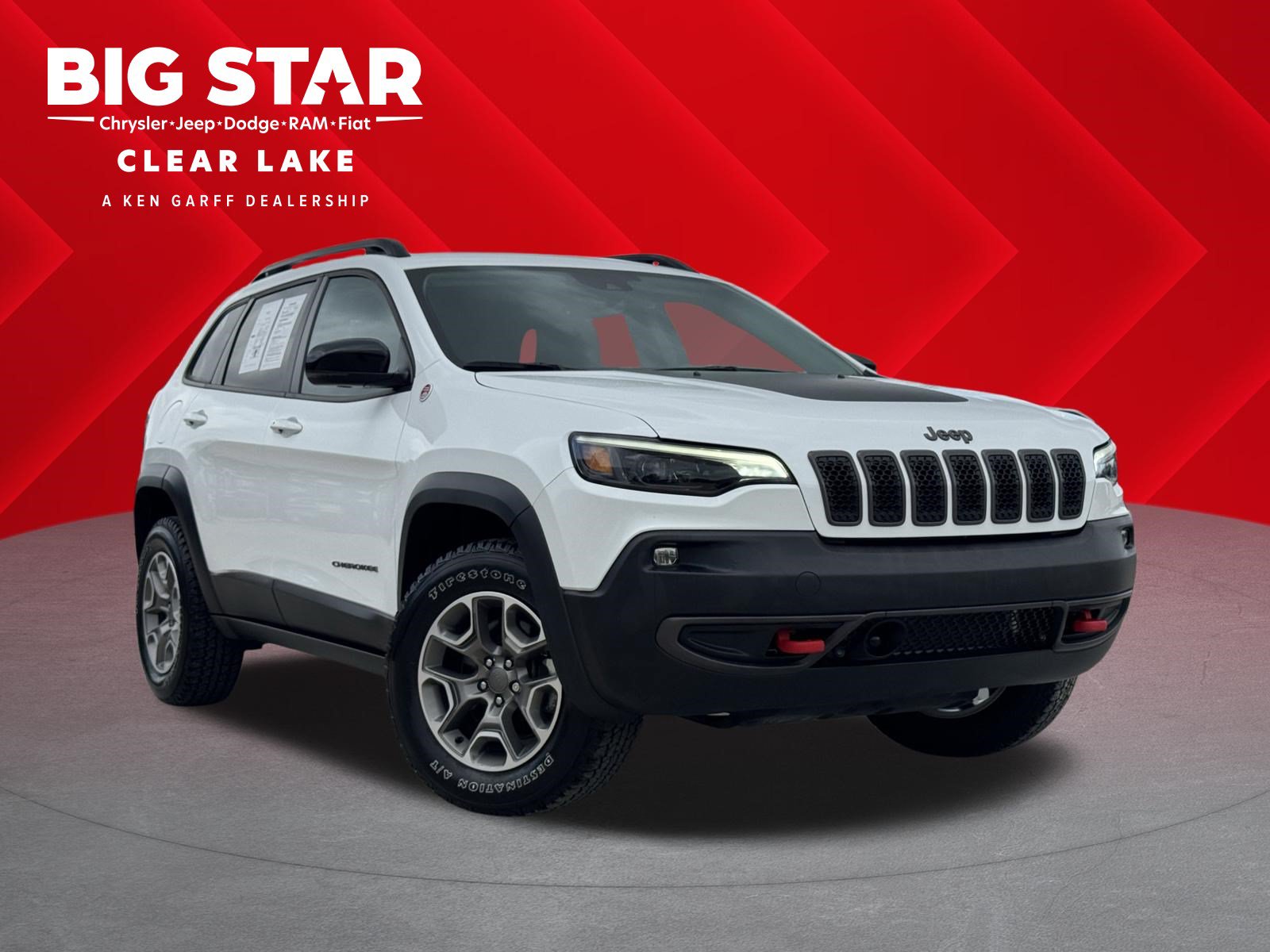
When the Cherokee Trailhawk is a good choice
The Cherokee Trailhawk makes sense for a U.S. buyer who wants:
- A daily driver with genuine trail ability
- Better snow and gravel performance than a typical crossover
- A comfortable cabin for long road trips
- A used SUV with standard off-road equipment
- Moderate towing ability
- A vehicle that can reach campsites and trailheads without Wrangler-level compromises
It is especially attractive when the vehicle will spend most of its time on pavement but needs to handle poor weather and occasional trails.
The Trailhawk is less suitable for someone who wants:
- Frequent extreme rock crawling
- Deep mud and water crossings
- Large aftermarket tires
- Maximum suspension articulation
- Easy field repairs
- An open-air driving experience
- A large third-row or cargo area
For those needs, a Wrangler, Toyota 4Runner, or another truck-based SUV may be a better fit.
Final verdict
The Jeep Cherokee Trailhawk is a good off-road car for moderate trails and all-weather driving. It offers much more capability than a normal crossover because it has low-range gearing, dedicated traction modes, all-terrain tires, skid plates, tow hooks, and increased clearance.
Its limits come from its crossover design. Independent suspension improves comfort but reduces articulation. The unibody structure and lower aftermarket support also make it less suitable for severe rock crawling than a Wrangler.
For a used buyer, the best Trailhawk is one with a clean service history, working four-wheel-drive system, healthy transmission, matching tires, and little underbody damage. Buy it as a capable daily SUV with real trail ability—not as a Wrangler substitute.

FAQs
Is the Jeep Cherokee Trailhawk better than a Subaru Outback off road?
The Cherokee Trailhawk generally has more dedicated off-road hardware, including low-range gearing, Rock mode, recovery hooks, and stronger trail-focused equipment. The Subaru Outback may offer a smoother ride, more cargo space, and good performance on gravel and snow. The better choice depends on whether the priority is moderate technical trails or comfortable long-distance travel.
Can a Cherokee Trailhawk drive on difficult Jeep trails?
It can handle many moderate Jeep trails, but difficulty ratings vary by region and trail condition. Deep ruts, large ledges, narrow shelf roads, and severe rock sections may exceed its clearance, articulation, or body protection. Trail conditions can change after rain, snow, or vehicle traffic.
Is the Cherokee Trailhawk reliable?
Reliability depends heavily on model year, maintenance, mileage, and prior trail use. A well-maintained example can be a useful long-term vehicle, but buyers should inspect the nine-speed transmission, four-wheel-drive system, suspension, electronics, and underbody before purchase.
Does every Cherokee Trailhawk have a V6?
No. Engine availability changed by model year and configuration. Many Trailhawk models use the 3.2-liter V6, while some Cherokee versions offered a 2.0-liter turbocharged engine. Check the vehicle’s factory build information rather than relying on the trim name alone.
How does the Cherokee Trailhawk compare with the Grand Cherokee Trailhawk?
The Cherokee Trailhawk is smaller and built as a compact crossover. The Grand Cherokee Trailhawk is larger, heavier, and uses a different platform and drivetrain range. They share the Trailhawk name but are not the same vehicle, so specifications and off-road behavior differ.
What should I inspect first on a used Trailhawk?
Start with the four-wheel-drive system, warning lights, transmission operation, underbody, skid plates, suspension, CV axles, tires, and service records. A professional pre-purchase inspection is strongly recommended if the vehicle shows signs of trail use.
Official information to verify before buying
Specifications vary by model year. Use the following documents for the exact vehicle:
- Jeep owner’s manuals
- Jeep vehicle information
- NHTSA recalls and VIN lookup
- The vehicle’s original window sticker
- The factory build sheet
- The tire and loading information label
- A service history report
Always confirm the model year, engine, drivetrain, towing package, tire size, and published limits before making a purchase or planning a trail trip.