How To Remove Jeep Soft Top Completely: Easy Step Guide
 Reading Time: 13 minutes
 Removing a Jeep soft top completely means taking the fabric, windows, bows, door surrounds, tailgate bar, and other removable top hardware off the vehicle—not merely folding the roof down. On most U.S.-market Jeep Wrangler models, the job can be completed at home with basic tools, careful labeling, and a second person to support the top.
The exact procedure varies by generation. A Jeep Wrangler TJ, JK, JL, and JL 4xe may use different fasteners, window retainers, bow assemblies, and storage systems. Always use the owner’s manual for your specific model and year before forcing a latch, zipper, retainer, or plastic component.

What You Need Before Removing the Soft Top
Prepare a clean, level work area and enough space to place the soft top without folding or dragging it on concrete. Soft-top windows are especially vulnerable to scratches, creases, and heat damage.
Recommended tools and supplies
- Factory owner’s manual
- Basic socket set, commonly including 10 mm and 13 mm sockets
- Ratchet or appropriate Torx drivers, if your Jeep uses them
- Trim-safe plastic tool
- Painter’s tape and a marker for labeling hardware
- Clean microfiber towels
- Soft blanket, moving pad, or padded storage bag
- Small containers or resealable bags for bolts and clips
- A second adult to help lift and stabilize the top
- Mild soap and water, if cleaning is needed
The tools depend on the Jeep’s year, trim, aftermarket hardware, and whether the top is a factory Mopar soft top or an aftermarket replacement. Do not assume every Wrangler uses the same fastener size.
Choose the right conditions
Remove the top when the fabric is dry and the temperature is moderate. Cold vinyl windows become stiff and can crack or crease more easily. Very hot material can stretch, fold, or stick to itself.
Park on level ground, set the parking brake, and turn off the vehicle. Close the doors before removing structural pieces such as door surrounds unless your manual specifies otherwise. Keep the hood, tailgate, and doors clear so the top cannot contact painted surfaces.
Understand what “completely removed” includes
A full removal commonly involves:
- Side and rear windows
- Tailgate bar or rear-window retainers
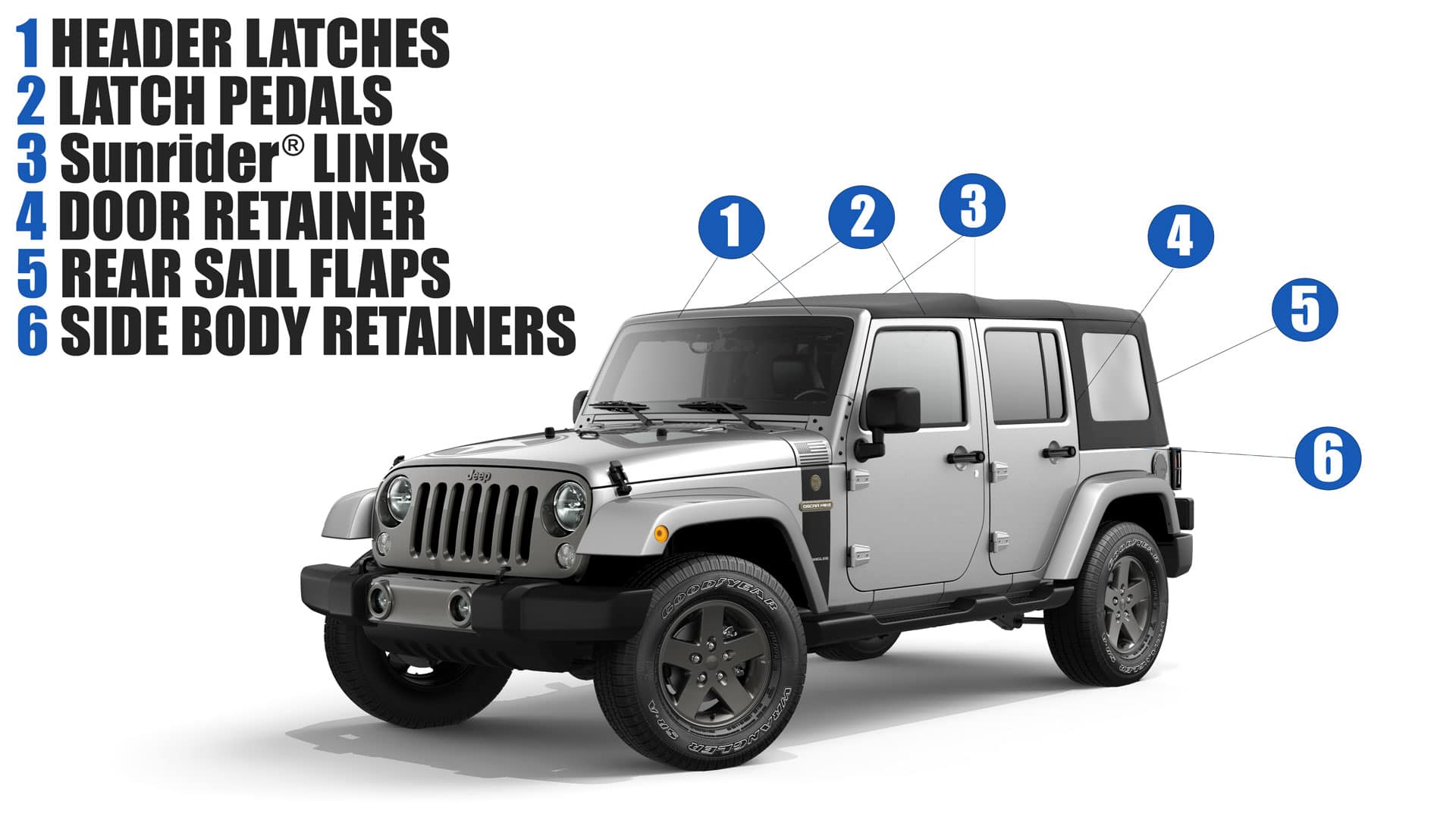
- Header latches at the windshield
- Side bows and fabric retainers
- Door surrounds
- Main bow or frame assembly
- The soft-top fabric itself
- Any remaining brackets that the owner’s manual identifies as removable
Some Jeep owners leave the door surrounds or bow brackets installed for convenience. That is a partial removal, not a complete soft-top removal.

How to Remove a Jeep Soft Top Completely
The safest general method is to remove the windows first, release the fabric from the body, disconnect the top from the windshield, and then lift the complete assembly away with assistance. The sequence below applies broadly to factory-style Wrangler soft tops, but model-specific differences are listed afterward.
1. Photograph and label the top before disassembly
Take photographs of both sides of the top, the windshield header, the rear window area, and the door-surround connections. Mark left and right components with painter’s tape.
This is useful because several parts can look interchangeable while having different shapes or attachment points. Label fasteners by location, such as:
- Driver-side door surround
- Passenger-side door surround
- Front header
- Rear bow
- Tailgate bar
- Window retainers
Do not rely on memory if you plan to reinstall the top later.
2. Remove the side windows
Open the Jeep doors and begin with the side windows.
Most Wrangler soft tops use some combination of:
- Zippers
- Hook-and-loop flaps
- Plastic retainers
- Fabric channels
- Snap-style connections on older designs
Release the lower and rear retainers before pulling the zipper. Move the zipper slowly and keep it straight. If the zipper resists, check for fabric tension or dirt rather than forcing it.
After removing each window, place it flat between clean, soft layers. Store clear vinyl windows in a sleeve or bag that will not rub against them. Avoid folding them sharply, placing heavy items on them, or leaving them in direct sunlight.
3. Remove the rear window and tailgate bar
Open the tailgate or swing gate as required by the model. Remove the rear window retainers and release the window from its channels or zipper.
Many Wrangler soft tops use a tailgate bar at the bottom of the rear window. The bar may slide into brackets, rotate out of retainers, or release through model-specific clips. Remove it carefully and label the brackets and hardware.
Do not pull the rear window straight out while the tailgate bar or side retainers remain engaged. That can stretch the fabric or damage the plastic edge.
4. Release the fabric from the body
With the windows removed, release the soft-top fabric from the Jeep’s body tub.
Typical attachment points include:
- Plastic body retainers along the rear quarter panels
- Lower side channels
- Rear corners
- Wheel-well areas
- Front door openings
- Windshield header
- Bow pockets or sleeves
Work from one end to the other instead of pulling multiple areas at once. Use your fingers or a plastic trim tool to separate retainers. A metal screwdriver can puncture the fabric or mark painted surfaces.
If the fabric remains tight, have a second person slightly support or reposition the frame. Do not use excessive force to stretch the top over a retainer.
5. Release the front windshield header latches
Open the front latches that connect the soft top to the top of the windshield frame. Most factory Wrangler designs use two front header latches, one on each side.
Before releasing the final latch, support the front section of the top. Once the latches are open, the frame can shift or fold unexpectedly.
If a latch will not release:
- Confirm the top is not under tension.
- Check whether the windshield frame or header is misaligned.
- Look for fabric trapped in the latch.
- Refer to the owner’s manual for the correct latch direction.
- Stop if the latch requires unusual force.
Forcing a latch can bend the mechanism or damage the windshield header.
6. Fold the soft top into its service position
Most Wrangler tops must be folded back or partially collapsed before the frame can be removed. Follow the frame’s natural hinge points and keep fabric from being pinched between bows.
The fabric should fold loosely rather than sharply. Do not drag the top over the roll bars, windshield frame, or body panels. If the top catches, stop and identify the remaining retainer or bow connection.
At this stage, the Jeep may look like it has a “top-down” configuration, but the frame and several components may still be attached. Continue with the hardware removal steps for a complete removal.
7. Remove the door surrounds
Door surrounds are the rigid side pieces that guide the soft-top fabric around the upper door openings. They may be secured with bolts, knobs, clips, or locating tabs.
Remove the driver-side and passenger-side surrounds one at a time. Keep the hardware with the correct side because left- and right-hand pieces may not be interchangeable.
Inspect the surrounding seals and trim as you work. If a seal pulls loose, press it back into its channel rather than stretching it. Do not drive the Jeep with loose body seals or unsecured top components.
8. Disconnect the bows and frame assembly
The top frame may include several bows connected by pivots, brackets, or fabric sleeves. The frame arrangement differs substantially between TJ, JK, JL, and aftermarket designs.
Support the frame before removing the final bolt or pin. A complete soft-top assembly can be awkward even when it is not especially heavy. Two people should lift it evenly to avoid bending the frame or striking the Jeep.
Remove only the hardware required by the factory procedure. Do not remove roll-bar bolts, seat-belt anchors, windshield hinges, or unrelated body hardware. If a component appears structurally integrated with the Jeep, confirm its purpose before loosening it.
9. Lift the top off the Jeep
With the fabric detached and the frame disconnected, lift the soft-top assembly straight up and away from the Jeep. One person should stand on each side.
Protect the windshield frame, mirrors, door edges, and painted body panels. Do not rest the assembly on the clear window material or place it directly on asphalt.
If the top does not lift free, stop and inspect for:
- An overlooked bolt or pin
- A remaining body retainer
- A door-surround connection
- A bow still attached to a bracket
- Fabric caught beneath a trim piece
- An aftermarket mounting system
Never pull harder to compensate for an unidentified attachment point.
10. Recheck the Jeep before driving
After removal, inspect the Jeep for loose hardware, open mounting holes, disconnected seals, or components that could move while driving.
Confirm that:
- No bolts or clips are loose inside the cabin
- Door surrounds are removed or securely installed
- Tailgate-bar brackets are not hanging loose
- The rear window is not still attached
- Fabric is not trapped in the doors or hinges
- No wiring or seat-belt component was disturbed
- The windshield header area is secure
- All removed parts are accounted for
A Jeep without its soft top may have more wind noise and exposure to weather, but it should not have loose parts that can contact passengers, controls, or moving doors.

Jeep Wrangler Model Differences
The basic removal logic is similar across Wranglers, but the components and sequence are not identical. Identify your generation before following a model-specific step.
| Wrangler generation | Common soft-top characteristics | Important consideration |
|---|---|---|
| TJ, generally 1997–2006 | Simpler fabric-and-bow design; removable windows and door surrounds | Older retainers, zippers, and fabric may be brittle |
| JK, generally 2007–2018 | Multiple window retainers, tailgate bar, door surrounds, and folding bow assembly | The top can appear fully lowered while the frame remains installed |
| JL, generally 2018–present | Updated retainers, latches, frame geometry, and storage arrangements | Do not substitute JK and JL removal instructions without verifying compatibility |
| JL 4xe | Similar soft-top concepts with additional vehicle-specific packaging | Keep removed parts clear of high-voltage components and follow the 4xe manual |
TJ soft tops
TJ tops often use a straightforward bow system with removable door surrounds and zippered windows. Older plastic retainers may become hard or brittle with age. Warm the vehicle naturally in moderate conditions rather than using a heat gun near vinyl or seals.
Because many TJ soft tops have seen years of sun exposure, inspect for torn fabric, cracked window material, and weakened stitching before reinstalling the top.
JK soft tops
JK soft tops commonly use removable side and rear windows, a tailgate bar, door surrounds, and a folding frame. Releasing the fabric from the body and removing the door surrounds is essential if the goal is to remove the frame completely.
Some JK versions include a storage system for the folded top. That storage arrangement is not the same as complete removal.
JL soft tops
JL soft tops use newer frame and retainer designs, and the exact procedure depends on the top option and model year. Do not assume a JL window, bow, or retainer fits a JK system.
Use the JL owner’s manual for the order of releasing rear-window retainers, side windows, header latches, and frame connections. If the top is an aftermarket design, follow that manufacturer’s instructions instead of combining them with a factory procedure.

How to Store a Jeep Soft Top After Removal
Store the fabric and windows indoors in a cool, dry location away from fuel, solvents, sharp tools, and direct sunlight. The most important rule is to prevent clear vinyl windows from being scratched or permanently creased.
Store windows separately
Clean the windows with clean water and a soft microfiber cloth. Do not use paper towels, abrasive cleaners, or household glass cleaner unless the window manufacturer specifically permits it.
Store each window:
- Flat when possible
- Between soft, clean sheets
- Away from metal hardware
- Without heavy objects placed on top
- In a temperature-controlled area
If the manufacturer permits rolling, roll the window loosely in the recommended direction. Do not make a tight roll or create a sharp fold.
Store fabric without compression
Allow damp fabric to dry completely before storage. Long-term storage of wet fabric can encourage mildew and odors.
Place the fabric and frame in a padded bag or on a clean blanket. Avoid compressing the top under heavy cargo. Keep all bolts, pins, brackets, tailgate bars, and door surrounds together in labeled bags.
Inspect before reinstallation
Before reinstalling the soft top, check:
- Stitching and seams
- Zippers
- Window edges
- Plastic retainers
- Bow pivots
- Door-surround seals
- Tailgate-bar brackets
- Header latches
- Fabric tension points
Replacing a damaged retainer before installation is usually easier than discovering the problem after the top is back on the Jeep.

Common Problems When Removing a Jeep Soft Top
Most removal problems result from hidden retainers, incorrect sequencing, cold material, or model-specific hardware.
The window will not unzip
Possible causes include fabric tension, a misaligned zipper, trapped dirt, or a damaged zipper slider. Support the window, release nearby retainers, and move the slider gradually. Do not yank the zipper or pull on the clear vinyl.
The fabric will not release from the body
Look for a plastic edge still seated in a channel. Start at the corner and work along the retainer in small sections. If the fabric is cold or tight, wait for warmer conditions. A plastic trim tool can help, but avoid metal tools.
The top is folded but will not come off
The frame, door surrounds, or bow assembly may still be bolted to the Jeep. Review the model-specific removal diagram and inspect both sides of the vehicle. Folding the top down is not the same as removing the top assembly.
A latch is stuck
Do not force it. Reduce tension on the frame, check for trapped fabric, and verify that you are moving the latch in the correct direction. If the latch remains stuck, a Jeep dealer or qualified off-road shop can prevent damage to the header or windshield frame.
The soft top has developed mildew
Clean and dry the fabric according to the top manufacturer’s care instructions. Avoid storing it while damp. Severe mildew, weakened stitching, or deteriorated fabric may require professional cleaning or replacement.
Hardware is missing
Do not substitute random bolts or self-tapping screws. The correct fastener must have the appropriate length, thread, head style, and corrosion resistance. Check the owner’s manual, factory parts catalog, or a Jeep parts specialist for the exact component.
Safety Limits and Mistakes to Avoid
A soft-top removal is usually a manageable home project, but mistakes can damage expensive fabric, windows, seals, or painted panels.
Avoid these common errors:
- Removing the top alone when the frame is awkward or heavy
- Folding clear windows sharply
- Pulling a zipper while the fabric is under tension
- Using a screwdriver against vinyl or painted trim
- Forcing a plastic retainer in cold weather
- Mixing left- and right-side hardware
- Leaving loose brackets attached to the Jeep
- Storing wet fabric
- Removing unrelated roll-bar or seat-belt hardware
- Driving before checking for loose components
- Assuming JK and JL instructions are interchangeable
- Using a heat gun, open flame, or harsh solvent near the top
Stop and seek qualified help if you find damaged mounting points, bent frame members, missing structural hardware, torn windshield-header connections, or interference with seat belts or roll-bar components.
Key Takeaways
- Removing a Jeep soft top completely requires more than folding it down.
- Remove the windows, tailgate bar, fabric retainers, header latches, door surrounds, bows, and frame hardware in the correct order.
- The exact procedure depends on whether the Jeep is a TJ, JK, JL, JL 4xe, or has an aftermarket top.
- Use two people, protect the clear windows, label the hardware, and never force a latch or retainer.
- Store the dry fabric and windows indoors, flat or in the manufacturer-approved position.
Frequently Asked Questions
Can I remove a Jeep soft top by myself?
You may be able to remove individual windows or door surrounds alone, but complete removal is safer with two adults. The frame can shift unexpectedly and may contact the windshield, body panels, or doors.
Do I have to remove the door surrounds?
If you want the soft top completely off, usually yes. Door surrounds are part of the top’s side structure and may remain attached even when the fabric is folded down. Confirm the requirement for your specific Wrangler generation.
Can I leave the soft-top windows folded?
Avoid sharply folding clear vinyl windows. Store them flat when possible, or use the storage method specified by the top manufacturer. Tight folds can create permanent creases and reduce visibility.
How long does it take to remove a Jeep soft top?
The time varies by model, condition, and experience. A first-time removal may take considerably longer than a later seasonal removal because you must identify hardware and inspect each connection. Rushing increases the chance of damaged zippers, windows, and retainers.
Can I drive a Jeep with the soft top removed?
Yes, if the vehicle is configured according to the owner’s manual and all remaining hardware is secure. Check local requirements for mirrors and equipment, and do not drive with loose brackets, unsecured fabric, or improperly reinstalled components.
Conclusion
To remove a Jeep soft top completely, take off the windows and tailgate bar first, release the body retainers and windshield header, remove the door surrounds, disconnect the bows and frame, and lift the assembly away with a second person. Because Wrangler soft tops changed between the TJ, JK, and JL generations, verify every step against the manual for your Jeep’s exact year and top design.
After removal, protect the clear windows from scratches, keep the fabric dry, label the hardware, and inspect every component before reinstallation.