How To Reset Check Engine Light On 2012 Jeep JK: Easy Fix
 Reading Time: 9 minutes
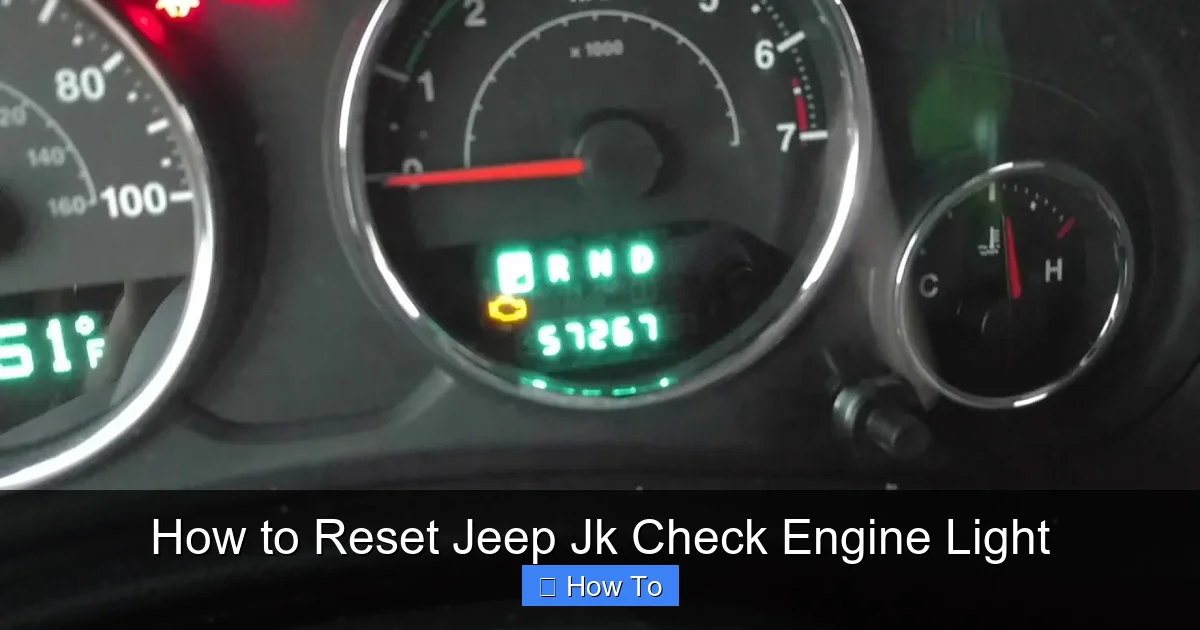
 If the check engine light on a 2012 Jeep Wrangler JK is on steadily, you can reset it with a compatible OBD-II scan tool after diagnosing the stored fault code. Plug the scanner into the diagnostic port under the driver’s side dashboard, turn the ignition to ON without starting the engine, read and record the codes, then select Erase or Clear Codes.
Do not reset the light without checking the code first. Clearing the warning may hide an active problem, and it resets the Jeep’s emissions readiness monitors. If the check engine light is flashing, stop driving as soon as it is safe because a severe misfire may damage the catalytic converter.
What the Check Engine Light Means on a 2012 Jeep Wrangler JK
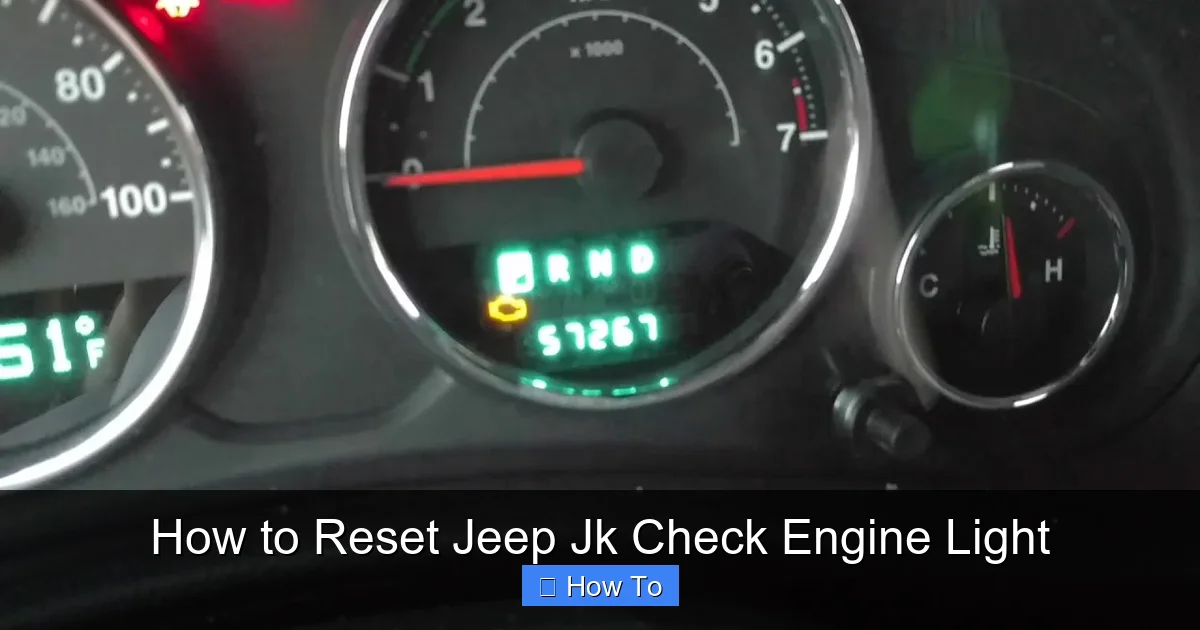
The check engine light, also called the malfunction indicator lamp (MIL), is controlled by the Jeep’s onboard diagnostic system. The system monitors components that affect emissions, engine operation, fuel delivery, ignition, and certain transmission functions.
A steady light usually indicates that the Jeep detected a fault but may still be safe to drive for a short distance, depending on the symptoms. A flashing light generally indicates a more serious condition, most commonly an active engine misfire.
Common causes on a 2012 Jeep JK include:
- Loose, damaged, or incorrectly installed fuel cap
- Evaporative emissions leaks
- Oxygen sensor or air-fuel mixture faults
- Ignition coil or spark plug problems
- Engine misfires
- Faulty crankshaft or camshaft position sensors
- Catalytic converter efficiency faults
- Low battery voltage or an interrupted electrical connection
- Throttle control or electronic stability-related faults
The light may remain on even after the original problem is corrected. The Jeep stores a diagnostic trouble code (DTC), and the light typically turns off only after the vehicle’s computer confirms that the fault is no longer present or a scan tool clears the code.
Steady versus flashing check engine light
| Light behavior | What it may indicate | Recommended response |
|---|---|---|
| Steady yellow or amber light | A stored or active emissions or engine-control fault | Read the code promptly and repair the cause |
| Flashing light | A potentially damaging misfire or severe fault | Reduce load, stop when safe, and arrange diagnosis |
| Light turns off by itself | The computer no longer detected the fault during later checks | Read stored or pending codes before assuming the issue is fixed |
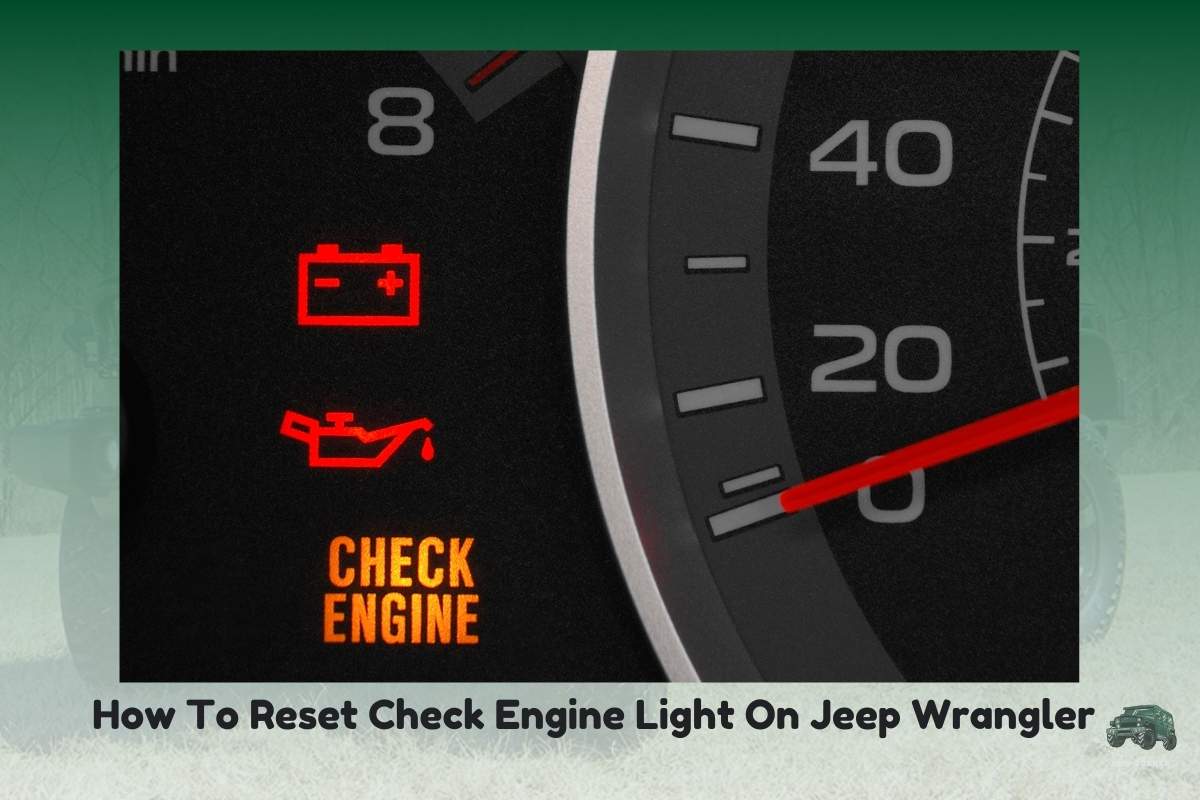
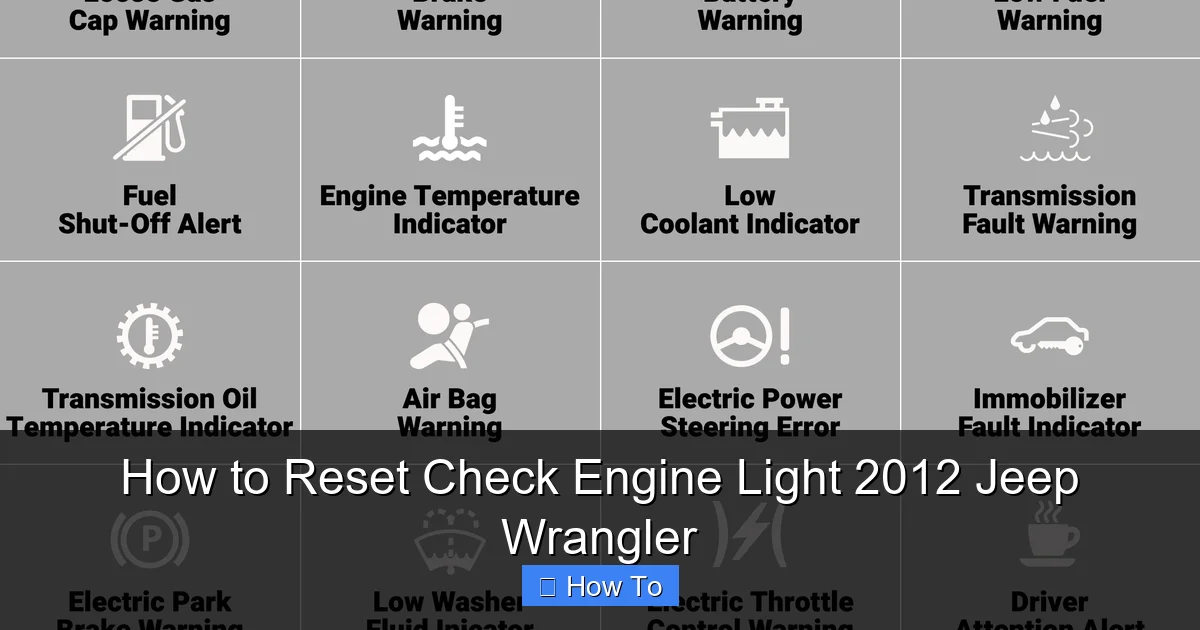
The check engine light is not the same as the red oil pressure, charging system, or engine temperature warning lights. A red warning light can require immediate shutdown even if the check engine light is not flashing.
The Best Way to Reset the Check Engine Light
The most reliable method is to use an OBD-II diagnostic scanner. A basic code reader can usually clear generic powertrain codes, while a more capable scan tool may access manufacturer-specific, chassis, body, and ABS-related systems.
What you need
Before starting, gather:
- An OBD-II scanner or code reader compatible with a 2012 Jeep Wrangler
- The Jeep’s key
- A fully charged vehicle battery
- A safe, level location
- The original diagnostic code or a written record of any codes found
the diagnostic connector is normally located beneath the driver’s side of the dashboard, near the lower dash panel and steering column area.
Step-by-step instructions
- Park the Jeep safely. Set the parking brake and place the transmission in Park, or in first gear or neutral if equipped with a manual transmission.
- Turn off accessories. Switch off the headlights, radio, climate control, and other electrical loads.
- Locate the OBD-II port. Look beneath the driver’s side dashboard for the 16-pin diagnostic connector.
- Connect the scan tool. Push the connector firmly into the port. Do not force it if the pins do not align.
- Turn the ignition to ON. Insert the key and turn it to the position where the dashboard warning lights illuminate, but do not start the engine.
- Allow the scanner to communicate. Select the vehicle or allow the tool to identify it automatically.
- Choose “Read Codes.” Record all stored, pending, and permanent codes before clearing anything.
- Investigate the code. A code identifies the system that detected a problem; it does not always identify the failed part.
- Select “Erase Codes,” “Clear Codes,” or a similar option.
- Confirm the reset. Turn the ignition off, wait briefly, and turn it back to ON. The check engine light should remain off if no current fault is detected.
- Disconnect the scanner. Start the Jeep and watch for warning lights or abnormal running.
- Drive normally and recheck the system. If the light returns, the fault is still present or has been detected again.
The exact menu names vary by scanner. Follow the instructions supplied with the device rather than selecting unrelated functions such as transmission relearn, throttle relearn, or module programming.
What a successful reset looks like
After clearing the codes, the check engine light should go out with the ignition on or shortly after the engine starts. However, a successful reset does not prove that the repair worked. It only confirms that the stored codes were erased at that moment.
If the light returns immediately, the Jeep is detecting an active fault. If it returns after several miles or driving cycles, the problem may occur only under a particular condition, such as cold starting, highway cruising, refueling, or climbing a hill.
How to Reset the Light Without a Scan Tool
Disconnecting the battery is sometimes used as a makeshift reset, but it is not the preferred method for a 2012 Jeep JK.
Battery-disconnect method
If a scan tool is unavailable, a vehicle owner may disconnect the negative battery cable after turning the ignition off. Leave it disconnected for several minutes, reconnect it securely, and then start the Jeep.
This method has limitations:
- It may not erase every code, especially permanent emissions codes.
- It may reset learned engine-control values.
- It can erase radio presets and other retained settings.
- It resets emissions readiness monitors.
- It does not repair the underlying fault.
- The light can return immediately if the problem is still active.
- Incorrect battery handling can cause sparks, short circuits, or damage.
Because of these limitations, use a scan tool whenever possible. The battery should not be disconnected while the ignition is on, and the positive and negative terminals should never be shorted together with a tool.
Why key cycling usually does not reset the light
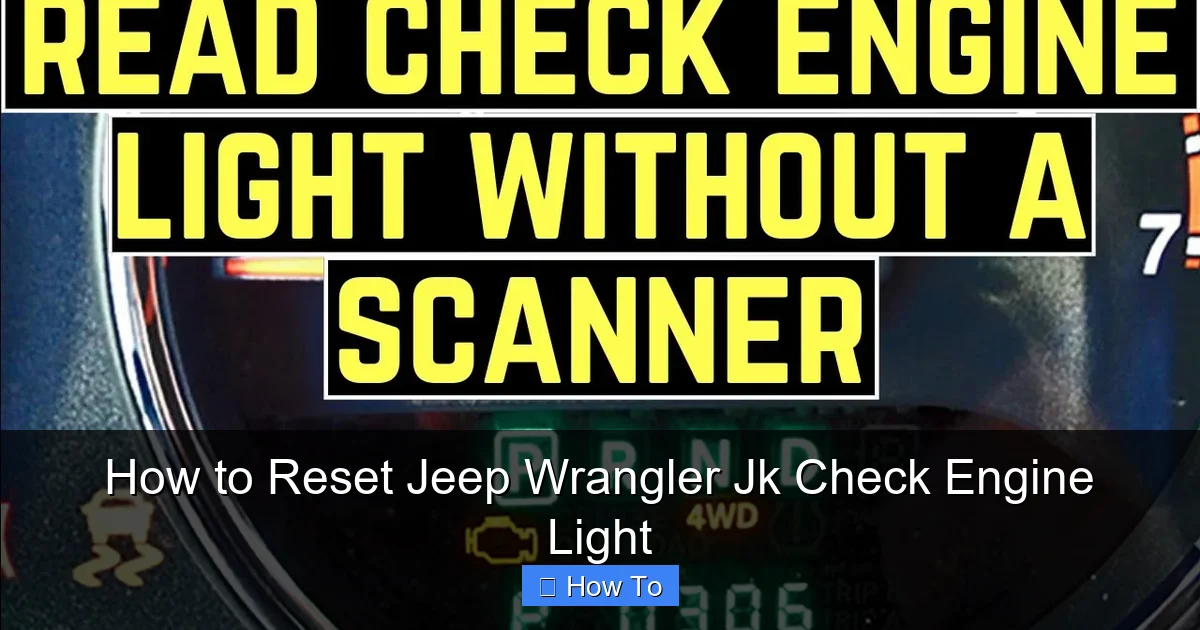
Turning the ignition on and off repeatedly may help some vehicles display diagnostic information, but it should not be treated as a dependable way to clear the check engine light on a 2012 Jeep JK. Reading or displaying a code is different from erasing it.
A scan tool is the appropriate method because it allows you to:
- Save the original code
- View pending codes
- Check whether the fault is active
- Clear the code deliberately
- Review emissions readiness status
- Confirm whether the Jeep’s computer detects the problem again
What to Do If the Check Engine Light Comes Back
If the light returns, do not repeatedly erase it. Use the new code and the vehicle’s symptoms to determine the next diagnostic step.
Check the fuel cap first
A loose fuel cap can trigger an evaporative emissions fault. Remove the cap, inspect the seal for damage or dirt, reinstall it, and tighten it until it clicks or is firmly secured according to the cap design.
A fuel-cap-related light may not turn off immediately. The Jeep may need several normal driving cycles before the computer confirms that the evaporative system is no longer leaking.
Look for symptoms that change the urgency
Arrange prompt diagnosis if the Jeep has:
- Rough idle
- Loss of power
- Hard starting
- Stalling
- Poor acceleration
- Strong fuel odor
- Unusual exhaust smoke
- Knocking or severe engine vibration
- A flashing check engine light
A steady light with no drivability symptoms is generally less urgent than a flashing light, but it still deserves attention. Continuing to drive with an unresolved misfire can overheat and damage the catalytic converter.
Understand what the code does—and does not—tell you
A diagnostic code points to a monitored circuit or condition. It does not automatically identify the component that should be replaced.
For example:
- An oxygen-sensor code may result from a sensor, wiring problem, exhaust leak, vacuum leak, fuel issue, or catalytic-converter problem.
- A misfire code may result from a spark plug, ignition coil, injector, compression issue, vacuum leak, or timing-related fault.
- An evaporative emissions code may result from a fuel cap, cracked hose, purge valve, leak-detection pump, or wiring issue.
A proper diagnosis may require inspecting wiring, checking live data, testing fuel pressure, performing a smoke test, or checking engine compression.
Do not clear codes before an emissions test
Clearing the codes or disconnecting the battery resets the Jeep’s OBD-II readiness monitors. These monitors perform self-tests for systems such as the catalytic converter, oxygen sensors, evaporative emissions system, and exhaust-gas-related functions.
If the monitors are incomplete, the Jeep may fail an emissions inspection even when the check engine light is off. The exact inspection rules vary by state. Before an emissions test, verify the applicable requirements with the relevant state inspection authority.
Can You Drive a 2012 Jeep JK After Resetting the Light?
You may be able to drive the Jeep if the light is steady, the engine runs normally, and there are no red warning lights or serious symptoms. Drive conservatively and arrange a diagnosis rather than treating the reset as a repair.
Stop driving and seek professional assistance if:
- The check engine light flashes
- The engine shakes or misfires severely
- The Jeep loses substantial power
- The engine temperature rises
- The oil pressure warning appears
- The charging warning appears
- The vehicle stalls repeatedly
- You smell raw fuel
- You hear loud mechanical knocking
A reset can remove the warning temporarily while leaving the fault unresolved. The safest next action is to read the code, repair the cause, clear the code, and confirm that the light stays off during normal operation.
Common Mistakes to Avoid
Avoid these mistakes when resetting the check engine light on a 2012 Jeep Wrangler JK:
- Clearing the code before recording it. The original code can provide valuable diagnostic information.
- Replacing the part named in the code immediately. The code may identify a circuit or system rather than a failed component.
- Ignoring a flashing light. A flashing light can indicate an active misfire capable of damaging the catalytic converter.
- Assuming the reset fixed the vehicle. Erasing a DTC changes the computer’s memory, not the mechanical condition.
- Disconnecting the battery before an emissions inspection. Readiness monitors may become incomplete.
- Using a scanner for a function it does not support. Some tools read only generic engine codes and cannot access ABS, airbag, body, or manufacturer-specific systems.
- Driving aggressively after clearing the codes. If the problem remains, heavy load can worsen engine or emissions damage.
Frequently Asked Questions
Will disconnecting the battery reset the check engine light on a 2012 Jeep JK?
It may clear some stored information, but it is not guaranteed to erase every code and does not repair the cause. It also resets emissions readiness monitors and learned values. An OBD-II scanner is the better method.
How long does it take for the check engine light to turn off after tightening the gas cap?
The light may not turn off immediately. The Jeep may need multiple normal drive cycles to verify that the evaporative emissions fault is gone. You can use a scan tool to check and clear the code after confirming the cap and related components are in good condition.
Can an OBD-II scanner clear all warning lights on a Jeep JK?
No. A basic scanner may clear generic engine and emissions codes, but it may not communicate with the ABS, airbag, body, or other control modules. Use a scan tool designed for the specific module when another warning light remains on.
Why did the check engine light return after I reset it?
The underlying fault may still be active, or the Jeep may have detected the same condition during a later self-test. Read the code again and diagnose the related system instead of repeatedly clearing the warning.
Will resetting the check engine light make the Jeep pass an emissions test?
Not necessarily. Clearing the light resets the emissions monitors, and the inspection computer may report that the monitors are not ready. The Jeep must complete its required self-tests, and the underlying fault must remain corrected.
Does a check engine light reset itself?
Sometimes the light turns off after the Jeep completes several successful checks without detecting the fault. The code may remain stored even after the lamp goes out, so scanning the vehicle is still useful.
Final Recommendation
For a 2012 Jeep Wrangler JK, use an OBD-II scan tool to read the diagnostic codes first and clear them only after addressing the cause. A steady light with normal operation calls for prompt diagnosis; a flashing light, severe misfire, overheating, low oil pressure, or major loss of power calls for immediate caution and professional assistance.
The reset is complete only when the fault has been corrected, the code has been cleared, and the Jeep completes its self-tests without turning the warning light back on.