How To Put Jeep In 4 Low: Easy Step-By-Step Guide
 Reading Time: 9 minutes
 To put a compatible Jeep in 4 Low (4L), bring the vehicle to a stop or a very low speed, shift the transmission into Neutral, and select 4L using the transfer-case lever or electronic control. Wait for the 4WD indicator to stop flashing before shifting back into Drive or first gear.
The exact procedure varies by Jeep model, model year, transmission, and four-wheel-drive system. This guide applies to common U.S.-market Jeeps equipped with a low-range transfer case, including many Wrangler, Gladiator, Grand Cherokee, and Cherokee Trailhawk models. Always confirm the instructions in the owner’s manual for your specific Jeep.
What 4 Low Means
4 Low, commonly displayed as 4L or 4LO, uses the transfer case’s low-range gearing to increase torque at the wheels. It is designed for slow, controlled driving where traction and power are more important than speed.
4L is useful for:
- Steep climbs and descents
- Deep mud, sand, or snow
- Rocky trails and uneven terrain
- Slow-speed off-road obstacles
- Pulling through conditions where the tires may slip
- Controlled engine braking on descents
4L does not automatically make a Jeep safer or more capable in every situation. It changes the gearing, which increases wheel torque but limits vehicle speed. It can also cause driveline stress if used on high-traction surfaces or when the tires cannot slip enough to relieve drivetrain windup.
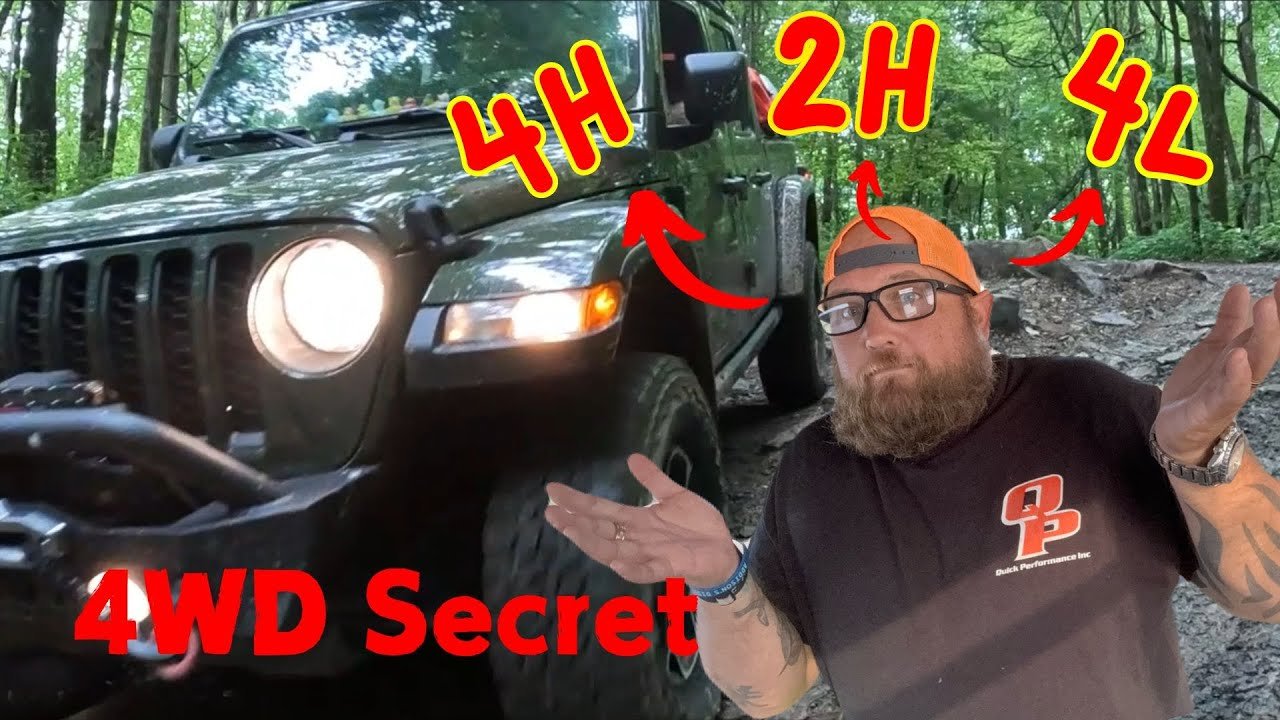
4H versus 4L
| Setting | Main purpose | Typical use |
|---|---|---|
| 2H | Rear-wheel drive on compatible models | Normal dry-road driving |
| 4H | Four-wheel drive at normal or moderately reduced speeds | Snow, gravel, mud, sand, and slippery roads |
| 4L | Four-wheel drive with low-range gearing | Slow, demanding off-road conditions |
The labels and available settings differ between Jeep systems. Some vehicles have Command-Trac, Rock-Trac, Selec-Trac, or an electronically controlled 4WD system. Some Jeep SUVs have no 4L setting at all.

Before You Shift a Jeep Into 4 Low
Before selecting 4L, verify that your Jeep is designed for low-range four-wheel drive. Many two-wheel-drive Jeeps and several Jeep crossover models do not have a mechanical 4L range.
Check these prerequisites:
- Confirm that 4L is available. Look for a transfer-case lever or a clearly marked 4L/4LO control. A normal 4WD or 4×4 button does not necessarily mean the Jeep has low range.
- Use a suitable surface. Engage 4L before entering the most difficult section of a trail whenever possible.
- Keep the wheels pointed mostly straight. This reduces driveline load during engagement.
- Remove your foot from the accelerator. The drivetrain should not be under heavy power while changing ranges.
- Use the correct transmission position. Most Jeep systems require the automatic transmission to be in Neutral. Manual-transmission models generally require the clutch pedal to be fully depressed.
- Read the dashboard indicator. A flashing 4L or 4LO light normally means the shift is still in progress or has not completed.
Do not use 4L on dry pavement merely to gain more traction. On part-time four-wheel-drive systems, turning on high-traction surfaces can prevent the front and rear axles from rotating at different speeds. This condition, often called driveline windup, may make steering difficult and can increase stress on drivetrain components.

How to Put a Jeep in 4 Low
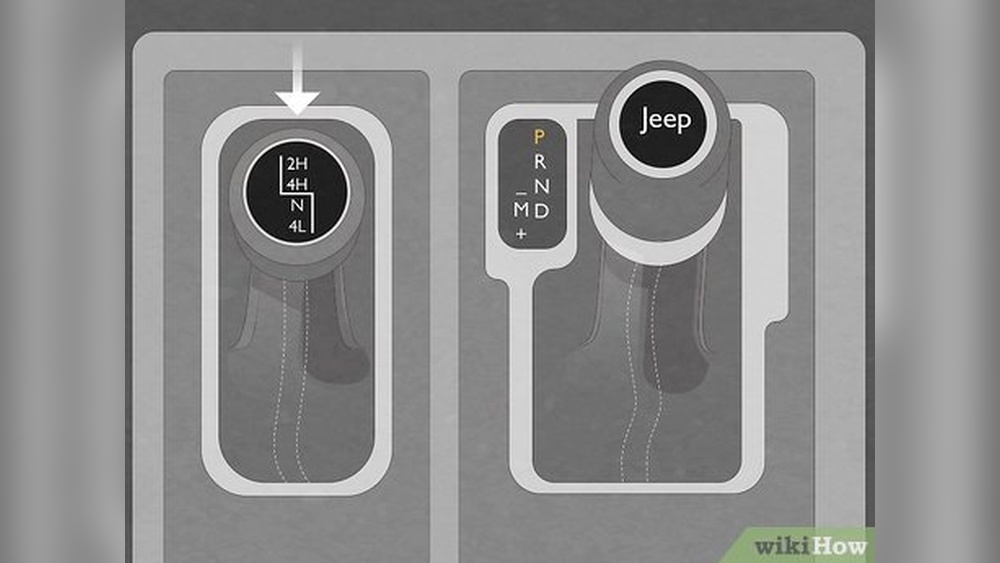
Traditional transfer-case lever
Use the following general procedure for a Jeep with a mechanical transfer-case lever:
- Slow to a crawl or stop. Many Jeep manuals specify shifting into 4L at very low speed, often below approximately 3 mph, while others recommend stopping completely. Use the speed stated in your owner’s manual.
- Keep the vehicle pointed straight.
- Press and hold the brake pedal.
- Shift the automatic transmission into Neutral. Do not confuse transmission Neutral with the transfer-case Neutral position.
- For a manual transmission, depress the clutch fully.
- Move the transfer-case lever firmly from 4H to 4L. The lever may require steady pressure, but do not force it aggressively.
- Wait for the 4L indicator to illuminate steadily.
- Shift the transmission into a suitable gear. Select first gear in a manual Jeep or Drive/low gear in an automatic Jeep, depending on the terrain.
- Apply gentle throttle. Allow the low gearing to provide most of the pulling force.
The transfer-case lever may pass through a Neutral position between 4H and 4L. Move the lever through that position as directed by the vehicle’s markings and owner’s manual. Do not leave the transfer case in Neutral unless you intentionally need to disconnect the drivetrain, such as for a properly approved towing procedure.
Electronic 4L controls
Newer Jeeps may use a rotary selector, push button, or electronic switch instead of a mechanical lever. The general process is similar:
- Reduce speed or stop according to the owner’s manual.
- Hold the brake pedal.
- Shift the transmission into Neutral.
- Select 4L, 4LO, or the equivalent low-range setting.
- Wait for the dashboard message or indicator to confirm engagement.
- Shift the transmission into gear and proceed slowly.
Some systems may display a message such as “Shifting 4WD” while the transfer case changes range. Do not accelerate or shift into Drive until the system confirms the change or the manual states that it is complete.

How to Use 4 Low While Driving
Once 4L is engaged, drive slowly and avoid abrupt throttle changes. Low-range gearing increases torque at the wheels, so a small accelerator input may produce a stronger response than it would in 4H.
Use these techniques:
- Select a low gear before a steep climb or descent.
- Maintain steady momentum in sand or mud without excessive wheelspin.
- Use gentle throttle over rocks and ledges.
- Keep both hands available for steering.
- Avoid sudden steering inputs while the tires are heavily loaded.
- Use engine braking on descents rather than riding the brakes continuously.
- Stop and reassess if the tires spin continuously or the Jeep begins to slide.
4L is not intended for normal highway driving. It is generally used at low speeds, and the maximum permitted speed depends on the Jeep model, tire size, transfer case, surface, and owner’s manual. Do not assume that a speed limit from one Wrangler or Gladiator applies to another Jeep.
Choosing a gear
The correct gear depends on the obstacle and the transmission:
- Steep climb: Use a low gear and steady throttle.
- Steep descent: Use a low gear and let engine braking help control speed.
- Rock crawling: Use the lowest practical gear and avoid sudden acceleration.
- Mud or sand: A slightly higher gear may help maintain momentum, but excessive wheelspin can reduce traction.
- Towing or pulling: Follow the Jeep’s towing and transmission instructions; 4L is not a substitute for staying within the vehicle’s rated limits.

How to Shift a Jeep Out of 4 Low
To return to 4H:
- Slow to a stop or the low speed specified in the owner’s manual.
- Keep the wheels straight.
- Hold the brake pedal.
- Shift the automatic transmission into Neutral, or depress the clutch on a manual model.
- Move the transfer-case control from 4L to 4H, or select 4H electronically.
- Wait for the 4H indicator to illuminate steadily.
- Shift the transmission into Drive or the appropriate manual gear.
- Resume normal driving only after the system confirms the range change.
If you are leaving a trail for a paved road, shift out of 4L before reaching dry pavement. If the Jeep uses a part-time 4WD system, select 2H for ordinary dry-road driving unless the owner’s manual specifies another operating mode.
What to Do If 4L Will Not Engage
A 4L shift that does not complete is often caused by incorrect speed, transmission position, drivetrain load, or a normal delay in the electronic shift system.
If the 4L light keeps flashing
Try the following sequence:
- Stop in a safe location.
- Keep the brake pedal depressed.
- Shift the transmission into Neutral.
- Return the transfer-case control to 4H if the system allows it.
- Wait briefly, then select 4L again.
- If the Jeep has a manual transmission, fully depress the clutch.
- Follow the owner’s manual procedure for a very slow roll if it specifies one.
Do not repeatedly force a mechanical lever or rapidly cycle an electronic control.
If the transfer-case lever will not move
Possible causes include:
- The transmission is not fully in Neutral.
- The vehicle is moving too fast.
- The drivetrain is under load.
- The transfer-case gears are not aligned.
- The clutch is not fully depressed on a manual model.
- The vehicle has stopped with the driveline wound up on a high-traction surface.
- A transfer-case actuator, sensor, fuse, or linkage may have a fault.
A gentle, controlled roll at the speed specified in the manual can help align the gears on some systems. Do not place any part of your body beneath the Jeep to manipulate the linkage while the vehicle is running or unsupported.
If the Jeep remains in 4L
Do not continue driving at normal road speed. Stop safely, place the transmission in Neutral, and follow the model-specific disengagement procedure. If the indicator continues flashing, a warning message appears, or the Jeep makes grinding or binding noises, have the vehicle inspected by a qualified technician.
Common Mistakes to Avoid
Shifting while the transmission is in Park
Many Jeep transfer cases require the transmission to be in Neutral. Park can prevent the range change from completing and may place unnecessary load on the drivetrain.
Using 4L on dry pavement
Part-time 4WD systems can bind when used on surfaces that prevent the tires from slipping slightly during turns. Use 4L on loose, slippery, or off-road surfaces unless your specific full-time system’s manual states otherwise.
Applying throttle during the shift
Accelerating while shifting ranges can make engagement harsher and increase the chance of an incomplete shift. Keep the Jeep stationary or within the specified low-speed range.
Assuming every Jeep has 4L
The Jeep brand includes body-on-frame off-road vehicles and front-wheel-drive-based crossovers. A Jeep Compass or Renegade, for example, may have an electronically controlled 4WD system without a driver-selectable low-range transfer case. A Cherokee usually needs a specific off-road-oriented configuration, such as a Trailhawk trim, for true low-range capability.
Forcing the control
If a lever or selector does not move normally, stop and check the procedure. Forcing it can damage the linkage or transfer case.
Driving too fast after engagement
4L is a low-speed range. High vehicle speed can over-rev the engine and drivetrain. Use the maximum speed stated in the manual for the exact Jeep.

Jeep 4 Low Quick Reference
| Situation | Recommended action |
|---|---|
| Entering a rocky trail | Engage 4L before the obstacle |
| Steep descent | Use 4L and a low gear for engine braking |
| Deep mud | Use 4L when low-speed torque is needed; avoid excessive wheelspin |
| Dry highway | Do not use 4L |
| 4L light flashing | Remain in Neutral and follow the shift procedure |
| Lever will not move | Stop, verify Neutral, reduce drivetrain load, and do not force it |
| No 4L control present | Check whether the Jeep has a low-range transfer case |
| Grinding or severe binding | Stop using the system and seek professional inspection |
The safest general rule is: low speed, transmission Neutral, no accelerator, firm selection, and confirmation from the indicator.

Frequently Asked Questions
Can I put a Jeep in 4 Low while moving?
Some Jeep models permit a very low-speed shift, while others require a complete stop. The permitted speed is model-specific. If the owner’s manual does not clearly authorize shifting while moving, stop before selecting 4L.
Does the Jeep transmission need to be in Neutral?
Usually, yes. Most Jeep transfer-case systems require the automatic transmission to be in Neutral before changing between 4H and 4L. Manual-transmission models generally require the clutch to be fully depressed as well.
Can I use 4 Low on snow-covered roads?
You can use 4L on snow when driving slowly and when extra torque or engine braking is needed, such as on a steep trail or driveway. For ordinary snowy roads where higher speeds are necessary, 4H is usually more appropriate. Avoid 4L on dry sections with tight turns unless the Jeep’s full-time 4WD instructions allow it.
Why is my Jeep’s 4L light flashing?
A flashing light usually means the transfer case has not completed the range change or the system is waiting for the correct conditions. Verify the vehicle speed, transmission Neutral position, brake or clutch use, and the model-specific procedure. Persistent flashing or warning messages require inspection.
Can I shift from 4L directly to 2H?
Many Jeeps allow a direct shift from 4L to 2H by passing through 4H, but the exact procedure depends on the transfer case. Follow the markings and owner’s manual rather than moving the control based on another Jeep’s layout.
Does 4L improve braking?
4L can increase engine braking because the lower gearing resists wheel rotation more strongly. It does not shorten every stopping distance, and it cannot replace appropriate speed, braking technique, or traction. On slippery surfaces, abrupt braking can still cause a loss of control.
Final Takeaway
To put a compatible Jeep in 4 Low, slow down or stop, hold the brake, shift the transmission into Neutral, select 4L, and wait for the indicator to confirm engagement. Drive slowly and use 4L only where low-range gearing is appropriate, such as steep, loose, rocky, muddy, or uneven terrain.
For the correct speed limits, shift position, and available modes, verify the owner’s manual for the exact U.S.-market Jeep model and model year. If 4L will not engage, the indicator continues flashing, or the vehicle binds or grinds, stop forcing the system and have it checked by a qualified Jeep technician.