
Best And Worst Years For Jeep Renegade: Reliability Guide
 Reading Time: 13 minutes
For U.S. used-car shoppers, 2015–2016 Jeep Renegades deserve the most caution, while 2020–2023 models with the 1.3-liter turbo engine are a reasonable starting shortlist. These are buying priorities, not proven rankings of failure rates. Service records, engine type, recall status, and a sound inspection can matter more than the model year.
The Renegade was sold in the United States for model years 2015 through 2023. Its engine options changed during that run, so two Renegades from the same year may carry different risks. A well-kept older example can be a better purchase than a newer SUV with low oil, poor records, or rough shifts.
This guide focuses on U.S.-market vehicles. It separates documented concerns from buying judgments and explains what to check before you commit. Live complaint totals, current recall completion, and repair prices have not been verified, so no numerical reliability scores are assigned.
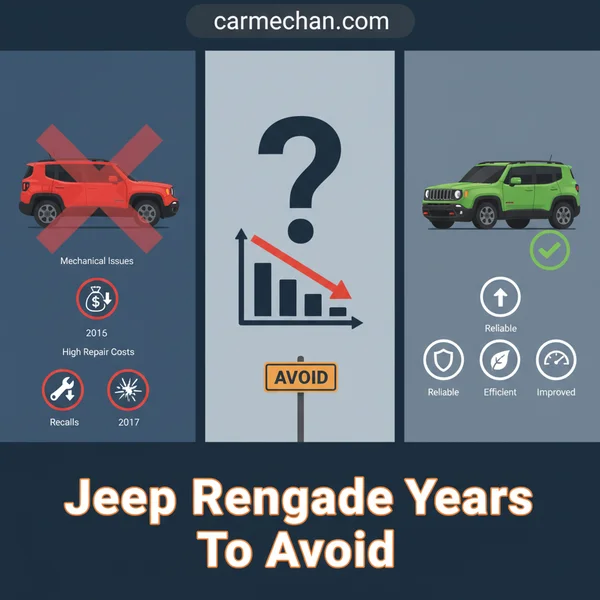
Best and Worst Jeep Renegade Years at a Glance
Start with the vehicle’s engine and condition, then use its model year as a screening tool. The table below shows where to begin your search—not which vehicle to buy without an inspection.
| U.S. model year | Buying position | Main reason | Key condition |
|---|---|---|---|
| 2015–2016 | Highest caution | Early production years; some automatic-equipped vehicles fall within a documented transmission-related recall | Verify the VIN, recall repairs, oil use, and cold and warm shifting |
| 2017–2018 | Consider selectively | Later than the launch models, but 2.4-liter oil-consumption concerns still warrant attention | Require strong service records and an engine-specific inspection |
| 2019 | Evaluate by engine | The 1.3-liter turbo joined the U.S. lineup; the 2.4-liter remained available | Confirm the engine rather than judging by trim or year alone |
| 2020–2021 | Useful shortlist, especially with the 1.3-liter | Offers the later turbo powertrain without limiting the search to the newest examples | Check maintenance, cooling, turbo operation, and transmission behavior |
| 2022–2023 | Useful newer shortlist | The 1.3-liter turbo became standard across the U.S. lineup for 2022 | Do not confuse a shorter service history with proven long-term durability |
The clearest distinction is between years worth inspecting first and years that need a stronger reason to buy. No model year earns a pass on maintenance history.

Which Jeep Renegade Years Are the Best to Buy?
The most defensible shortlist is a well-maintained 2020–2023 Renegade with the 1.3-liter turbo. That recommendation reflects its later powertrain configuration and the chance to avoid the specific oil-consumption concern associated with some 2.4-liter vehicles. It does not establish that the turbo engine has a lower lifetime failure rate.
2020–2021: A Practical Starting Point
A 2020 or 2021 Renegade with the 1.3-liter turbo is worth comparing with newer examples. These years let buyers shop the later engine without restricting the search to the final two model years.
Check the engine on each listing. The 2.4-liter engine was still offered, and sellers do not always identify the powertrain correctly.
A clean service history matters more than a trim badge. Look for dated oil-change invoices, evidence of the correct oil specification, and no unexplained gaps in care.
2022–2023: Simpler Engine Shopping, but Less Long-Term Evidence
For 2022, the 1.3-liter turbo became standard in the U.S. Renegade lineup. That makes these years easier to screen if your goal is to exclude the 2.4-liter engine.
Their newer age can also mean less wear, but it creates an evidence limit. A vehicle that has spent fewer years on the road has had less time to develop age-related faults.
Treat 2022–2023 as newer candidates, not as proven trouble-free years. Inspect the battery, electronics, cooling system, drivetrain, and underbody just as carefully.
When an Older Renegade Is the Better Purchase
An older Renegade can make sense when its condition and price offset the added risk. Useful evidence includes:
- Complete service invoices.
- A documented response to any oil-use complaint.
- Proof that applicable recalls were completed.
- Smooth operation from a cold start through a fully warm road test.
- A clean inspection by a shop familiar with Jeep and Fiat-derived powertrains.
The best year cannot rescue a neglected vehicle. The reverse is also true: an early year does not prove that a particular vehicle is defective.

Which Jeep Renegade Years Should You Avoid?
Give 2015–2016 models the closest scrutiny, and approach any 2.4-liter Renegade with unexplained oil loss cautiously. “Avoid” should mean rejecting poor evidence or unresolved faults—not assuming that every vehicle from one year will fail.
2015–2016: The Strongest Caution Flag
The first two U.S. model years combine early-production uncertainty with a specific transmission-related recall affecting certain vehicles.
NHTSA recall 16V-529 covers certain 2015–2016 Jeep Renegades and other FCA vehicles equipped with a nine-speed automatic transmission. The recall concerns insufficient crimps in the transmission wire harness, which could cause an unexpected shift to neutral.
That finding has a narrow scope. It does not mean every 2015–2016 Renegade is affected, nor does it prove that all transmission complaints have the same cause.
For an affected vehicle, require confirmation of the recall remedy. Separately investigate any delay when selecting Drive or Reverse, harsh engagement, warning messages, or loss of drive.
2017–2018: Do Not Assume Every Concern Was Fixed
A later model year is not proof that the 2.4-liter oil-consumption concern no longer applies. Manufacturer service and customer-satisfaction documents address excessive oil consumption in certain Renegades with that engine.
The relevant question is whether the exact vehicle is affected and what work it received. Ask a Jeep dealer to check the VIN for applicable campaigns, software updates, and repair history.
A seller’s statement that “they all use oil” is not enough. You need a measured usage history, a documented diagnosis, or a reason to walk away.
2019: A Transition Year, Not an Automatic Rejection
The 2019 model year introduced the 1.3-liter turbo to the U.S. Renegade range, while the 2.4-liter remained available. As a result, a single reliability label hides a meaningful difference.
A 2019 Renegade may be worth buying if its records and inspection are strong. There is no sound basis here to declare every 2019 example either safe or unsuitable.

How the Engine and Transmission Change Reliability Risk
The powertrain is often more useful than the year badge when narrowing your choices. U.S. Renegades used three main gasoline engines, paired with different transmissions.
| Engine | Where U.S. buyers will encounter it | Main inspection focus |
|---|---|---|
| 1.4-liter turbo four-cylinder | Earlier models, paired with a six-speed manual | Timing-belt maintenance, clutch wear, turbo operation, and oil history |
| 2.4-liter naturally aspirated four-cylinder | Many earlier and middle-year models, paired with the nine-speed automatic | Oil consumption, oil level, campaign history, and shifting |
| 1.3-liter turbo four-cylinder | Introduced for 2019; standard for 2022–2023 | Correct oil specification, cooling-system health, turbo operation, and shifting |
Confirm the engine through the VIN, original build information, or a dealer lookup. A listing’s description is not enough.
The 2.4-Liter: Check Oil Use, Not Just Oil Level
Some 2.4-liter Renegades have been covered by manufacturer communications addressing oil consumption. Search the relevant model year under Manufacturer Communications on NHTSA’s vehicle information pages, then have a dealer confirm applicability by VIN.
Oil consumption and an external oil leak are different faults. An engine can burn oil without leaving a puddle beneath the vehicle.
A full dipstick on viewing day only shows the current level. It does not show how much oil the engine used since its last change. Ask how much oil was added, over how many miles, and whether a formal consumption test was performed.
The 1.3-Liter Turbo: A Different Choice, Not a Guarantee
Choosing the 1.3-liter removes the specific decision about buying a 2.4-liter engine. It does not remove the need to inspect for oil leaks, coolant loss, boost-related faults, or poor maintenance.
Use the oil grade, approval, and service schedule in the correct U.S. owner’s manual. Engine oil specifications are not interchangeable merely because two bottles show a similar viscosity.
The Manual Transmission: Different Risks Remain
An early 1.4-liter manual Renegade avoids the nine-speed automatic. That can be useful for a buyer who wants a manual, but it is not proof of lower overall repair costs.
Check clutch engagement, gear changes, and timing-belt service requirements. Confirm the exact maintenance schedule in the vehicle’s Jeep owner’s manual.

Common Jeep Renegade Problems: Symptoms and What They May Mean
Use symptoms to guide diagnosis, not to name a failed part on sight. Similar warning lights or driving faults can have very different causes.
| Symptom | Possible causes—not a diagnosis | Useful next check |
|---|---|---|
| Oil level drops between services | Internal consumption, an external leak, or an incorrect previous fill | Record mileage and oil added; arrange a leak check and any applicable consumption test |
| Delayed or harsh shifting | Control software, wiring, hydraulic faults, mounts, or internal wear | Scan the vehicle and test it cold and fully warm |
| Several warnings appear at once | Weak battery, charging fault, poor connection, or a system-specific problem | Test the battery and charging system, then read all relevant modules |
| Hesitation or reduced power | Ignition, fuel, intake, boost-control, or other engine faults | Scan codes and diagnose under the conditions that trigger the fault |
| Noise or binding during turns | Tires, bearings, joints, or four-wheel-drive components | Check tires and inspect the drivetrain |
| Damp carpet or musty odor | Roof, drain, seal, body, or HVAC-related water entry | Trace the water source and inspect for hidden damage |
Multiple warning lights do not automatically mean several major parts have failed. A weak battery can create a confusing set of symptoms, but a battery replacement should not be used to dismiss a persistent fault.
Do not continue driving with an oil-pressure warning, overheating, a severe misfire, or loss of drive. Stop safely, follow the owner’s manual, and arrange professional help when needed.

How to Inspect a Used Jeep Renegade Before Buying
Arrange an independent pre-purchase inspection before you agree to buy. Choose a shop that can scan more than the engine computer and is familiar with the Renegade’s powertrain.
1. Check the VIN and Records First
Use the NHTSA VIN recall lookup to check for unrepaired safety recalls. Ask a Jeep dealer to check manufacturer campaigns and service history separately.
These records serve different purposes. A safety recall, a service bulletin, and a customer-satisfaction campaign are not the same thing.
Request:
- Oil-change and maintenance invoices.
- Records of oil-consumption testing or engine repairs.
- Transmission diagnosis and repair receipts.
- Battery and charging-system work.
- Title, collision, flood, and mileage history.
A history report is useful, but it cannot confirm that every repair or collision was reported.
2. Insist on a Cold Start
Ask the seller not to warm the vehicle before you arrive. Observe the start, idle, exhaust, warning lights, and any unusual noise.
If the engine is already warm, ask why. A warm engine can hide some starting and running faults.
3. Check Fluids Safely
On level ground, follow the manual’s procedure for checking engine oil. Inspect for visible leaks and look at the coolant reservoir only when it is safe to do so.
Never open a hot cooling system. Leave unfamiliar fluid checks to the inspecting shop.
4. Test the Transmission Cold and Warm
Drive at low speed, in stop-and-go traffic, and at normal road speed where lawful. Check engagement into Drive and Reverse, light-throttle shifts, and moderate acceleration.
Do not accept “they all do that” as a diagnosis. A strange shift needs an explanation supported by inspection or repair records.
5. Check Tires and Four-Wheel Drive
On a four-wheel-drive Renegade, verify tire size, condition, and tread wear. Inspect for drivetrain leaks, damaged boots, and signs of off-road impact.
Have the shop test the four-wheel-drive functions in line with the manual. Do not force a locked mode through tight turns on dry pavement.
6. Scan for Codes and Readiness Status
A basic code reader may miss transmission, body, or four-wheel-drive faults. A capable shop should check stored, pending, and relevant history codes.
Incomplete emissions readiness monitors can follow a battery disconnect or recent code clearing. They do not prove deception, but they justify asking questions and, when appropriate, testing again after normal driving.
7. Turn Findings Into a Decision
Ask for a written list of repairs, separated into urgent safety items, near-term work, and routine maintenance.
Walk away if the seller refuses inspection, cannot explain repeated oil top-ups, or minimizes an unresolved loss-of-drive complaint. A low price is not much help if the vehicle cannot be used with confidence.

How Strong Is the Evidence Behind These Year Recommendations?
This is a cautious buying guide, not a statistically validated reliability ranking. No live competitor pages, current complaint totals, or repair-cost databases were inspected for this article. Claims that require those checks—such as “lowest failure rate” or “best year by owner data”—are therefore withheld.
The evidence sources below answer different questions:
| Source | What it can establish | What it cannot establish alone |
|---|---|---|
| NHTSA recall records | A defined safety defect, affected population, and remedy | Overall reliability for every vehicle in a model year |
| NHTSA vehicle records | Complaints, investigations, recalls, and manufacturer communications | A fair failure-rate comparison without exposure and sales data |
| Jeep owner resources | Vehicle-specific instructions and maintenance requirements | Proof that a used vehicle received that maintenance |
| Service invoices and an independent inspection | Evidence about the particular vehicle being considered | A guarantee against future faults |
Raw complaint counts can mislead. Older vehicles have had more time to accumulate miles and complaints, and higher-selling years have more vehicles exposed to failure. A recall count also measures something different from repair frequency.
Next-Question Gap Map
These are inferred next needs, based on the used-car buying task—not verified search-demand findings. Competitor coverage is marked “not checked” because no live pages were inspected.
| Question | Reader stage and basis | Competitor coverage | Reader benefit and answer evidence | Priority and placement |
|---|---|---|---|---|
| Does the engine change the year recommendation? | Shortlisting; inferred from changing powertrains | Not checked | Prevents unlike vehicles being grouped together; build information and manuals | High; engine section |
| Does a completed recall resolve rough shifting? | Inspection; inferred from recall scope | Not checked | Separates one repaired defect from other faults; recall record and diagnosis | High; inspection section |
| Can a full dipstick hide oil consumption? | Viewing; inferred from oil-use concern | Not checked | Prevents false reassurance; measured oil-use records | High; oil section |
| What if codes were recently cleared? | Inspection; inferred from scan limitations | Not checked | Helps assess an incomplete test; readiness status and repeat diagnosis | High; inspection checklist |
The main improvement is practical: use year lists to find candidates, then use vehicle-specific evidence to choose one.
FAQs
How Many Miles Can a Jeep Renegade Last?
There is no dependable mileage guarantee for the model. Claims that every Renegade will last 150,000 or 200,000 miles go beyond what a model-year list can establish.
At higher mileage, assess oil use, cooling-system health, transmission operation, corrosion, and prior repairs. Mileage is one part of the record, not the verdict.
Is a Trailhawk More Reliable Than Other Renegade Trims?
The Trailhawk badge does not establish better engine or transmission reliability. Its off-road equipment serves a different purpose.
Check for underbody impacts, damaged shields, water exposure, and drivetrain wear. A road-driven lower trim may have had an easier life than a Trailhawk used hard on trails.
Will Jeep Repair an Open Safety Recall for Free?
Safety recall remedies are generally provided without charge, subject to applicable rules and the specific campaign. Confirm eligibility and remedy availability with a Jeep dealer.
A service bulletin is not the same as a recall and does not automatically make a repair free.
Is an Extended Warranty Worth Buying?
It depends on the contract, cost, exclusions, and condition of the vehicle. Read the terms for oil consumption, pre-existing faults, diagnostic charges, maintenance proof, deductibles, and repair authorization.
A warranty is not a substitute for an inspection. Do not assume an engine problem is covered simply because the contract mentions powertrain protection.
Should I Buy a Renegade With a Replacement Engine?
Possibly, if the work is fully documented. Confirm why the original engine failed, what replacement was installed, who performed the work, and whether any warranty remains.
Also ask whether the underlying cause was corrected. A replacement engine does not fix unrelated cooling, wiring, or maintenance problems.
Conclusion
For U.S. buyers, start with well-maintained 2020–2023 Renegades with the 1.3-liter turbo, and apply the most caution to 2015–2016 models. Treat any 2.4-liter example with unexplained oil loss as a vehicle that needs further evidence, not reassurance.
Before buying, take three steps: verify the VIN, review the service records, and arrange an independent inspection. Choose the Renegade whose condition supports the price—not one that merely appears on a “best years” list.


