How To Charge Jeep 4xe: Easy 2026 Charging Guide
 Reading Time: 13 minutes
 A 2024 Jeep 4xe—either the Jeep Wrangler 4xe or Jeep Grand Cherokee 4xe—charges by connecting its AC charging port to a 120-volt household outlet or a 240-volt Level 2 electric-vehicle charging station. The vehicle does not use DC fast charging. For the quickest routine charging, use a compatible 240-volt Level 2 EVSE installed according to U.S. electrical requirements.
Charging procedures are similar across 2024 Jeep 4xe models, but port location, estimated charging time, equipment, battery size, and dashboard messages can vary by model and trim. Always use the owner’s manual and charging-equipment instructions for your specific vehicle.
What You Need Before Charging a 2024 Jeep 4xe
Before charging, confirm that you have the correct equipment and a safe electrical connection.
Required equipment
You may charge a 2024 Jeep 4xe with:
- The Jeep-supplied portable charging cable, if included with your vehicle
- A standard, properly grounded U.S. 120-volt household outlet for Level 1 charging
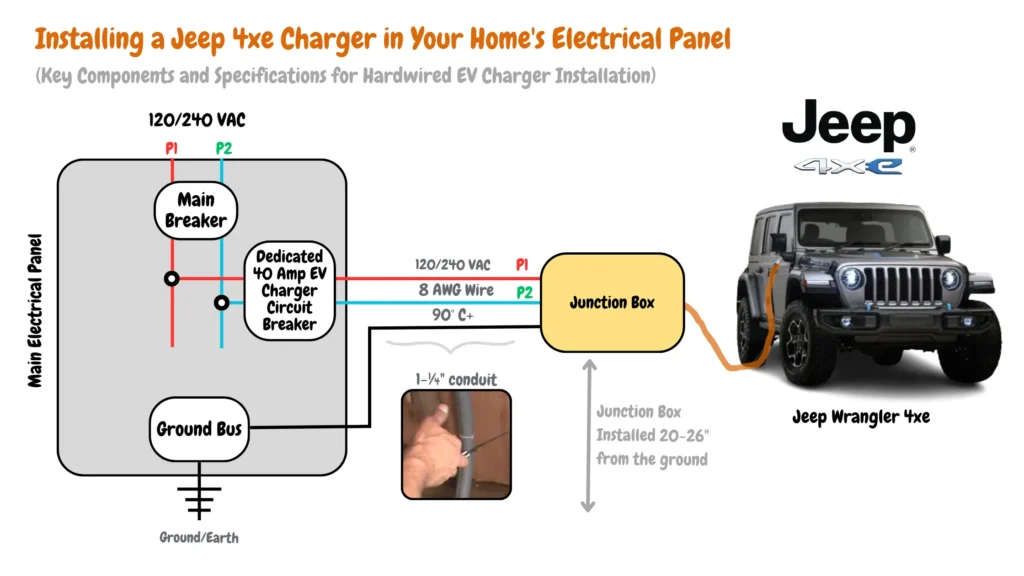
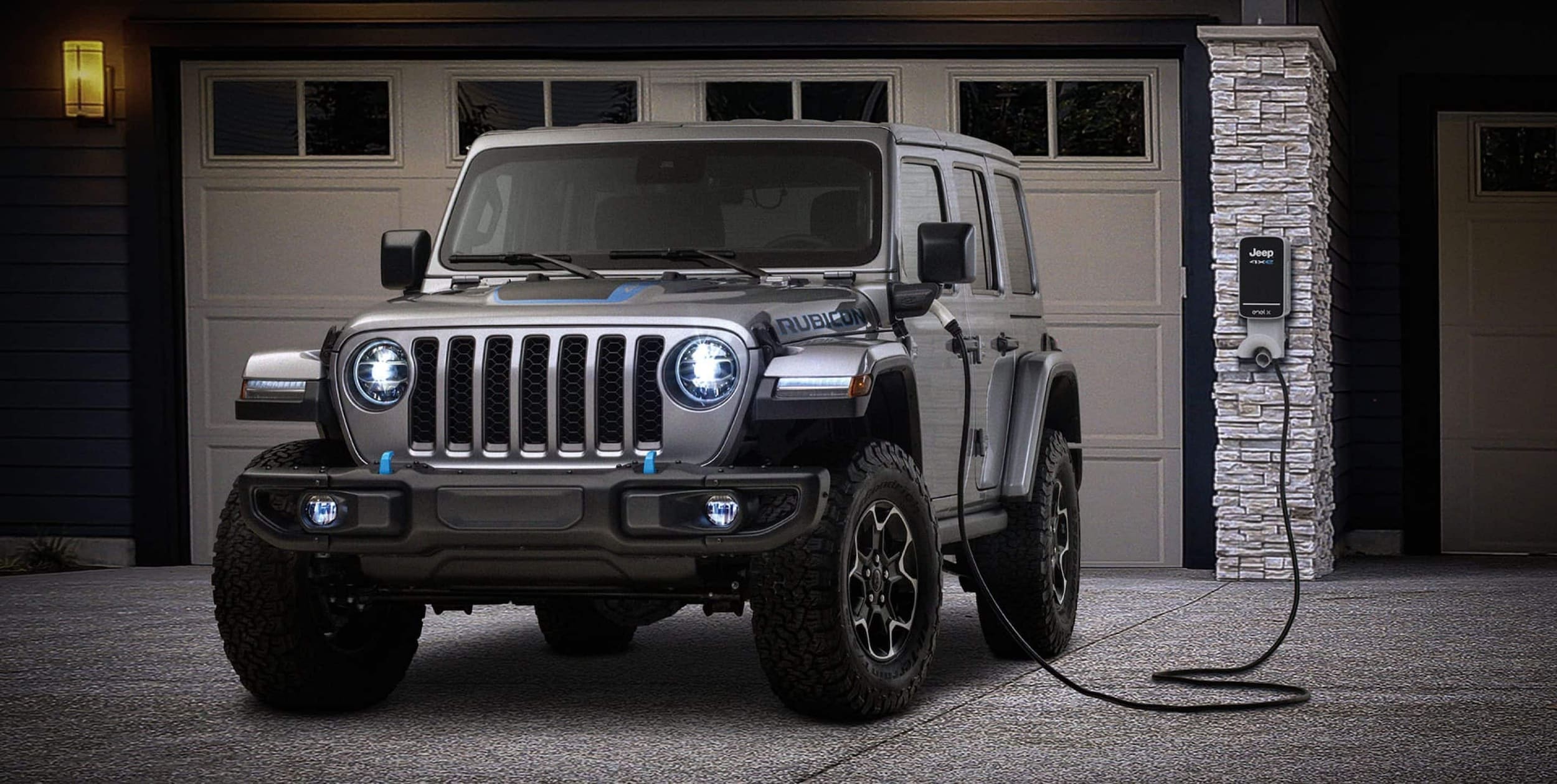
- A compatible 240-volt Level 2 EVSE
- A public AC charging station with an SAE J1772 connector, either directly or through an appropriate station cable
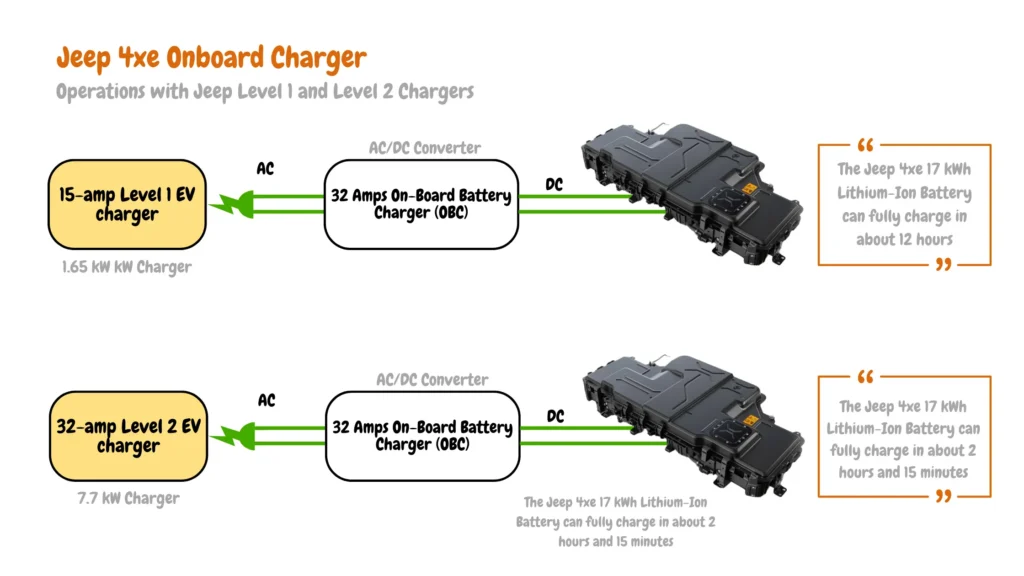
EVSE stands for electric vehicle supply equipment. It controls and monitors the electricity delivered to the vehicle; it is commonly called an EV charger, although the actual battery charger is built into the Jeep.
The 2024 Jeep 4xe uses AC charging through a J1772-style connection. It is not designed for DC fast-charging stations that use CCS or NACS connectors.
Identify your Jeep 4xe model
The 2024 U.S. lineup includes plug-in hybrid versions of:
- Jeep Wrangler 4xe
- Jeep Grand Cherokee 4xe
Do not assume that charging times or battery-only range are identical between these vehicles. The onboard charger, battery capacity, software, climate conditions, battery temperature, and starting state of charge all affect the result.
Inspect the charging equipment
Before plugging in, check that:
- The cable and connector are dry and free of visible damage.
- The outlet or EVSE is correctly rated for the installation.
- The outlet is properly grounded.
- The connector is free of dirt, ice, moisture, and debris.
- The cable is not stretched, pinched, driven over, or exposed to standing water.
- No extension cord, power strip, or household adapter is being used unless Jeep specifically approves it for that equipment.
For a new 240-volt circuit, have a qualified electrician install the outlet or hardwired EVSE. The circuit must match the charging equipment and local U.S. electrical requirements.
How to Charge a 2024 Jeep 4xe at Home
The basic process is the same for Level 1 and Level 2 charging: park safely, open the charge port, connect the equipment, and confirm that charging has started.
Step-by-step charging instructions
-
Park the Jeep 4xe.
Put the vehicle in Park, switch it off, and make sure the parking brake is applied when appropriate. -
Locate the charging port.
The port location depends on the 4xe model. Open the charging-port door and remove the protective cap if your vehicle has one. -
Connect the charging equipment to power.
For Level 1 charging, plug the portable charging cable into the approved 120-volt outlet. For Level 2 charging, activate or connect the EVSE according to its instructions. -
Insert the vehicle connector fully.
Push the J1772 connector into the Jeep’s charging port until it is seated. Do not force it. The connector should remain secure during charging. -
Confirm the charging indicators.
The vehicle’s charge-port light, instrument cluster, or Uconnect system should indicate that charging has begun. The exact color and display message can vary by model, software version, and charging condition. -
Check the estimated completion information.
The dashboard or Uconnect system may show charging status, battery percentage, and an estimated time remaining. These estimates can change as the battery temperature and electrical conditions change. -
Leave the vehicle connected until the desired charge level is reached.
The Jeep’s charging system is designed to stop drawing energy when the battery reaches its programmed target or when the session ends. -
End the charging session before unplugging.
Unlock the vehicle if necessary, stop the session through the station or Uconnect system when required, and then press the connector-release button. -
Remove and store the connector.
Pull the connector straight out, replace the port cap, close the charge-port door, and store the cable in a dry location.
How to tell whether charging has started
Successful charging usually produces one or more of these signs:
- The charge-port indicator changes to a charging status.
- The instrument cluster displays a charging message.
- The Uconnect screen shows an active charging session.
- The portable cable or Level 2 EVSE shows a normal operating status.
- The battery state of charge begins increasing after several minutes.
A light that indicates connection but not active charging may mean that the vehicle is waiting for a scheduled charging time, the connector is not fully seated, the EVSE has detected an error, or the outlet cannot supply power.
Level 1 vs. Level 2 Charging for a 2024 Jeep 4xe
For most U.S. owners, Level 1 charging is convenient but slow, while Level 2 charging is substantially faster and better suited to daily use.
| Charging method | Typical U.S. power source | Practical use | Approximate charging experience |
|---|---|---|---|
| Level 1 | 120-volt household outlet | Overnight or occasional charging | Slowest option; a depleted battery may require much of a day |
| Level 2 | 208–240-volt EVSE | Daily home charging, workplaces, public stations | Usually completes a 4xe charge in a few hours, depending on model and conditions |
| DC fast charging | CCS or NACS station | Not supported by the 2024 Jeep 4xe | Do not attempt to use a DC fast charger |
Level 1 charging
Level 1 charging uses a standard 120-volt outlet. It can be useful when:
- You drive short distances each day.
- The Jeep remains parked overnight.
- You do not have access to a 240-volt circuit.
- You need an emergency or temporary charging option.
Level 1 charging may add only a limited amount of electric range per hour. A full charge from a very low battery can take approximately 12 hours or longer, depending on the model, outlet capacity, battery temperature, and charging conditions.
Use a dedicated, properly grounded outlet whenever possible. Avoid sharing the outlet with high-load appliances such as space heaters, refrigerators, compressors, or power tools.
Level 2 charging
Level 2 charging uses a 208- or 240-volt circuit and is generally the most practical home solution for a 2024 Jeep 4xe. Depending on the model and conditions, a full charge may take roughly 2.5 hours.
The actual time may be longer if:
- The battery is very cold or very hot.
- The vehicle is using energy for cabin heating or cooling.
- The charging station is power-limited.
- The electrical circuit is shared or configured below the EVSE’s maximum output.
- Charging begins with the battery management system balancing or conditioning the battery.
A Level 2 installation does not automatically make the Jeep charge faster than its onboard charger allows. The vehicle determines how much AC power it can accept.
Why a 240-volt outlet does not guarantee a specific charging time
Charging speed depends on the lowest-rated component in the system:
- The utility supply and circuit
- The outlet or hardwired EVSE
- The portable cable or charging station
- The Jeep’s onboard AC charger
- Battery temperature and state of charge
For example, installing a higher-rated EVSE will not necessarily reduce charging time if the 4xe’s onboard charger cannot accept additional power.
How to Use a Public Charging Station
A 2024 Jeep 4xe can use public AC charging stations equipped with a compatible J1772 connector. Public stations may require an app, account, payment card, or authorization through the station’s display.
Public charging steps
- Confirm that the station provides AC Level 2 charging, not DC fast charging.
- Check the connector for damage, dirt, ice, or moisture.
- Park so the cable reaches the Jeep without pulling or stretching.
- Follow the station’s instructions to start the session.
- Insert the connector completely into the Jeep’s charge port.
- Confirm the station and vehicle both show an active charging session.
- End the session through the station, app, or vehicle instructions.
- Remove the connector and return the cable to its holder.
Some public charging stations have a permanently attached J1772 cable. Others require you to use your own compatible charging cable. Check the station description before arriving.
Public-charging considerations
Public Level 2 charging may cost more than charging at home because the station operator can charge by energy used, time connected, session, or a combination of fees. Some stations also apply idle fees after charging ends.
The Jeep may continue to display a full or nearly full battery after the session ends, but the station may still consider the vehicle connected. Disconnect promptly when charging is complete if the station’s terms require it.
How to Schedule Charging in a Jeep 4xe
Scheduled charging can help you charge during preferred hours or take advantage of an electricity rate plan. Availability and menu names may differ between the 2024 Wrangler 4xe and Grand Cherokee 4xe.
Typical controls may be found in:
- The Uconnect touchscreen
- The vehicle’s charging or hybrid settings
- The Jeep mobile application, where supported
- The charging station’s own app or controls
A schedule can prevent immediate charging. If you plug in the vehicle and it does not begin charging, check whether a delayed-charge setting is active.
General scheduling process
- Connect the Jeep to the charging equipment.
- Open the charging, hybrid, or vehicle settings menu.
- Select the charging schedule option.
- Set the preferred start time and, if available, the departure or completion time.
- Save the settings.
- Confirm whether the schedule applies to the current location or all charging locations.
- Verify that the vehicle shows a scheduled or delayed-charging status.
If the vehicle must charge immediately, temporarily disable the schedule or select the immediate-charge option. A public charging station may also have its own schedule or authorization process, so check both systems.
Battery conditioning and departure settings
Some Jeep 4xe systems can prepare the vehicle for departure while it is connected to power. Cabin preconditioning can use electricity from the charging connection instead of using as much battery energy after you begin driving.
This function may depend on:
- The vehicle’s software
- Uconnect settings
- A saved departure time
- Whether the vehicle is plugged in
- Outdoor temperature
- The selected climate settings
Do not rely on a scheduled feature without confirming that the vehicle displays an active schedule and charging connection.

Charging While Driving: What eSave Does
A Jeep 4xe can use different hybrid driving modes, including an electric-priority mode and eSave-related settings. These modes do not replace plugging the vehicle into an external power source.
Depending on the selected setting, eSave may:
- Preserve the existing battery charge for later use.
- Prioritize the gasoline engine.
- Use the engine to maintain or increase battery charge within system limits.
Using the gasoline engine to charge the battery while driving generally consumes fuel and does not provide the same energy efficiency as charging from the electrical grid. If your goal is to begin a trip with a full high-voltage battery, plug in before driving rather than depending on engine-generated charging.
The vehicle may also change operating modes automatically when battery temperature, power demand, traction needs, or other system conditions require it.
How Much Does It Cost to Charge a Jeep 4xe?
You can estimate home charging cost with this formula:
Charging cost = electricity used in kilowatt-hours × utility price per kilowatt-hour
The electricity used from the wall is higher than the energy stored in the battery because charging has losses.
Hypothetical example
If a charging session uses 13 kWh from the wall and your electricity rate is $0.18 per kWh:
13 kWh × $0.18 = $2.34
This is an example, not a guaranteed 4xe charging cost. Your result depends on:
- Local utility rates
- Time-of-use pricing
- Charging losses
- Battery state of charge before charging
- Battery temperature
- Whether the vehicle is heating or cooling the cabin
- Public-station fees
Your utility bill or EVSE energy display may show the electricity drawn from the wall. That figure is more useful for cost calculations than the battery percentage alone.
Common Jeep 4xe Charging Problems and Fixes
Check the simplest and safest causes first. Stop using the equipment if you see overheating, melting, arcing, burning smells, exposed conductors, or repeated breaker trips.
The Jeep does not begin charging
Possible causes include:
- The connector is not fully inserted.
- The vehicle is locked in a way that prevents release or activation.
- Scheduled charging is enabled.
- The portable cable is not receiving power.
- The EVSE has reported a fault.
- The outlet or circuit breaker has no power.
- The charging port or connector is wet or contaminated.
Try this sequence:
- Confirm that the vehicle is in Park and switched off.
- Unplug and inspect the connector.
- Check the EVSE status lights or display.
- Confirm that the outlet has power without using an extension cord.
- Reconnect the equipment firmly.
- Disable scheduled charging temporarily.
- Check the Jeep instrument cluster for a specific warning.
- Try a known-compatible charging station if one is available.
If the problem occurs with multiple known-good charging sources, contact a Jeep dealer or qualified EV technician.
The charging session stops early
Possible causes include:
- A power interruption
- EVSE overheating or fault detection
- A tripped breaker
- An active charging schedule
- A public-station timeout or payment problem
- Excessive battery or connector temperature
- A vehicle warning that limits charging
Check the station status, electrical panel, charging schedule, and dashboard messages. Do not repeatedly reset a breaker that trips during charging; have the circuit inspected.
The charging cable is difficult to remove
The vehicle may lock the connector during an active session. End the session through the station or vehicle, unlock the Jeep, and use the connector-release button.
Never pull forcefully on the cable. If the connector remains locked, follow the emergency-release procedure in the 2024 Jeep owner’s manual or contact roadside assistance.
The Jeep charges more slowly than expected
Slower charging can be normal when:
- The battery is near full.
- The battery is cold or hot.
- The station supplies less power than expected.
- The circuit is shared or limited.
- Cabin climate control is operating.
- The EVSE or outlet has detected abnormal conditions.
Compare the result with another compatible Level 2 station. If charging remains unusually slow under similar conditions, have the vehicle and charging equipment evaluated.
A warning message appears
Record the exact message and any warning-light color. Do not continue using the system if the message concerns high-voltage battery safety, insulation, overheating, smoke, or electrical failure.
For a persistent warning, contact an authorized Jeep dealer. High-voltage battery and charging-system repairs require appropriately trained technicians.

Jeep 4xe Charging Safety Rules
Follow the safety instructions supplied with the vehicle and charging equipment. Key precautions include:
- Do not charge with a damaged cable, connector, outlet, or EVSE.
- Do not use an extension cord, travel adapter, or power strip unless explicitly approved by Jeep for that specific equipment.
- Keep connectors dry and do not handle them with wet hands.
- Do not charge in standing water or where water can collect around the connection.
- Do not place heavy objects on the charging cable.
- Keep children away from the connector and charging port.
- Do not modify the charging equipment.
- Use only a properly grounded outlet for Level 1 charging.
- Have a qualified electrician install or troubleshoot a 240-volt circuit.
- Stop charging if you smell burning, see smoke, hear repeated arcing, or notice unusual heat.
- Do not open or service high-voltage components yourself.
The portable charging cable may become warm during operation, but excessive heat, discoloration, melted plastic, or a hot outlet requires immediate attention.
Key Takeaways
- Charge a 2024 Jeep 4xe through a 120-volt Level 1 outlet or 208–240-volt Level 2 EVSE.
- Level 2 charging is usually the practical choice for daily home use.
- Use a compatible AC J1772 connection; the 2024 Jeep 4xe does not use DC fast charging.
- Confirm charging through the vehicle display, charge-port indicator, and EVSE.
- Check scheduled charging if the vehicle does not start immediately.
- Never use damaged equipment, unsuitable extension cords, or unapproved adapters.
- Contact a qualified electrician or authorized Jeep dealer for electrical faults and high-voltage warnings.
Frequently Asked Questions
How long does it take to charge a 2024 Jeep 4xe?
A 240-volt Level 2 charger can typically charge a 2024 Jeep 4xe in approximately 2.5 hours under suitable conditions. A 120-volt household outlet may take about 12 hours or longer from a low battery. Exact times vary by model, battery temperature, starting charge level, circuit capacity, and charging equipment.
Can I charge a 2024 Jeep 4xe with a Tesla charger?
Only if the charging station provides a compatible AC connection and you use an appropriate, safety-compliant adapter that is approved for the specific equipment and vehicle. A Tesla Supercharger is a DC fast charger and is not compatible with the 2024 Jeep 4xe. Do not assume that an adapter makes every Tesla-branded station suitable.
Can I charge a Jeep 4xe in the rain?
The vehicle and approved charging equipment are designed for normal outdoor use when connected correctly, but you should not charge in standing water or handle the connector with wet hands. Keep the connection away from flooding, damaged outlets, and water accumulation. Follow the Jeep and EVSE manufacturer safety instructions.
Should I charge the Jeep 4xe after every drive?
Charging after each drive is useful if you want to maximize electric driving for your next trip. Plug-in hybrids do not need to be fully depleted before charging. You can connect the vehicle whenever convenient, provided the equipment and circuit are safe.
Why does my Jeep 4xe say it is plugged in but not charging?
The most common explanations are a scheduled-charge setting, an incompletely inserted connector, an EVSE fault, an unpowered outlet, or a public-station authorization problem. Check the charging schedule, connector seating, EVSE indicators, circuit breaker, and dashboard message before trying another compatible charging source.
Conclusion
To charge a 2024 Jeep 4xe, park the vehicle, connect approved AC charging equipment to the vehicle’s J1772 port, and verify the charging status on the Jeep and EVSE. Level 1 charging works from a properly grounded 120-volt outlet, while a 240-volt Level 2 EVSE normally provides a much faster charge for daily use.
For the safest setup, follow the 2024 Wrangler 4xe or Grand Cherokee 4xe owner’s manual, use equipment rated for the installation, and involve a qualified electrician for any new 240-volt circuit or electrical fault.