

Jeep P0622: Causes, Symptoms And Fixes
 Reading Time: 11 minutes
 For Jeep owners in the United States, P0622 generally means the vehicle has detected a problem with the generator field control circuit—the electrical circuit used to control alternator output. A scan tool may describe it as “Generator Field ‘F’ Control Circuit Malfunction.” Some Jeep service information uses manufacturer-specific wording, such as “Generator Field Not Switching Properly.”
P0622 does not automatically mean the alternator needs replacement. Damaged wiring, loose connectors, poor grounds, a charging-system component failure, or a control-module problem can produce this code. The correct diagnostic procedure depends on your Jeep’s model year, engine, and charging-system design.
If the battery warning light is on, the headlights are dimming, or the engine is beginning to stall, stop somewhere safe. An actual charging failure can leave the vehicle running only on stored battery energy until it shuts down.

What Does P0622 Mean on a Jeep?
P0622 identifies a generator field-control fault, not simply a weak battery or low charging voltage. It is a generic powertrain diagnostic trouble code, but Jeep-specific detection conditions and repair procedures vary.
An alternator produces electricity while the engine runs. On conventional alternators, electrical current through the rotor’s field winding helps determine how much output the alternator produces. A regulator or vehicle control module manages that current.
Depending on the Jeep’s configuration, the powertrain control module, or PCM, may directly control aspects of the field circuit or participate in a different charging-control arrangement. When the monitored circuit does not behave as expected, the module can store P0622.
Why the exact vehicle matters
A diagnostic procedure for an older Jeep Wrangler should not automatically be applied to a newer Grand Cherokee, a diesel model, or a Jeep with an electrified powertrain.
Before choosing a test procedure, identify:
- Model year and model.
- Engine and powertrain type.
- Vehicle identification number, or VIN.
- Whether the alternator or battery was recently replaced.
- All stored, pending, and permanent diagnostic codes.
- Any battery, charging, or stop/start warning messages.
For a Jeep 4xe or another electrified configuration, use the exact factory procedure. Do not assume that conventional alternator tests apply to its low-voltage charging system.
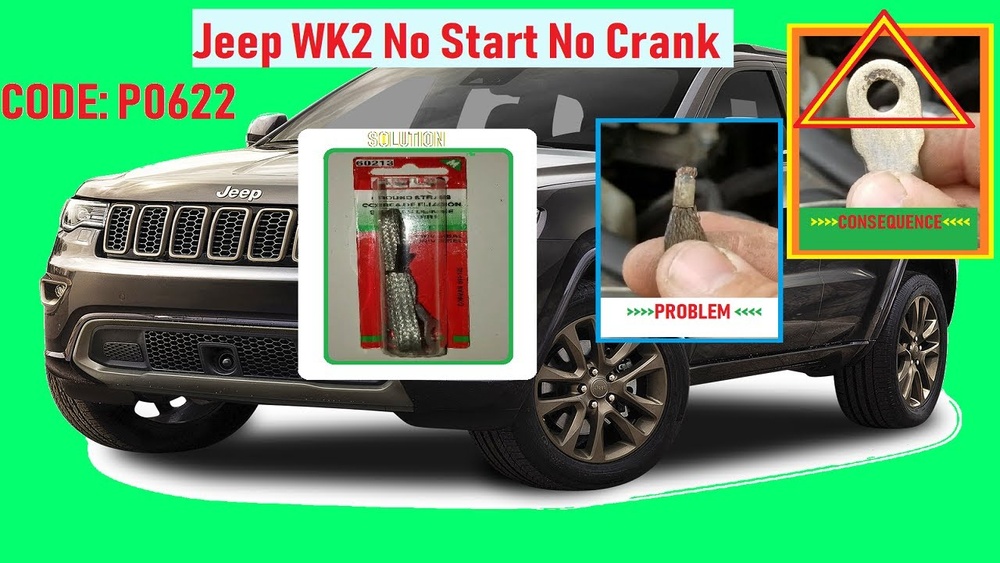
Symptoms of a Jeep P0622 Code
Symptoms can range from an illuminated check-engine light to a vehicle that loses electrical power. The code alone does not establish how severely charging performance is affected.
Possible symptoms include:
| Symptom | What it may indicate | Practical response |
|---|---|---|
| Check-engine light with otherwise normal operation | A detected circuit fault that may be intermittent | Schedule diagnosis and check for companion codes |
| Battery or charging warning light | A possible charging-system malfunction | Stop safely and assess whether continued driving is appropriate |
| Slow cranking or repeated dead battery | An undercharged battery, battery failure, or another electrical problem | Test both battery condition and charging operation |
| Lights that dim or fluctuate | Unstable voltage, excessive resistance, or changing electrical load | Inspect connections and measure system behavior |
| Several electrical warnings appearing together | Low system voltage may be affecting multiple modules | Diagnose the power-supply problem before replacing unrelated components |
| Engine stalls or will not restart | available battery energy may be depleted | Arrange roadside assistance or towing |
These symptoms are not unique to P0622. A battery can fail independently, and loose battery connections can create symptoms that resemble an alternator failure.

What Causes P0622 on a Jeep?
The main possibilities are a field-circuit wiring problem, a defective charging component, or a control problem. Inspection and testing should determine which one applies.
Damaged field-control wiring or connectors
An open circuit, short circuit, loose terminal, or corroded connector can prevent the generator field circuit from operating correctly.
Look particularly closely at:
- Wiring near the alternator.
- Harness sections exposed to engine movement.
- Connectors disturbed during recent repairs.
- Areas exposed to oil, coolant, road salt, or water intrusion.
A connector can look properly attached while a terminal inside it has poor contact.
Alternator or regulator failure
An internal field-winding fault or a regulator problem can trigger P0622 on an applicable system.
However, an alternator that fails a basic charging check still requires supporting diagnosis. Its output can be affected by missing control signals, poor grounds, or excessive resistance in the main charging cable.
Power-supply or ground problems
Loose battery terminals, damaged ground straps, or a high-resistance charging connection can interfere with charging operation.
A weak battery is also relevant because it affects the vehicle’s electrical condition, but P0622 is not a battery-replacement instruction. Battery condition and field-circuit operation should be evaluated separately.
Incorrect replacement parts or installation
A replacement alternator may fit physically without having the correct electrical configuration. Connector damage, unsecured terminals, or wiring routed against a hot or moving component can also create a post-repair fault.
Match replacement parts to the exact vehicle application rather than appearance alone.
Control-module or software problems
A PCM driver fault or an applicable software issue is possible on some configurations. These should generally be investigated after the relevant wiring, power supplies, grounds, and charging components have been tested.
A technical service bulletin is useful only if its vehicle coverage and conditions match your Jeep.
Can You Drive a Jeep With P0622?
Do not assume it is safe to continue driving until charging operation is checked. P0622 can be intermittent, but a genuine charging failure can eventually cause a stall and prevent restarting.
Use the vehicle’s symptoms to guide the immediate decision:
- Battery warning light, dimming lights, electrical resets, or stalling: Pull over safely and arrange assistance.
- Burning smell, smoke, or unusually hot electrical connections: Stop driving. Do not touch suspect components.
- Check-engine light only, with normal operation: Arrange prompt diagnosis. Normal starting does not prove the charging system is healthy.
There is no dependable mileage or driving-time estimate after an alternator stops charging. Remaining operation depends on battery condition, state of charge, electrical demand, and vehicle design.
Do not switch off equipment needed for safe driving, such as headlights or windshield wipers, simply to stretch battery life.
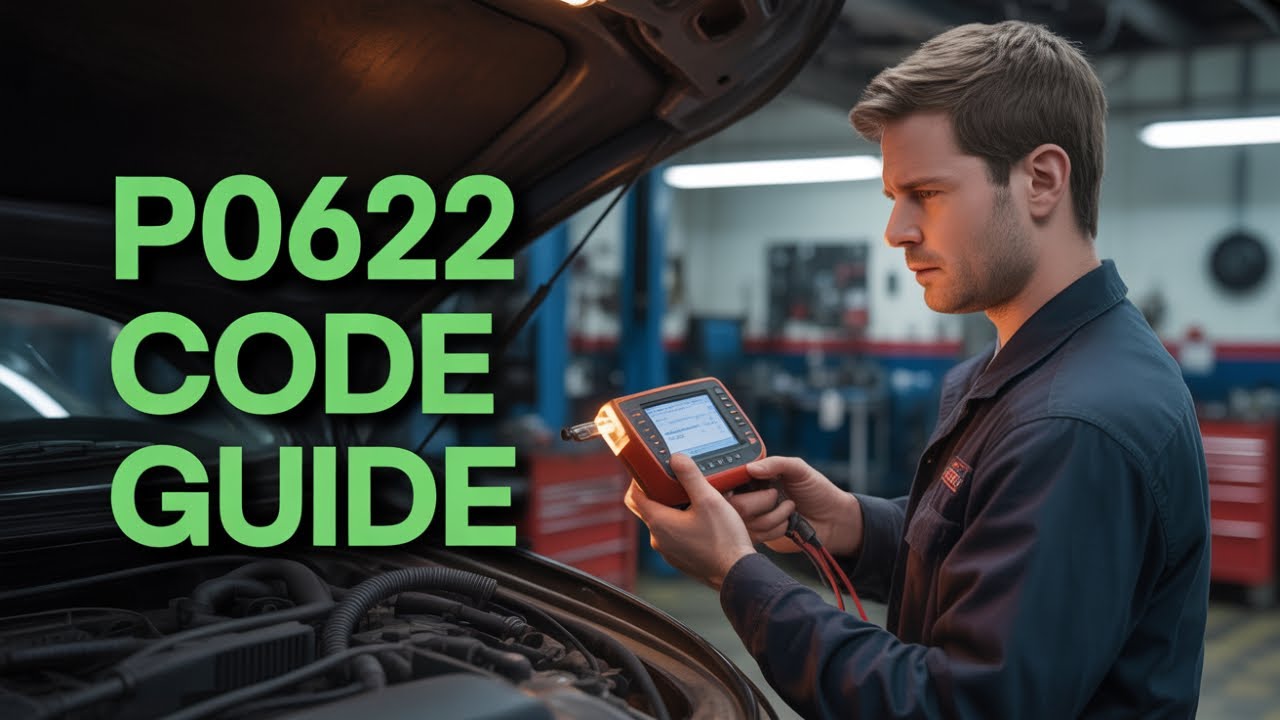
How to Diagnose Jeep P0622 Step by Step
Start with vehicle identification, saved scan data, and a visual inspection before replacing parts. Circuit-level diagnosis then requires the correct wiring diagram and model-specific test procedure.
Prerequisites and safety precautions
Useful equipment includes:
- An OBD-II scan tool that can read stored and pending codes.
- A digital multimeter.
- A suitable battery tester.
- Factory service information for the exact vehicle.
- Proper back-probing equipment for circuit tests.
Park on level ground, apply the parking brake, and keep tools, clothing, and hands away from belts and fans. Cooling fans can start unexpectedly.
Never disconnect a battery cable with the engine running to “test the alternator.” That method can create voltage disturbances and damage electronics.
Do not probe orange high-voltage wiring or components on an electrified Jeep. If access or testing involves the high-voltage system, use a qualified technician.
1. Save every code before clearing anything
Record:
- The exact P0622 description.
- Stored and pending codes.
- Freeze-frame data, when available.
- Whether the fault appeared after starting, during driving, or after repairs.
Related voltage, communication, or generator-control codes can change the diagnostic sequence. Clearing the codes first removes useful evidence.
2. Inspect the belt, terminals, wiring, and grounds
With the engine off, inspect the applicable drive belt and charging-system connections.
Check for:
- Loose or corroded battery terminals.
- Missing or damaged ground straps.
- A loose alternator connector.
- Broken connector locks.
- Chafed, stretched, or heat-damaged wiring.
- Evidence of recent work near the alternator.
If testing reveals a blown fuse or fusible link, identify the reason before replacing it. Never install a higher-rated fuse to prevent repeated failure.
3. Test battery condition
A discharged or defective battery can complicate charging-system diagnosis.
As general context, a fully charged conventional 12-volt lead-acid battery often measures approximately 12.6 volts at rest. That figure is not a universal pass/fail threshold: temperature, battery chemistry, surface charge, and the time since charging all affect the reading.
A voltage reading alone does not establish battery capacity. Use an appropriate battery test, and charge or replace the battery only when the results justify it.
4. Check charging performance using the correct procedure
On many traditional systems, battery-terminal voltage rises into roughly the 13.5- to 14.8-volt range while charging. Modern variable-voltage systems may operate outside that range under normal conditions.
Therefore, do not condemn the alternator from a single idle-voltage reading.
The proper test may require:
- A specified engine speed.
- Defined electrical loads.
- Battery temperature or state-of-charge information.
- Scan-tool charging commands or data.
- Comparison with the factory specification.
A normal voltage reading during one brief test does not rule out an intermittent P0622 fault.
5. Check voltage drop under load
Voltage-drop testing can reveal resistance in cables and connections that appear normal during a visual inspection.
The technician measures voltage across the relevant positive-side and ground-side paths while current is flowing. The exact test points, loads, and acceptable limits must come from the vehicle’s service information.
This distinction matters: a continuity test can pass even when a cable or connection cannot carry operating current properly.
6. Test the generator field circuit
Use the factory wiring diagram to identify the field circuit and its control arrangement.
Depending on the vehicle, testing may include:
- Checking circuit continuity with the required components disconnected.
- Checking for a short to ground or power.
- Inspecting connector terminal tension.
- Comparing commanded generator operation with the circuit response.
- Checking a pulsed control signal with suitable equipment.
Do not apply battery voltage directly to a PCM-controlled field terminal unless the factory procedure explicitly instructs it. Incorrect testing can damage a module.
A basic multimeter may show an averaged value on a pulsed circuit rather than reveal the actual signal behavior. Some faults require a capable scan tool or oscilloscope.
7. Repair the confirmed fault and verify operation
After the repair:
- Confirm battery condition and charge level.
- Clear erasable codes as directed.
- Repeat the prescribed charging and circuit checks.
- Operate the vehicle under appropriate conditions.
- Recheck for stored and pending codes.
Signs of success include correct charging behavior, no recurring warning symptoms, and no returning active or pending P0622 fault.
If the code returns, investigate whether it depends on heat, vibration, moisture, or electrical load. Do not simply replace the next component in the circuit.
How to Avoid Unnecessary Alternator and PCM Replacement
The most useful repair question is: “What test proved this component failed?” P0622 identifies a fault area, not a guaranteed replacement part.
Use this table when discussing a diagnosis:
| Test finding | What it supports | Appropriate next step |
|---|---|---|
| Connector or wire damage is found | A possible circuit fault | Repair correctly, then retest |
| Excessive charging-cable or ground voltage drop | A high-resistance connection or cable | Repair the affected path |
| Correct control and supply conditions, but the alternator fails its specified test | A probable alternator fault | Replace the correct unit and verify |
| Field-circuit readings fail the factory test | A wiring, component, or control fault depending on the result | Follow the diagnostic branch |
| Wiring and alternator pass, but module control fails the specified test | A possible module-related fault | Confirm all prerequisites before replacement |
| Code appears after an alternator replacement | Installation, compatibility, wiring, or an unresolved original fault | Recheck the repair rather than assuming another bad alternator |
A PCM replacement deserves particular scrutiny because programming or vehicle configuration may be required. Replacing a module without identifying a shorted circuit can leave the original fault unresolved.
What determines repair cost?
The repair may involve a connector, wiring, an alternator, or more complex diagnosis. A single national price estimate would conceal those differences.
Request an itemized estimate covering:
- Diagnostic labor.
- The verified fault.
- Part number and application.
- Repair labor.
- Required programming, if any.
- Post-repair testing.
A recent replacement part may also have a parts or labor warranty, so retain the invoice.

Evidence Scope and Useful Reference Sources
Exact Jeep service information takes priority over a generic P0622 description. This guide explains a general diagnostic approach; it does not provide a universal pinout, test threshold, or alternator specification.
Live browsing was not available for this article. Current competitor pages, model-specific bulletins, recall applicability, and repair prices were therefore not verified. No hands-on testing is claimed.
For vehicle-specific information, use:
- Mopar owner resources for owner’s manuals and warning-light guidance.
- Stellantis Technical Information for applicable service information and diagnostic procedures.
- NHTSA’s recall lookup to check open safety recalls by VIN.
A recall search does not diagnose P0622. Likewise, a service bulletin describes a covered condition; it does not prove that condition caused your vehicle’s fault.
Next-question coverage map
The following needs are inferred from the troubleshooting task, not claimed as observed search demand.
| Question | Reader stage | Basis | Competitor coverage | Reader benefit and evidence needed | Priority and placement |
|---|---|---|---|---|---|
| Can I keep driving? | Before diagnosis | Inferred from possible charging failure | Not checked | Avoid a stall; use symptoms and vehicle guidance | High; driving-safety section |
| Does normal voltage rule out P0622? | During diagnosis | Inferred from intermittent and variable-voltage operation | Not checked | Avoid a false diagnosis; use factory test conditions | High; charging-test section |
| Why did the code return after replacement? | After repair | Inferred from circuit-versus-component distinction | Not checked | Avoid repeat parts replacement; verify installation and circuit tests | High; repair decision table |
| Does a 4xe use the same procedure? | Before testing | Inferred from differing powertrain architecture | Not checked | Prevent unsafe or inapplicable testing; use exact service information | High; vehicle context and safety |

FAQs About Jeep P0622
Can disconnecting the battery fix P0622?
No. Disconnecting the battery may erase some stored information or reset certain systems, but it does not repair a damaged circuit or defective charging component. Save diagnostic information before any reset.
Will a jump-start solve the problem?
A jump-start may start a Jeep with a discharged battery, but it does not establish why the battery discharged. If charging is inadequate, the vehicle may stall again. Follow the exact jump-start procedure in the owner’s manual.
Can a basic OBD-II scanner diagnose the entire problem?
Usually not. A basic scanner can identify the code and may display freeze-frame data, but it generally cannot perform all generator-control tests or inspect a circuit electrically. Full diagnosis may require enhanced scan functions and electrical testing.
Does P0622 mean my Jeep has an alternator recall?
No. A diagnostic code does not establish recall coverage. Check the VIN through NHTSA and Jeep owner resources. Recall eligibility depends on the specific vehicle and campaign.
Can a permanent P0622 remain after a successful repair?
Yes, if the vehicle supports permanent diagnostic trouble codes. A permanent code generally remains until the vehicle’s onboard monitoring confirms that the fault is no longer present. It is not necessarily evidence that the repair failed, but active or pending codes and charging behavior still need to be checked.
Conclusion
Jeep P0622 points to a generator field-control problem, not an automatic alternator replacement. Start by saving scan data, identifying the exact vehicle, and inspecting the battery connections, grounds, belt, and alternator wiring. Then follow the correct factory tests for charging performance and the field circuit.
If charging warnings, dimming lights, or stalling accompany the code, stop safely and arrange assistance. Otherwise, schedule a diagnosis and ask for the test results that justify the repair.