Jeep Check Engine Light Codes: Meanings And Fixes
 Reading Time: 14 minutes
 Introduction
For Jeep vehicles sold in the United States, a check engine light—officially called the malfunction indicator lamp (MIL)—means the onboard diagnostics system detected a problem involving the engine, emissions system, fuel system, transmission controls, or related electronics. The light itself does not identify the failed part. A diagnostic trouble code (DTC) must be retrieved with an OBD-II scanner and interpreted alongside symptoms, freeze-frame data, wiring checks, and manufacturer service information.
A steady check engine light often permits careful driving to a repair facility when the Jeep runs normally. A flashing check engine light usually indicates an active misfire that can damage the catalytic converter. Reduce speed, avoid heavy acceleration, and stop driving if the vehicle is shaking, losing power, overheating, or producing smoke.
This guide explains common Jeep check engine light codes, how to read them, what they can and cannot prove, and how to choose the safest next diagnostic step for U.S.-market Jeep models.
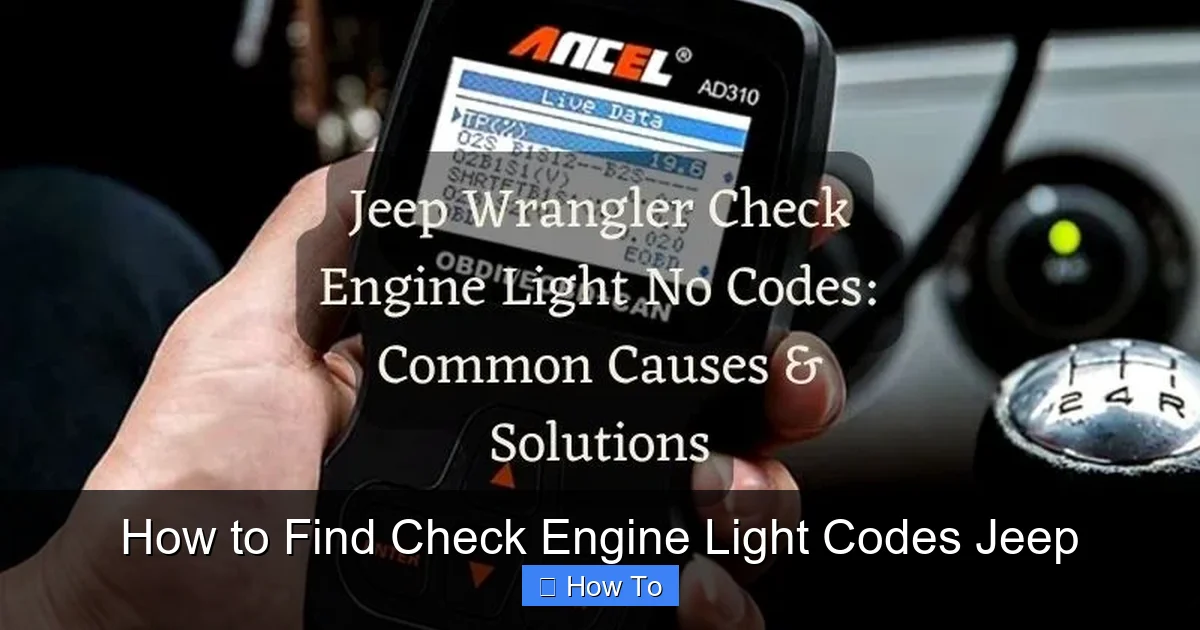
Quick Answer: What Should You Do When a Jeep Check Engine Light Comes On?
- Check whether the light is steady or flashing.
- Inspect and tighten the fuel-filler cap, unless your Jeep uses a capless or differently designed fuel system.
- Scan the Jeep for stored, pending, and permanent codes.
- Record the code, freeze-frame data, mileage, and symptoms before clearing anything.
- Diagnose the system identified by the code instead of automatically replacing the named sensor.
- Repair the root cause, clear the code only after repairs, and complete the required drive cycle.
- Seek professional help immediately for a flashing light, severe misfire, overheating, low oil pressure, unsafe drivability, or major power loss.
A code such as P0300 identifies an engine misfire condition, but it does not automatically prove that the spark plugs, ignition coils, fuel injectors, or engine itself is defective. A code such as P0456 indicates a small evaporative-emissions leak, which may involve a loose cap, damaged hose, purge valve, vent valve, or leak-detection component.
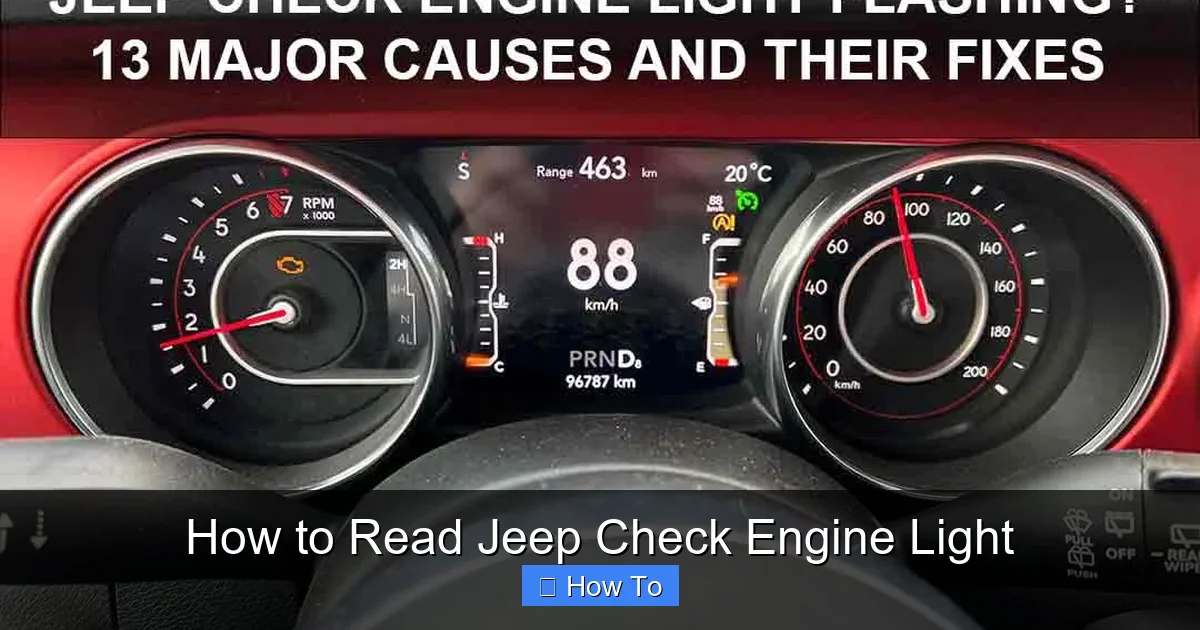
What Jeep Check Engine Light Codes Mean
Jeep check engine light codes are part of the standardized OBD-II diagnostic system used on U.S. vehicles. Jeep may display additional manufacturer-specific information, but the basic code format follows common industry conventions.
A typical code contains one letter and four numbers:
| Code position | Meaning |
|---|---|
| First character | System category |
| Second character | Whether the code is generic or manufacturer-specific |
| Third character | Subsystem |
| Last two characters | Specific fault or operating condition |
The first letter
- P — Powertrain, including the engine and transmission
- B — Body systems, such as airbags, power windows, or climate controls
- C — Chassis systems, such as steering, suspension, or some brake-related systems
- U — Network or communication systems between electronic control modules
Most check engine light questions involve P codes, but a Jeep may store U or B codes that help explain warning lights, starting problems, or electrical faults.
The second character
- 0 — Generic SAE code used across many vehicle brands
- 1 — Manufacturer-specific code
- 2 or 3 — Additional code ranges that vary by system and application
A generic code has a common definition, but its diagnostic procedure can still vary by Jeep engine, model year, transmission, and emissions configuration.
The third character
The third character narrows the affected area:
- 1 — Fuel or air metering
- 2 — Fuel or air metering, depending on the code family
- 3 — Ignition or misfire
- 4 — Auxiliary emissions controls
- 5 — Vehicle speed or idle control
- 6 — Computer and output circuits
- 7 or 8 — Transmission
- 9 — Reserved or manufacturer-defined functions
The exact meaning should be verified against the Jeep’s service information or a reliable scan-tool database. Code definitions can differ in detail across engines and model years.
Stored, pending, and permanent codes
A scanner may report several types of codes:
- Stored or confirmed code: The fault met the conditions required to turn on the warning light or record a confirmed failure.
- Pending code: The system detected a problem, but it may not have occurred often enough to confirm it.
- Permanent code: The vehicle’s computer retains evidence of an emissions-related fault until the system verifies that the problem has been repaired. A scan tool generally cannot erase it immediately.
A code that disappears after several trips may still matter. Intermittent wiring, loose connections, temperature-related faults, and fuel-vapor leaks can be difficult to reproduce.
How to Read Jeep Trouble Codes
The most useful first step is to retrieve the codes without erasing them. Many U.S. auto-parts stores offer basic code reading, but a simple reader may not access all Jeep modules or manufacturer-specific data.
What you need
For basic powertrain codes, you may need:
- An OBD-II code reader or scan tool
- The Jeep’s owner’s manual
- A safe, well-ventilated work area
- A notebook or phone for recording codes and data
- Battery voltage within the normal operating range
Use a scan tool that supports the Jeep’s model year and engine. A low-cost reader may display only generic P0 codes, while a more capable tool may access manufacturer-specific P1 codes, ABS, airbag, body, transmission, and network modules.
Where the diagnostic connector is located
The OBD-II connector is usually beneath the driver-side dashboard near the steering column. Exact placement varies by Jeep model and year. Do not force the connector, and do not use a damaged cable or tool that causes the vehicle’s electrical system to behave abnormally.
Basic scanning procedure
- Park safely, set the parking brake, and switch off unnecessary electrical loads.
- Plug the scan tool into the OBD-II connector.
- Turn the ignition to the key-on position without starting the engine, unless the tool instructs otherwise.
- Select the option to read diagnostic trouble codes.
- Record every stored, pending, and permanent code.
- Save freeze-frame information if the tool provides it.
- Note the mileage, fuel level, weather, engine temperature, and driving conditions when the light appeared.
- Do not clear the codes until the information has been documented.
Freeze-frame data may show engine speed, coolant temperature, vehicle speed, fuel-trim values, throttle position, and other conditions present when the computer detected the fault. This information can be more useful than the code definition alone.
Why a basic code reader may not be enough
A generic scanner may not communicate with every Jeep module. This matters when the symptom involves:
- ABS or traction-control warnings
- Airbag warnings
- Electronic throttle faults
- Transmission issues
- Four-wheel-drive system faults
- Body-control-module problems
- Communication errors
- Security or immobilizer issues
A full-system scan may be necessary when multiple warning lights appear or when the Jeep will not start.
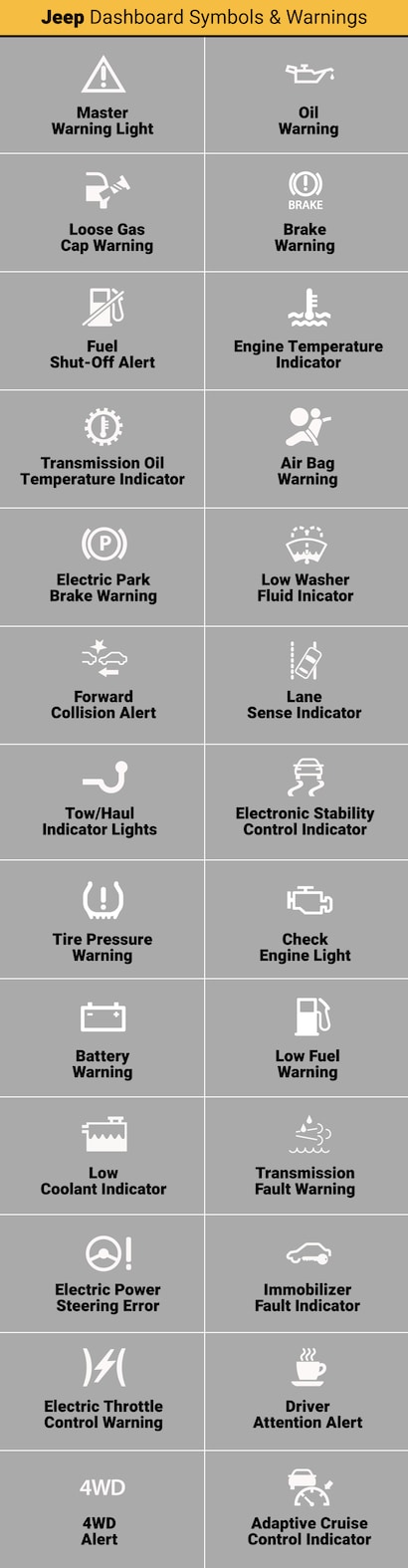
Common Jeep Check Engine Light Codes
The following codes are common across many Jeep vehicles, but the most likely cause depends on the engine, model year, mileage, maintenance history, and other codes present.
| Code | General meaning | Common possibilities | Best first check |
|---|---|---|---|
| P0300 | Random or multiple-cylinder misfire detected | Ignition problem, fuel delivery issue, vacuum leak, low compression, timing problem | Determine which cylinders are misfiring and whether the light is flashing |
| P0301–P0308 | Misfire detected on a specific cylinder | Spark plug, coil, injector, wiring, compression, intake leak | Swap-test the coil or plug only when appropriate and monitor whether the misfire follows |
| P0171 | System too lean, usually Bank 1 | Vacuum leak, unmetered air, weak fuel delivery, exhaust leak near sensor, inaccurate airflow measurement | Inspect intake hoses and look for fuel-trim patterns |
| P0174 | System too lean, usually Bank 2 | Vacuum leak, fuel-delivery issue, sensor or exhaust problem | Check for leaks and compare both banks |
| P0172/P0175 | System too rich | Excess fuel pressure, leaking injector, restricted air supply, sensor-data error | Check fuel-trim data, air filter condition, and fuel-pressure evidence |
| P0420 | Catalyst system efficiency below threshold, Bank 1 | Worn catalytic converter, exhaust leak, misfire damage, oxygen-sensor issue | Repair misfires and exhaust leaks before condemning the converter |
| P0430 | Catalyst system efficiency below threshold, Bank 2 | Similar causes on the opposite bank | Compare sensor signals and inspect the exhaust system |
| P0455 | Large evaporative-emissions leak | Missing or loose cap, disconnected hose, vent or purge problem | Inspect the cap, filler area, and visible EVAP hoses |
| P0456 | Small evaporative-emissions leak | Small hose crack, cap seal, purge valve, vent valve, tank leak | Perform an EVAP leak test if a visual inspection finds nothing |
| P0441 | Incorrect evaporative-emissions purge flow | Purge valve, hose routing, wiring, vacuum leak | Test purge operation and inspect hoses |
| P0128 | Coolant temperature below regulating temperature | Thermostat stuck open, coolant-temperature sensor, low coolant, wiring | Verify coolant level and compare actual temperature with scan data |
| P0117/P0118 | Engine coolant-temperature sensor circuit low or high | Sensor, connector, wiring, coolant contamination, control-module fault | Inspect the connector and compare resistance or scan data with actual temperature |
| P0700 | Transmission control system requested a malfunction indication | Transmission-related code stored in another module | Perform a transmission-module scan; P0700 is not the complete diagnosis |
| P0562 | System voltage low | Weak battery, alternator problem, poor connection, excessive electrical load | Test battery and charging voltage under appropriate conditions |
| P0601/P0606 | Control-module memory or processor fault | Voltage event, software issue, module fault, communication problem | Check battery and grounds before replacing a module |
P0300 and cylinder-specific misfires
Misfire codes deserve priority because continued misfiring can overheat and damage the catalytic converter. A flashing MIL is especially concerning.
A practical diagnostic sequence is:
- Confirm whether the misfire is current.
- Identify whether it affects one cylinder or several.
- Inspect the spark plug and ignition coil.
- If the design permits, move the coil or plug to another cylinder.
- Clear only after recording data, then recheck whether the misfire follows the component.
- Test fuel delivery, injector operation, compression, and valve timing if the misfire remains on the original cylinder.
A misfire that remains on one cylinder after swapping ignition components may point toward an injector, wiring fault, intake leak, compression problem, or mechanical timing issue.
P0171 and P0174 lean codes
Lean codes mean the control module is adding fuel because the measured mixture appears to contain too much air or too little fuel. The code does not prove that the oxygen sensor is defective.
Possible causes include:
- Cracked intake tubing
- Vacuum leaks
- Intake-manifold gasket leaks
- Inadequate fuel pressure
- Restricted fuel delivery
- Exhaust leaks ahead of an oxygen sensor
- Airflow measurement errors
- Unmetered air entering the engine
Fuel-trim data can help separate a vacuum leak from a fuel-delivery issue. If the fuel trims are much higher at idle and improve at higher engine speed, an intake or vacuum leak becomes more plausible. This is a diagnostic pattern, not a substitute for a smoke test or pressure test.
P0420 and P0430 catalyst-efficiency codes
These codes indicate that the computer calculated catalyst performance below its expected threshold. They do not automatically mean the catalytic converter must be replaced.
Before replacing an expensive emissions component, verify:
- The engine is not misfiring
- There is no exhaust leak near the oxygen sensors
- The correct sensors and wiring are installed
- Fuel-control problems have been repaired
- The code returns after a complete drive cycle
- No additional codes provide a more direct cause
A catalytic converter can be damaged by long-term misfire or an excessively rich mixture. Replacing the converter without repairing that underlying condition can lead to another failure.
P0455, P0456, and other EVAP codes
The evaporative-emissions system captures fuel vapors so they do not escape into the atmosphere. The system includes the fuel tank, vapor lines, purge valve, vent valve, seals, and leak-detection components.
A loose or damaged fuel cap is a reasonable first check when the code appears after refueling. If the cap is secure and the code returns, the Jeep may require an EVAP smoke test. Small leaks are often difficult to find by sight alone.
A Step-by-Step Jeep Check Engine Light Diagnosis
The best diagnostic process starts with the simplest safe checks and advances only when the evidence supports them.
Step 1: Assess drivability and warning-light behavior
Stop driving and arrange professional assistance if the light is flashing or the Jeep has:
- Severe shaking
- Major power loss
- Overheating
- Low oil-pressure warnings
- Smoke or a strong fuel smell
- Unusual knocking
- Unsafe braking or steering behavior
A steady light with normal operation is less urgent, but it still requires diagnosis.
Step 2: Check recent events
Ask what changed before the light appeared:
- Was the Jeep refueled?
- Was the battery disconnected or replaced?
- Was maintenance performed?
- Did the vehicle drive through deep water?
- Did the problem begin after an aftermarket electrical installation?
- Did the light appear during very cold or hot weather?
- Did the Jeep run out of fuel or receive contaminated fuel?
This context helps prioritize likely causes without treating coincidence as proof.
Step 3: Inspect basic items
With the engine off and cool where necessary, inspect:
- Fuel cap and filler-neck sealing area
- Battery terminals
- Engine and body grounds
- Air-intake tubing
- Vacuum hoses
- Electrical connectors
- Visible wiring near heat or moving parts
- Fluid levels specified in the owner’s manual
Do not disconnect connectors or move wiring around a running engine unless the procedure specifically calls for it.
Step 4: Scan and document all modules
Read all available modules, not only the engine computer, when the Jeep has several warning lights or electrical symptoms. Codes occurring together may reveal a common power, ground, or network problem.
Step 5: Test instead of guessing
Useful tests vary by code but may include:
- Battery and charging-system testing
- Smoke testing for intake or EVAP leaks
- Fuel-pressure testing
- Voltage-drop testing
- Oscilloscope testing of sensors or ignition signals
- Compression or leak-down testing
- Exhaust-backpressure testing
- Manufacturer-specific actuator tests
The correct test depends on the code and vehicle configuration. Replacing parts based only on a code description often increases cost without solving the fault.
Step 6: Verify the repair
After the repair:
- Confirm connectors, hoses, fasteners, and wiring are properly restored.
- Clear codes only when appropriate.
- Start the Jeep and check for immediate return of the light.
- Perform the required drive cycle under safe conditions.
- Rescan the vehicle.
- Confirm that readiness monitors have run and no relevant codes have returned.
A repair is not fully verified simply because the warning light turns off.
Should You Clear Jeep Check Engine Light Codes?
Clearing codes can erase useful diagnostic evidence and reset emissions-readiness monitors. It should generally be done after documenting the codes and completing the repair, not as the first response.
What happens when codes are cleared?
Clearing codes may:
- Turn off the MIL temporarily
- Delete freeze-frame information
- Reset fuel-trim learning
- Reset emissions monitors to “not ready”
- Remove evidence of an intermittent fault
- Make an emissions inspection impossible until the monitors complete
Disconnecting the battery may also erase learned information on some vehicles, but it is not a proper diagnostic or repair method. It can create additional issues with clock settings, radio settings, idle learning, and security systems.
Can a Jeep pass a U.S. emissions inspection after the light is cleared?
That depends on the state and the vehicle’s inspection rules. In many U.S. emissions programs, the vehicle must have enough readiness monitors completed and no disqualifying active fault. A recently cleared system may be rejected as not ready, even if the light is currently off.
Requirements differ by state, vehicle model year, and emissions program. Check the official motor-vehicle or environmental agency in the state where the Jeep is registered.
How long does it take for monitors to reset?
There is no single mileage or time guarantee. Monitor completion depends on the Jeep’s model, engine temperature, fuel level, ambient conditions, driving pattern, and the specific monitor. Use the manufacturer’s drive-cycle instructions when available, and do not attempt an aggressive drive cycle on public roads.

When a Jeep Check Engine Light Requires a Professional
Professional diagnosis is the safer choice when the light flashes, the Jeep has multiple module codes, or the repair involves fuel, high heat, emissions components, electronic throttle control, or internal engine testing.
Seek qualified help when:
- The same code returns immediately after a repair
- A misfire does not follow a swapped ignition component
- The Jeep has low compression or unusual mechanical noise
- A network code appears with multiple electrical symptoms
- The vehicle has no-start, stalling, or unexpected throttle behavior
- An EVAP leak cannot be located visually
- A catalyst code returns after misfire and exhaust checks
- The diagnosis points to a control module or software update
- You are working near fuel vapors, hot exhaust components, or moving belts
Ask the repair facility for the exact codes, test results, failed component, and reason the proposed repair addresses the root cause. A reputable diagnosis should distinguish a confirmed failure from a possible cause.
Common Mistakes When Diagnosing Jeep Codes
Replacing the sensor named in the code
A code may identify a circuit, operating condition, or system performance problem. It does not necessarily identify a failed sensor. Wiring, connectors, vacuum leaks, exhaust leaks, and mechanical faults can produce similar readings.
Treating a code definition as a complete diagnosis
“Catalyst efficiency below threshold” and “system too lean” describe what the computer observed. They do not provide every test needed to find the cause.
Clearing the light before recording data
Clearing the code can remove freeze-frame information and make an intermittent issue harder to reproduce.
Ignoring additional codes
The first displayed code may be a consequence rather than the root fault. For example, low system voltage can create several communication or sensor codes at once.
Continuing to drive with a flashing light
A flashing MIL generally indicates a severe enough misfire to threaten the catalytic converter. Continuing to drive can increase repair costs and may leave the Jeep unsafe to operate.
Assuming every Jeep uses the same code interpretation
Engine options, emissions equipment, software revisions, drivetrain configurations, and model years affect both code definitions and diagnostic procedures. Always verify the code against the exact Jeep VIN or configuration when possible.
Key Takeaways
- A Jeep check engine light code identifies a detected condition, not automatically a failed part.
- A steady light is less urgent than a flashing light, but both require diagnosis.
- Retrieve and record stored, pending, permanent, and manufacturer-specific codes before clearing them.
- P0300-series misfire codes should receive prompt attention, especially when the light flashes.
- P0455 and P0456 often involve the EVAP system, but a fuel cap is only one possible cause.
- P0420 and P0430 do not prove that the catalytic converter must be replaced.
- Battery voltage, grounds, wiring, and related codes should be checked before condemning electronic modules.
- Emissions readiness monitors may reset after codes are cleared, affecting state inspection results.
Frequently Asked Questions About Jeep Check Engine Light Codes
Can I drive my Jeep with the check engine light on?
If the light is steady and the Jeep runs normally, limited driving to a repair facility is often reasonable. Avoid driving if the light flashes or the vehicle shakes, loses substantial power, overheats, smells strongly of fuel, or shows low oil pressure.
Will a loose gas cap turn on a Jeep check engine light?
Yes, a loose, missing, damaged, or incorrectly fitted fuel cap can allow an evaporative-emissions leak and may trigger codes such as P0455 or P0456. If tightening the cap does not solve the problem, the EVAP system may need further testing.
Can I read Jeep codes without a scanner?
Some older Jeep vehicles may display limited information through specific ignition-key procedures, but this is not universal and may not reveal all stored modules or code details. An OBD-II scanner is the dependable method for retrieving diagnostic information on U.S.-market vehicles.
How do I know whether a Jeep code is serious?
The seriousness depends on the code, warning-light behavior, drivability, and related symptoms. Flashing MILs, misfires, overheating, low oil pressure, stalling, severe power loss, and fuel leaks require immediate attention. A steady EVAP code with normal operation is generally less urgent but should still be repaired.
Why did the check engine light return after I replaced a part?
The replacement part may not have been the root cause, the code may require a complete drive cycle to verify the repair, or the installed component may be incorrect or defective. Recheck the original code, related codes, wiring, connectors, and the test results that justified the replacement.
Does disconnecting the Jeep battery reset the check engine light?
It may erase some codes and learned values, but it does not repair the fault. It can also reset emissions monitors and create additional electronic inconveniences. Record the diagnostic information first and use the correct scan-tool procedure whenever possible.
Conclusion
Jeep check engine light codes are starting points for diagnosis, not automatic parts orders. The safest approach is to assess the warning-light behavior, retrieve all relevant codes, save freeze-frame data, inspect basic causes, and perform tests that match the exact Jeep model and engine. Treat a flashing light or severe drivability problem as urgent, and verify both the repair and emissions-monitor status before returning the Jeep to normal use.


![How To Fix ESP BAS Light on Jeep Liberty [5 Causes & Solutions]](https://jeepcorner.com/wp-content/uploads/2023/11/How-To-Fix-ESP-BAS-Light-on-Jeep-Liberty-5-Causes-Solutions-768x512.jpg)