
Is Jeep Compass Good In Snow: Winter Driving Guide
 Reading Time: 8 minutes
Yes—a Jeep Compass with four-wheel drive and suitable tires can handle snow well for everyday driving. But not every Compass has four-wheel drive, and the vehicle’s traction system cannot make worn tires, ice, or unsafe speeds harmless.
For U.S. drivers, the difference between a snow-covered neighborhood street and an icy mountain pass matters. Your Compass’s model year, drivetrain, tires, and ground clearance all affect how it performs. Check the owner’s manual for your exact vehicle before using a drive mode or fitting tire chains.

What makes a Jeep Compass capable in snow?
A Compass can be a useful winter vehicle when its equipment matches the conditions. Four-wheel drive can help the tires put power to the road when starting or climbing on snow, while the right tires help the vehicle turn and stop.
The key limit is that four-wheel drive does not provide extra grip for braking. It also cannot prevent a slide on ice. Tires, speed, and road conditions still set the limits.
Drivetrain matters
Compass equipment varies by model year and trim. Some versions have front-wheel drive; others have a 4×4 system. Newer models may also have Selec-Terrain settings, including a Snow mode, but features are not the same across all years and trims.
Use the vehicle’s original window sticker, VIN-based equipment details, or owner’s manual to confirm what your Compass has. Do not assume that a Jeep badge—or a Snow setting shown in another Compass—means your vehicle has the same drivetrain or controls.
Snow mode helps manage power
If your Compass has a Snow mode, it can adjust how the vehicle responds to help reduce wheelspin on slippery surfaces. The exact changes depend on the model and system. Snow mode is a support feature, not a substitute for winter tires or careful driving.
Use the mode as described in your owner’s manual. If the vehicle starts to slide, ease off the accelerator and steer smoothly toward the path you want to travel. Sudden braking, steering, or acceleration can make a loss of traction worse.

Which Jeep Compass is best for snow?
For regular winter driving, a Compass with 4×4 and a set of winter tires is generally better equipped than a front-wheel-drive model on all-season tires. A front-wheel-drive Compass can still work in light snow if it has good tires and you drive cautiously.
| Compass setup | What it can do in snow | Main limit |
|---|---|---|
| Front-wheel drive, all-season tires | Handle some plowed roads and light snow | Less help when starting or climbing on slippery roads |
| 4×4, all-season tires | Send power to more than one axle, depending on the system | Tires still determine much of the grip for turning and stopping |
| Front-wheel drive, winter tires | Gain better cold-weather and snow traction from the tires | Still lacks the added power delivery of 4×4 |
| 4×4, winter tires | Combine added drive traction with tires made for winter conditions | Cannot eliminate the risks of ice, deep snow, or poor visibility |
This is a practical comparison, not a promise of performance. Tire condition, snow depth, road slope, and the exact 4×4 system can change the result.
For a Compass used in places with frequent snow, such as parts of the Upper Midwest, Northeast, or Mountain West, winter tires can be a worthwhile upgrade. For occasional light snow on roads that are cleared quickly, good all-season tires may be enough for some drivers.

Are the tires more important than 4×4?
For many winter driving tasks, tires matter more than the drivetrain. 4×4 can help a vehicle move, but it does not create grip where the tires meet the road. Winter tires use tread and rubber designed for cold conditions, which can improve traction on snow and cold pavement.
Look for the three-peak mountain snowflake symbol on a tire if you need a tire that meets a snow-traction performance standard. That mark does not mean a tire is designed specifically for ice, nor does it guarantee safe driving in every storm. Check the tire maker’s guidance and your local needs.
Before winter, check:
- Tread: Replace tires that are worn or damaged. Low tread can reduce grip in snow and slush.
- Pressure: Check tire pressure when the tires are cold, and use the pressure listed on the driver-door label—not the maximum pressure printed on the tire.
- Matching tires: Use the same tire type and size as required by the vehicle maker. For 4×4 systems, mismatched tire sizes or wear can affect system operation.
- Seasonal fit: Consider winter tires if you regularly drive on snow, ice, or very cold roads.
If you are unsure whether your tires are safe or compatible, ask a tire professional to inspect them. The NHTSA tire safety guidance explains basic tire checks, and the Compass owner’s manual covers vehicle-specific requirements.

How to drive a Jeep Compass in snow
Drive more slowly than you would on dry pavement, leave extra room to stop, and make steering and pedal inputs smooth. Even a Compass with 4×4 can take much longer to stop on a slick road than on a clear, dry one.
- Clear the vehicle. Remove snow and ice from the windows, mirrors, lights, roof, and hood so you can see and avoid loose snow blowing onto other drivers.
- Choose the right setting. If your Compass has a Snow mode, use it only as directed in the owner’s manual.
- Accelerate gently. A light touch helps reduce wheelspin when pulling away or climbing.
- Leave more space. Increase your following distance and allow extra room for turns, stops, and lane changes.
- Avoid abrupt moves. Brake, steer, and accelerate smoothly. Do not rely on 4×4 to compensate for speed or poor traction.
- Stop if conditions exceed your ability. If visibility is poor or the road is too slippery, find a safe place to wait rather than pushing on.
The NHTSA winter driving guidance also recommends preparing your vehicle and adjusting how you drive for winter road conditions. Local rules may require snow tires or chains on certain roads. Check the rules and your owner’s manual before fitting chains, as not every tire and wheel setup allows them.

Where the Jeep Compass can struggle in snow
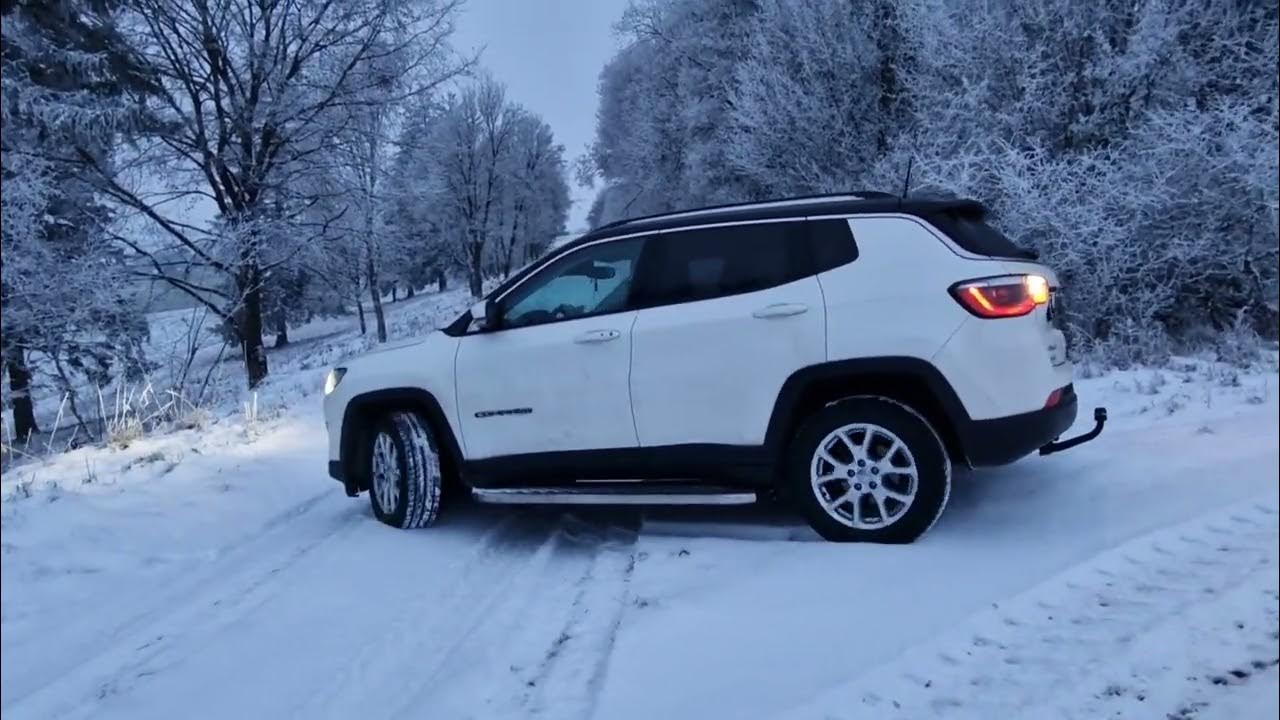
A Compass is a compact SUV, not a guarantee of passage through deep snow. Its ability to move through snow depends in part on ground clearance, tire size, and the depth and condition of the snow. Deep, heavy snow can leave the underside in contact with snow and reduce the tires’ ability to gain traction.
Ice is another major limit. A 4×4 system may help the Compass pull away, but it does not shorten stopping distances on ice or prevent a sideways slide. Black ice can be hard to see, so reduce speed when temperatures hover near freezing and road surfaces look wet or shiny.
Also consider the route, not just the vehicle. A steep, untreated driveway or rural road may be harder to manage than a flat city street after plows have passed. If the route looks unsafe, wait for road crews or choose a safer way to travel.
Common mistakes to avoid
- Assuming every Compass has 4×4: Confirm your vehicle’s drivetrain and features by model year and trim.
- Treating Snow mode as a safety guarantee: It can help manage traction, but it cannot overcome ice, worn tires, or excessive speed.
- Using summer or worn tires in winter: A capable drivetrain cannot make unsuitable tires grip well.
- Following too closely: Four-wheel drive does not make the vehicle stop faster on snow.
- Ignoring the manual: Drive modes, tire requirements, and chain fit can vary by model.
- Driving through snow deeper than the vehicle can handle: The vehicle may lose traction or become stuck if snow builds beneath it.
If the Compass repeatedly spins its wheels, pulls to one side, or shows a tire or drivetrain warning, stop when it is safe and check the owner’s manual. Do not keep accelerating to force the vehicle forward. If a warning stays on or handling feels abnormal, have a qualified repair shop inspect it.

FAQs
Is the Jeep Compass good in deep snow?
It can handle some deeper snow, but performance depends on the exact vehicle, tires, clearance, and snow depth. A compact SUV can become stuck if snow reaches the underside or blocks the path. Avoid driving through snow that is deeper than you can safely assess.
Is a front-wheel-drive Jeep Compass good in snow?
It can be adequate for light snow and cleared roads with suitable tires and careful driving. It has less help than a 4×4 Compass when starting or climbing on slippery surfaces. Winter tires can improve traction, but they do not turn a front-wheel-drive vehicle into a 4×4.
Does a Jeep Compass stop better with 4×4?
No. Four-wheel drive can help with power delivery, but it does not provide extra braking grip. Tires, road surface, speed, and following distance affect how safely the vehicle stops.
Should I use Snow mode on every winter road?
Not necessarily. Use Snow mode when conditions and your owner’s manual call for it. The setting may not be intended for dry roads, and the exact function varies by model.
Can I put chains on my Jeep Compass?
Only if chains or an approved traction device are allowed for your exact tire and wheel setup. Check the owner’s manual and local road rules first. Incorrect chains can damage the vehicle or interfere with its operation.
Conclusion
The Jeep Compass can be good in snow, especially when equipped with 4×4 and winter tires, but its capability depends on the specific vehicle and conditions. Confirm your drivetrain, check your tires, and follow the owner’s manual. Most of all, slow down and leave room to stop: no drive mode can cancel the limits of snow and ice.