How To Flat Tow A Jeep Wrangler JL Behind An RV: Guide
 Reading Time: 14 minutes
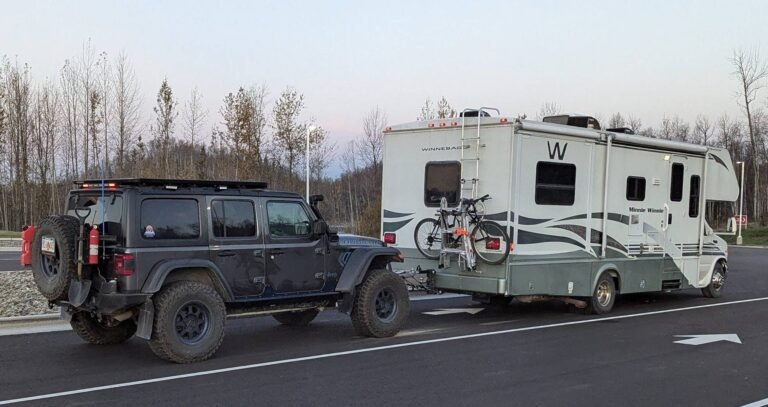
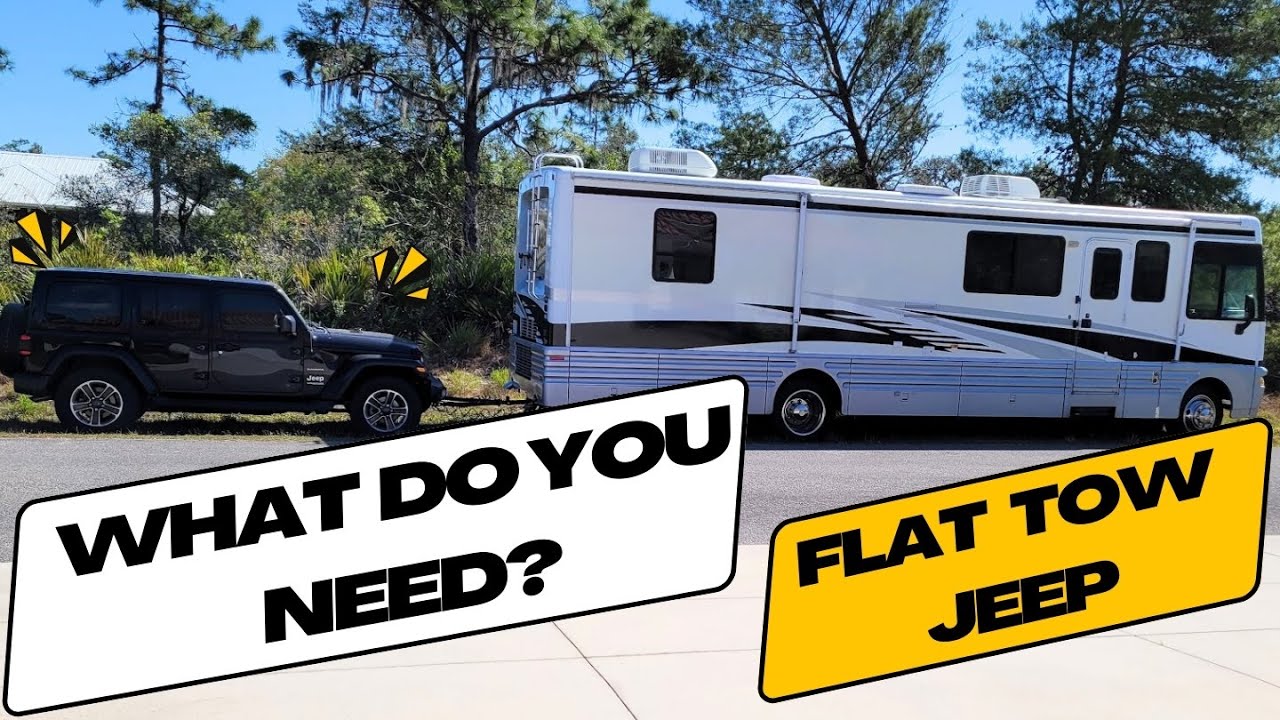
Flat towing a Jeep Wrangler JL behind a motorhome is possible when the Jeep has a compatible four-wheel-drive system and you follow the exact procedure in its owner’s manual. The basic setup uses a motorhome-rated tow bar, a model-specific base plate or tow-bar mounting system, safety cables, wiring for the Jeep’s rear lights, and a supplemental braking system.
The most important step is placing the Wrangler’s transfer case in Neutral. If the transfer case is not fully in Neutral, the Jeep’s drivetrain can suffer serious damage.
This guide covers Jeep Wrangler JL models sold in the United States, including common two-door and four-door versions. equipment, trim limits, battery instructions, and flat-tow steps can vary by model year. Always use the manual for your exact Jeep as the final authority.
Introduction: What You Need to Flat Tow a Wrangler JL
A safe flat-towing setup connects the Jeep to the rear of the RV with all four Jeep tires on the road. The Jeep’s wheels turn as the motorhome moves, but the transfer case disconnects the drivetrain so the transmission and axles do not run in a damaging way.
A complete setup normally includes:
- A motorhome-rated tow bar
- A base plate or approved tow-bar attachment system for the Wrangler JL
- Two safety cables or safety chains
- Wiring for the Jeep’s stop, tail, and turn lights
- A supplemental braking system
- A breakaway switch and cable
- Rated attachment points
- A hitch receiver with the correct rise or drop
- A locking tow-bar pin and receiver lock
- Optional rock guards, covers, and storage brackets
Do not use the Jeep’s factory recovery hooks as tow-bar attachment points unless the Jeep and tow-bar manufacturer specifically approves that setup. A recovery point is not automatically designed for the repeated pulling and braking forces created by an RV.

Is the Jeep Wrangler JL Flat Towable?
Most four-wheel-drive Jeep Wrangler JL models are designed for recreational towing with all four wheels on the ground. The exact instructions depend on the Jeep’s model year, transmission, transfer case, trim, and powertrain.
The JL is the Wrangler generation introduced for the 2018 model year in the United States. It includes:
- Two-door Wrangler models
- Four-door Wrangler Unlimited models
- Automatic-transmission models
- Manual-transmission models
- Rubicon and other four-wheel-drive trims
- Some hybrid and special-edition models
The word most matters here. Do not assume that every Wrangler-looking vehicle can be flat towed. A two-wheel-drive Wrangler, a vehicle with a modified drivetrain, or a model with special hybrid instructions may have different limits.
Check these items before buying towing equipment:
- Confirm that the Jeep has the required four-wheel-drive transfer case.
- Read the recreational towing section of the exact owner’s manual.
- Check the tow-bar and base-plate fit for the Jeep’s model year and front bumper.
- Confirm that the RV can tow the Jeep within its rated limits.
- Check state laws for supplemental brakes, breakaway systems, and lighting.
The Jeep’s curb weight is not the only number that matters. Compare the Jeep’s actual loaded weight with the RV’s maximum tow rating, gross combined weight rating, and hitch rating. The lowest applicable rating controls.

Equipment Checklist for an RV Flat-Tow Setup
Use equipment that is rated for the loaded Jeep and approved for the vehicle’s mounting points. A tow bar that can pull the weight may still be unsuitable if the base plate or hitch connection has a lower rating.
1. Tow bar
The tow bar connects the RV receiver to the Jeep. Common types include:
- Telescoping, self-aligning tow bars
- Non-telescoping tow bars that require more alignment
- Tow bars with integrated safety-cable storage
- Tow bars designed for a two-inch receiver
Choose a tow bar with a rating above the Jeep’s actual loaded weight. Follow the manufacturer’s limits for maximum weight, maximum vertical load, and maximum tow angle.
2. Base plate or approved mounting system
The base plate attaches to the Jeep’s frame or other approved structural points. It provides the connection point for the tow bar.
Base plates are usually specific to:
- Model year
- Two-door or four-door body
- Front bumper
- Winch configuration
- Steel or plastic bumper design
- Rubicon or non-Rubicon equipment
Do not drill or weld a mounting system unless the instructions expressly require it. Poor installation can change how forces move through the Jeep’s frame.
3. Safety cables or chains
Use two independent safety cables or chains. Cross them under the tow bar to help form a cradle if the primary connection fails.
Keep enough slack for turning, but do not allow the cables to drag on the road. Do not wrap them around brake lines, wiring, steering parts, or suspension components.
4. Lighting connection
The Jeep needs working rear stop, tail, and turn signals while it is behind the motorhome. Common systems include:
- A plug-in wiring harness
- A diode-based system
- Removable magnetic lights
- A separate bulb-and-socket system
A plug-in harness can offer a clean installation, but compatibility varies by model year. Test every light before departure.
5. Supplemental braking system
A supplemental brake system applies the Jeep’s brakes when the RV slows. Systems may be:
- Portable systems placed in front of the Jeep’s brake pedal
- Permanently installed proportional systems
- Systems that use the RV’s air or hydraulic brake signal
The legal requirement varies by state. Even where a state does not require a particular system for your combination, supplemental braking can reduce stopping demand on the motorhome.
6. Breakaway system
A breakaway system activates the Jeep’s brakes if it separates from the RV. Attach the breakaway cable to a solid point on the motorhome, not to the safety cables or the tow bar.
How to Install and Connect the Wrangler JL
Install the towing hardware before the travel day. A first installation often takes more time than expected, and some base plates require bumper removal or changes to trim panels.
Step 1: Inspect the mounting points
Check the base plate, tow-bar tabs, bolts, pins, and safety-cable points. Look for:
- Loose bolts
- Cracks
- Bent tabs
- Missing retaining clips
- Corrosion
- Contact with the bumper or skid plate
If the Jeep has aftermarket armor, a winch, a lift, or a replacement bumper, verify clearance and structural compatibility again.
Step 2: Match the tow-bar height
The tow bar should sit close to level when the RV and Jeep are connected. If the RV receiver is much higher or lower than the Jeep’s attachment points, use a rated drop or rise adapter.
Follow the tow-bar maker’s allowed angle. Excessive angle can increase forces during braking and may affect handling.
Step 3: Connect the tow bar
Park the motorhome and Jeep on a firm, fairly level surface. Keep the Jeep’s parking brake set while connecting.
Then:
- Align the RV and Jeep.
- Insert the tow-bar arms into the base-plate tabs.
- Install the rated pins and retaining clips.
- Lock the tow-bar arms according to the manufacturer’s instructions.
- Confirm that each arm is fully locked.
Never rely on a pin without its retaining clip or locking device.
Step 4: Attach the safety cables
Attach one cable from the RV to each approved Jeep attachment point. Cross the cables beneath the tow bar if the manufacturer permits or directs this arrangement.
The cables should:
- Avoid sharp edges
- Avoid the ground
- Allow a full turn
- Stay clear of the exhaust
- Remain separate from electrical and breakaway wiring
Step 5: Connect the electrical plug
Route the cable so it cannot touch the road, exhaust, driveshaft, or steering parts. Leave enough slack for turns.
Plug the cable into the RV and test:
- Left turn signal
- Right turn signal
- Tail lamps
- Brake lamps
- Hazard flashers
A helper can stand behind the Jeep while you operate the RV controls.
Step 6: Connect the brake system and breakaway cable
Install the supplemental brake unit as directed. A portable system must sit securely and push the brake pedal in a straight line.
Connect the breakaway cable to its switch and attach the other end to a strong point on the RV. Keep it separate from the safety cables.
Do not test a breakaway system by pulling the switch unless you know how to reset it. Some systems can drain a battery or require a specific reset procedure.

How to Put a Jeep Wrangler JL in Neutral for Flat Towing
The transfer case must be in Neutral before the Jeep is towed. The procedure below describes the common JL process, but the exact steps and dashboard messages can vary.
Automatic transmission procedure
Use this sequence unless the owner’s manual for your Jeep gives a different one:
- Connect the Jeep to the RV.
- Start the Jeep’s engine.
- Press and hold the brake pedal.
- Shift the automatic transmission into Neutral.
- Use the transfer-case controls to select Neutral.
- Hold the transfer-case Neutral button as instructed by the manual.
- Wait for the dashboard message or indicator confirming transfer-case Neutral.
- Shift the automatic transmission into Park.
- Turn the engine off.
- Release the parking brake.
- Confirm that the Jeep remains in the correct tow configuration.
Do not confuse transmission Neutral with transfer-case Neutral. The transmission can show Neutral while the transfer case remains engaged. The transfer-case indicator or message must confirm the correct position.
Manual transmission procedure
Manual-transmission Wranglers use a different sequence. The owner’s manual may direct you to:
- Start the engine.
- Press the clutch pedal.
- Place the transmission in the specified gear.
- Shift the transfer case into Neutral.
- Confirm the Neutral indicator.
- Turn the engine off.
- Release the parking brake.
The specified gear matters. Do not guess based on another Wrangler or another model year.
Battery instructions
Some Wrangler JL manuals include battery-related steps or restrictions for recreational towing. These may vary by year and equipment.
Do not disconnect the battery unless the manual or an approved vehicle-specific procedure tells you to do so. Disconnecting power can affect:
- Alarm functions
- Electronic systems
- Radio settings
- Brake-system equipment
- Lighting circuits
- Vehicle fault messages
If your Jeep requires a battery disconnect, use a safe, properly rated disconnect device and confirm that the supplemental brake and lighting systems still work.

Pre-Trip Safety Check
Complete a walk-around every time you connect the Jeep. A correct setup should pass all of these checks:
- Tow-bar arms are locked.
- Tow-bar pins have retaining clips.
- Safety cables are attached to approved points.
- Safety cables are crossed and off the ground.
- Electrical connectors are fully seated.
- Brake-system power is on.
- Breakaway cable is connected to the RV.
- Jeep parking brake is released.
- Transfer case shows Neutral.
- Transmission is in the position required by the manual.
- The Jeep’s steering can move freely.
- Tires have correct pressure.
- Doors, hood, and tailgate are latched.
- Loose items are removed from the Jeep.
- RV mirrors provide a clear view.
- The total combination remains within the RV’s limits.
After driving a short distance, stop in a safe place and inspect the connection again. Check for loose pins, hot hubs, damaged wiring, cable drag, or unusual tire marks.

How to Drive With a Flat-Towed Wrangler
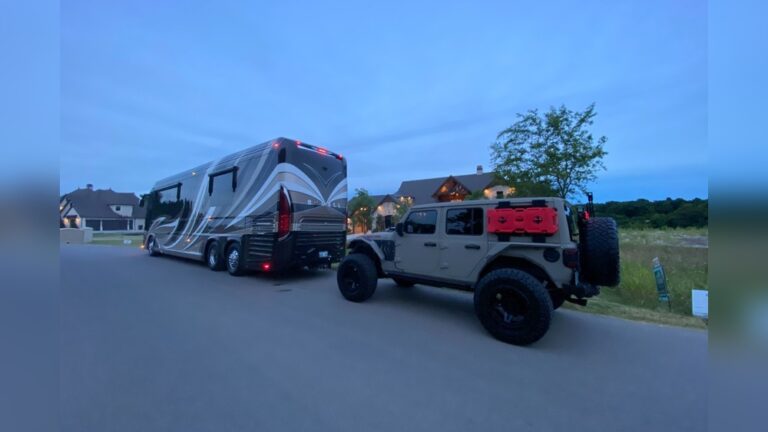
Drive more slowly and leave more space than you would with the motorhome alone. The Jeep adds weight and length, and it can change braking, turning, and backing behavior.
Allow extra stopping distance
The Jeep’s supplemental brake system helps, but it does not erase the added weight. Avoid sudden braking and watch traffic farther ahead.
Take wide turns
The Jeep follows a different path from the motorhome. Watch curbs, posts, parked cars, fuel pumps, and narrow campground lanes.
Avoid backing up
Most tow bars and base plates are not designed for backing the Jeep while it is connected. If you need to reverse, stop and disconnect the Jeep first unless the tow-bar manufacturer specifically permits a limited backing procedure.
Stop after the first few miles
After a short test drive, inspect:
- Tow-bar locks
- Safety cables
- Electrical wiring
- Brake-system operation
- Jeep tire condition
- Base-plate hardware
Then repeat the inspection at fuel stops and rest breaks.
Watch for warning signs
Stop as soon as it is safe if you notice:
- A Jeep warning light
- Steering pull
- Repeated braking from the Jeep
- Tire smoke or odor
- A loose tow bar
- Damaged wiring
- Abnormal noise
- Cable or chain contact with the pavement
Do not continue towing until you identify the cause.
Common Flat-Towing Problems and Fixes
The transfer case will not shift into Neutral
Possible causes include low battery voltage, an incomplete shift sequence, vehicle movement, or failure to hold the control long enough.
Try the procedure again on level ground. Keep your foot on the brake and follow the dashboard confirmation steps. If the Neutral indicator does not appear, do not tow the Jeep.
The Jeep shows a warning message
A warning message may indicate that the transfer case did not complete the shift or that the Jeep is not in the required towing mode.
Stop, read the message, and consult the owner’s manual. A warning message is not proof that the transfer case is safe for towing.
The Jeep battery is dead after towing
Possible causes include a required battery-disconnect step, an improperly wired lighting system, a portable brake unit, or an accessory left on.
Check the manual for battery instructions. Then inspect the lighting and brake-system wiring. Do not add a battery disconnect without confirming that it will not disable required safety equipment.
The Jeep brakes stay applied
A portable brake unit may be out of position, set too aggressively, or pressing the pedal after the seat or floor mat shifted.
Stop at once. Check the unit, pedal connection, and power supply. Do not drive with a dragging Jeep brake.
The tow bar is hard to release
A tow bar can bind when the RV and Jeep stop at an angle or on uneven ground. Set the Jeep’s parking brake, follow the tow-bar release instructions, and move the RV slightly only if the manufacturer permits it.
Never strike a locked arm with a hammer or drive away while connected.
The Jeep sways behind the RV
Sway may result from incorrect tow-bar height, loose hardware, tire problems, crosswinds, poor loading, or a vehicle outside the RV’s capacity.
Reduce speed smoothly. Do not make sharp steering movements. Stop and inspect the full combination before continuing.

Weight, Towing Capacity, and Legal Requirements
The Jeep must be within the RV’s tow rating after it is loaded for travel. Include fuel, passengers, cargo, accessories, tools, and any equipment stored in the Jeep.
Use these limits:
| Rating | What it controls |
|---|---|
| RV maximum tow rating | Maximum weight the RV may tow |
| RV gross combined weight rating | Maximum total weight of RV, Jeep, passengers, fuel, and cargo |
| Hitch rating | Maximum load allowed at the RV receiver |
| Tow-bar rating | Maximum weight supported by the tow bar |
| Base-plate rating | Maximum weight supported by the Jeep mounting system |
| Safety-cable rating | Required capacity for the connection system |
The lowest applicable rating is the practical limit. A heavy Jeep can exceed the RV’s available capacity even when the hitch itself has a higher rating.
State rules also differ. Requirements may cover:
- Supplemental brakes
- Breakaway devices
- Tail lights
- Safety chains or cables
- Maximum combination length
- Maximum width
- License plates
- Mirrors
- Speed or lane restrictions
Check the rules for every state where you will travel. An RV dealer, tow-equipment installer, or qualified vehicle technician can help verify the hardware. For a modified Jeep or unusual RV setup, professional inspection is worthwhile.
When Professional Installation Makes Sense
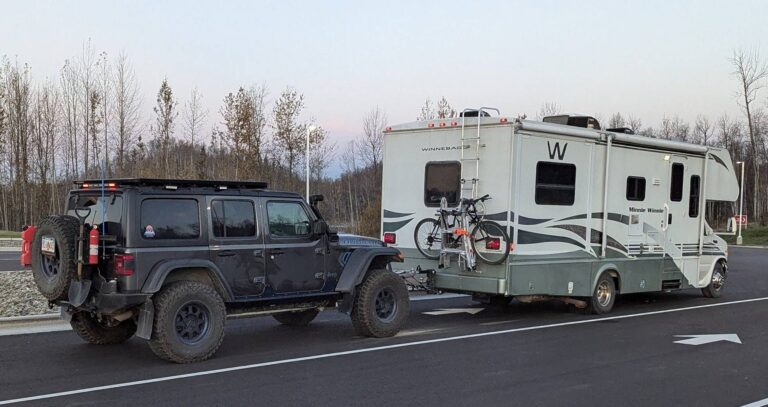
Professional help is a good choice when the Jeep has a modified bumper, winch, suspension lift, aftermarket steering parts, or electrical changes.
Have the setup inspected if:
- You are unsure whether the Jeep is a JL or another generation.
- The base-plate instructions conflict with the bumper design.
- The RV has an unusual receiver height.
- The brake system requires hydraulic or air integration.
- The Jeep shows a transfer-case fault.
- You cannot verify the vehicle’s loaded weight.
- The tow bar does not sit within its approved angle.
- You hear noise or feel sway during the test drive.
The installer should verify the physical attachment, wiring, braking system, breakaway function, and vehicle-specific neutral procedure. Ask for the installation instructions and keep them with the RV documents.

Key Takeaways
- Most four-wheel-drive Jeep Wrangler JL models can be flat towed, but the exact owner’s manual controls.
- The transfer case must be confirmed in Neutral.
- Use a rated tow bar, compatible base plate, safety cables, lighting, supplemental brakes, and a breakaway system.
- Confirm the RV’s tow rating, hitch rating, and gross combined weight rating.
- Never back up with the Jeep connected unless the tow-bar maker specifically allows it.
- Stop towing if the Neutral indicator does not appear or a warning message remains.
- Inspect the connection before departure and again after the first few miles.
Frequently Asked Questions
Can every Jeep Wrangler JL be flat towed?
No. Many four-wheel-drive JL models are designed for recreational towing, but two-wheel-drive models, modified vehicles, and certain powertrains may have different limits. Check the exact U.S. owner’s manual and vehicle identification information.
Should the Wrangler JL transmission be in Park or Neutral?
For many automatic JL procedures, the transfer case is placed in Neutral and the transmission is then placed in Park. Manual-transmission models may require a specified gear. Use the procedure for your exact model year.
Do I need a supplemental brake system?
The legal answer depends on the states where you travel. A supplemental system can also reduce braking demand on the RV and help control the Jeep. Use a system designed for the Jeep and test it before travel.
Can I flat tow a Wrangler JL with a lift kit?
Possibly, but a lift can change tow-bar height, steering geometry, tire clearance, and base-plate fit. Check the tow-equipment maker’s instructions and confirm that the tow bar remains within its approved height and angle limits.
Can I back up while the Jeep is connected?
Usually, you should disconnect first. Backing can damage or bind many tow bars and can cause the Jeep to turn sharply. Follow the tow-bar manufacturer’s instructions.
How often should I inspect the setup?
Inspect it before every trip, after the first few miles, and during long travel stops. Check the pins, locks, cables, wiring, brake system, tires, and transfer-case status.
Conclusion
Flat towing a Jeep Wrangler JL behind an RV is a practical setup when the Jeep, motorhome, and towing equipment are compatible. The process depends on more than attaching a tow bar. You must secure the hardware, connect the lights and brakes, place the transfer case in Neutral, confirm the Jeep’s towing status, and stay within every weight and legal limit.
Before your first long trip, perform a short road test near home. If the transfer-case indicator, brake system, lighting, or tow-bar hardware does not work exactly as expected, stop and correct the issue before entering highway traffic.