
33 Vs 35 Inch Tires On Jeep Wrangler: Which Fits Best
 Reading Time: 10 minutes
Introduction
For Jeep Wrangler owners in the United States, the choice between 33- and 35-inch tires often comes down to where the Jeep is driven and how much change you are willing to make. A 33-inch tire is usually easier to fit and live with. A 35-inch tire can add ground clearance and help on rough trails, but it may need more changes to the suspension, gearing, spare-tire setup, and speedometer.
There is no single fitment rule for every Wrangler. Model year, trim, wheel, tire shape, and suspension setup all matter. Before buying, check the tire maker’s actual dimensions and confirm fitment for your exact Jeep.

33-inch vs. 35-inch tires: the quick answer
Choose 33-inch tires if you want a practical upgrade for daily driving, light trails, and lower-cost installation. Choose 35-inch tires if you need more clearance for tougher trails and are prepared to check for rubbing, review your gearing, and address any spare-tire or calibration needs.
The labels are not exact measurements. A tire sold as a “33” or “35” may measure smaller than its name suggests. The wheel size, tire model, and measuring method affect its actual height and width. Compare the maker’s published specifications for the specific tire you plan to use.
| Factor | 33-inch tire | 35-inch tire |
|---|---|---|
| Typical fitment effort | Often simpler, but still vehicle-specific | More likely to need a lift, clearance checks, or other changes |
| Added clearance vs. a 33 | Baseline | About 1 inch more under the axle, if the actual diameters differ by 2 inches |
| Steering and acceleration | Usually closer to the Jeep’s current feel | May feel heavier or slower, depending on tire and gearing |
| Spare-tire fit | More likely to fit the factory carrier, but check | More likely to need a carrier check or support |
| Cost | Usually lower overall | Tire, wheel, lift, gearing, or carrier costs may add up |
These are general comparisons, not a fitment guarantee. Jeep Wrangler generations and trims differ, and a tire that clears one setup may rub on another.

What “33-inch” and “35-inch” tires really measure
The tire’s stated size is a class, not a promise that the mounted tire will measure exactly 33 or 35 inches tall. A metric size such as 285/70R17 gives more detail: 285 is the nominal section width in millimeters, 70 is the sidewall height as a share of the width, and 17 is the wheel diameter in inches.
For example, a 285/70R17 tire is about 32.7 inches tall by its size calculation. A 315/70R17 is about 34.4 inches tall by the same method. The tire maker’s published specs may differ from these calculations because of tire design and measurement conditions.
Check the tire’s listed overall diameter, section width, approved rim-width range, load rating, and weight. A tire’s actual mounted size can also vary with wheel width and air pressure. If you are comparing two tires, use their published measurements rather than relying only on the “33” or “35” label.

How much more clearance do 35-inch tires add?
If one tire is truly 35 inches tall and the other is truly 33 inches tall, the larger tire has a 1-inch greater radius. That can add about 1 inch of clearance under the axle and differential. It does not raise every part of the Jeep by 2 inches.
The real gain depends on the tires’ actual rolling dimensions and how much they compress under the Jeep’s weight. A 35-inch tire can help the axle clear rocks and ruts, but it does not replace good line choice or protect the body, skid plates, or other low parts of the vehicle.
A 35-inch tire is also wider in many common sizes, but not always by the same amount. More width can affect clearance inside the wheel well and near suspension parts. Check both height and width when judging fit.
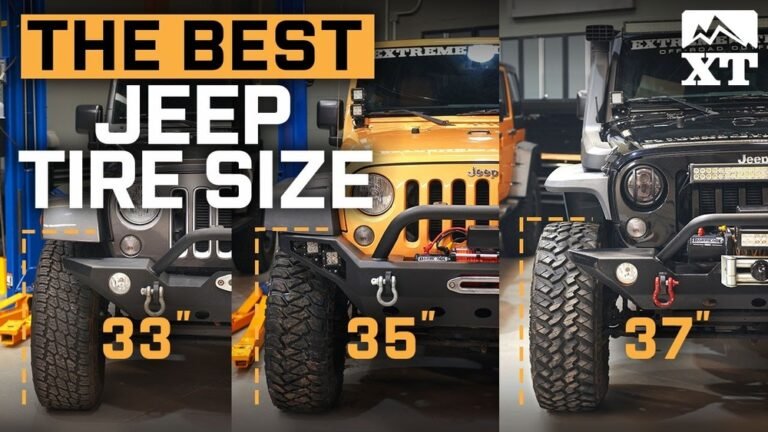
Fitment: will 33- or 35-inch tires fit your Wrangler?
Fitment depends on the Wrangler’s year, trim, wheel, suspension, and tire design. A stock-height Jeep may clear one tire during normal driving but rub when the suspension compresses or the steering is turned fully. A lift can create more room, but it does not guarantee clearance at every point.
Before buying, check these items:
- Identify the Jeep. Note the model year, generation, trim, axle, and any factory off-road package.
- Confirm the tire’s dimensions. Use the tire maker’s specs for overall diameter, section width, and approved wheel widths.
- Check the wheel. Confirm its width and offset or backspacing are suitable for the tire and Jeep. A wheel that moves the tire outward can change where it rubs.
- Inspect clearance. Check the fender liners, control arms, sway bar, shocks, and other nearby parts. Consider full steering lock and suspension movement, not just a parked Jeep.
- Ask for an exact fitment check. A tire shop or Jeep specialist can verify the setup for your model and intended use.
Do not assume that a fitment report for another Wrangler applies to yours. Even Jeeps from the same generation can differ in trim, suspension, wheel, and added accessories. Use the owner’s manual for your vehicle and the tire maker’s current fitment guidance as starting points.

How 35-inch tires can affect gearing and speed readings
A taller tire covers more ground per wheel rotation. This makes the effective gearing taller, which can reduce the engine’s leverage at the tire. The effect may show up as slower acceleration, more frequent downshifts, or less responsive climbing, especially if the Jeep already has tall gearing or carries extra weight.
A rough comparison can help. If a Jeep goes from a true 33-inch tire to a true 35-inch tire with 4.10 axle gears, the equivalent gearing is about 3.87:
4.10 × (33 ÷ 35) ≈ 3.87.
This is an estimate, not a gear recommendation. Actual tire diameter, transmission, engine, load, and driving conditions all affect how the Jeep feels. Regearing may help some setups, but the right choice depends on the full vehicle and how it is used.
A larger tire can also make the speedometer read lower than the Jeep’s actual speed if the vehicle is not recalibrated. With the same simplified 33-to-35-inch comparison, a displayed 60 mph would correspond to about 64 mph. Real results vary because tire rolling size is not always the same as the nominal size. Check speed with a trusted method after changing tire size, and ask a qualified shop about recalibration options for your Wrangler.
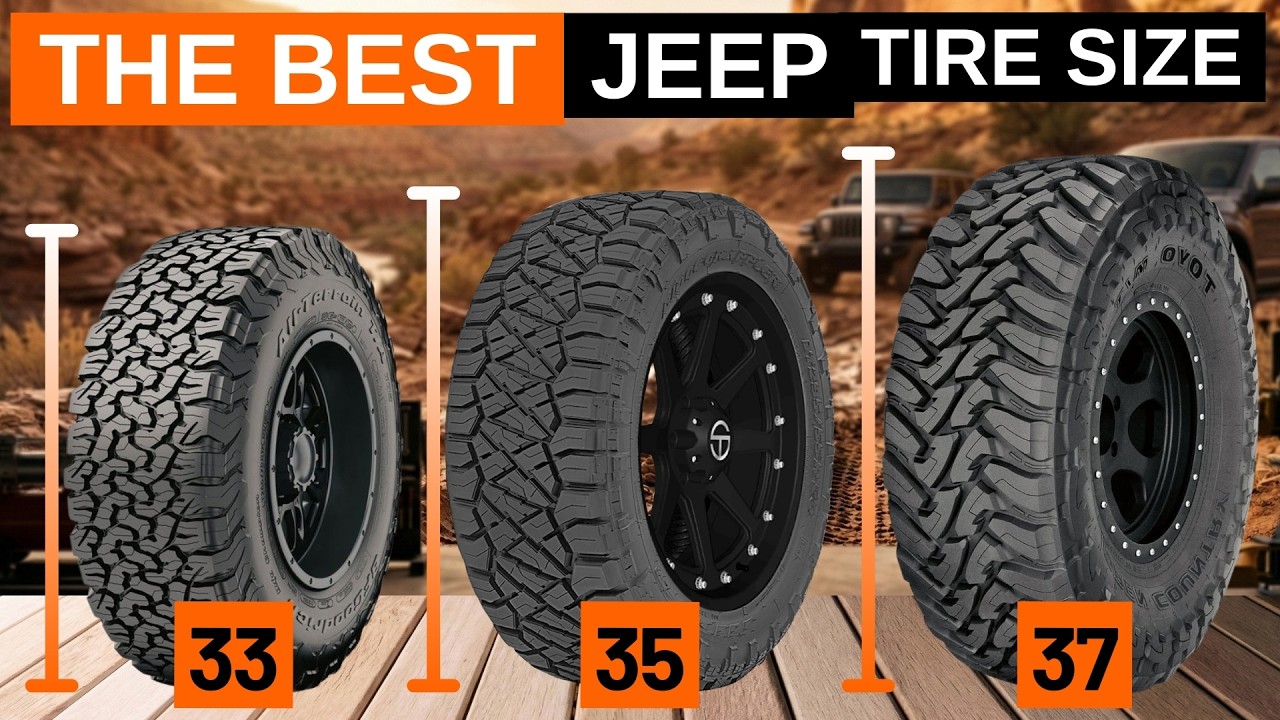
Ride, braking, fuel use, and daily driving
A 35-inch tire may weigh more than a 33-inch tire, but size alone does not tell you the full difference. Tire construction, tread, load range, and wheel weight also matter. More weight at the tire and wheel can affect steering response, ride, acceleration, and the suspension’s ability to control wheel movement.
Fuel use may change after a tire upgrade, but there is no reliable one-size-fits-all figure. Tire weight, tread pattern, pressure, gearing, driving speed, and vehicle load all play a part. Treat claims of a fixed mileage loss as estimates unless they are tied to a specific Jeep, tire, and test method.
Do not assume that a larger tire automatically makes braking unsafe or safe. The tire, brakes, vehicle weight, maintenance, and road conditions all matter. Keep tires in good condition, use a suitable load rating, and follow tire and vehicle guidance. NHTSA’s tire safety guidance covers tire care and basic inspection.

Wheels, tire pressure, spare tires, and other costs
A tire change can affect more than the four tires on the ground. Check these related parts before you choose a size:
- Wheel fit: The wheel must fall within the tire maker’s approved rim-width range. Confirm the wheel’s offset or backspacing and its clearance on your Jeep.
- Tire pressure: Do not use the pressure printed on the tire sidewall as the normal target. It is a maximum rating, not a vehicle-specific setting. For a non-stock tire, ask a tire professional to help set pressure based on the tire, load, and Jeep.
- Spare tire: A larger or heavier spare may not suit the factory carrier or may place more load on the tailgate. Check the carrier’s limits and how the spare is secured.
- TPMS: The tire pressure monitoring system may need attention when wheels or sensors change. Check that the system works after installation.
- Alignment and inspection: After changes to suspension or wheels, have the setup inspected and aligned as needed. Check for rubbing after installation and again after the suspension has settled.
- Total cost: Compare the full setup, not just the tire price. Include wheels, installation, spare support, calibration, suspension work, and possible gearing changes.
For vehicle-specific care, consult the Jeep owner’s manual. For tire dimensions and rim-width limits, use the tire maker’s published specifications.

Which size should you choose?
A 33-inch tire is often the more straightforward choice for a Wrangler that sees regular commuting, highway trips, and moderate trails. It can provide a larger look and useful trail capability while limiting the number of changes needed. It is not automatically a direct fit, so check clearance and the exact tire dimensions.
A 35-inch tire makes more sense when added axle clearance is useful for your trails and you can confirm that the whole setup works. Consider the cost of any lift or clearance work, the effect on gearing, the spare carrier, and the tire’s added weight. A 35 may be a poor trade if the Jeep is mostly a commuter and you do not need its extra clearance.
Use this short decision check:
- Pick 33s if easy fitment, daily comfort, and lower overall cost matter most.
- Consider 35s if trail clearance is a priority and you are ready to verify or modify the setup.
- Choose neither size until you check actual tire specs, wheel fit, load rating, and clearance for your exact Wrangler.

Key takeaways
- “33-inch” and “35-inch” are size classes. Check the tire maker’s actual measurements.
- A true 35-inch tire adds about 1 inch of axle clearance over a true 33-inch tire.
- Fit depends on the Wrangler’s year, trim, wheels, suspension, and tire shape.
- Larger tires can affect effective gearing, speed readings, steering feel, and the spare-tire setup.
- Verify fitment and pressure with reliable vehicle and tire guidance before installation.
FAQs
Do 35-inch tires always need a lift on a Jeep Wrangler?
No single answer fits every Wrangler. Clearance depends on the model, trim, wheel, tire, and suspension. A lift may help, but it does not guarantee that the tires will clear during full steering or suspension movement.
Will 35-inch tires hurt fuel economy?
They can affect fuel use, especially if they are heavier or the Jeep’s gearing is not well suited to them. The change depends on the whole setup and driving conditions, so a fixed mileage estimate is not reliable for every Wrangler.
Do I need to regear for 35-inch tires?
Not always. A larger tire makes the effective gearing taller, which may reduce acceleration or increase downshifting. Whether to regear depends on the Jeep’s axle ratio, engine, transmission, load, and use.
Can I put 35-inch tires on stock Wrangler wheels?
Only if the tire maker approves that wheel width for the specific tire and the wheel clears the Jeep. Check the approved rim-width range, wheel condition, and fitment for your Wrangler before mounting.
Can I use a 35-inch tire as the spare with the factory carrier?
Do not assume that it will fit or that the carrier can handle its size and weight. Check the carrier’s limits and how the spare mounts. A tire shop or Jeep specialist can inspect the carrier and tailgate setup.
Conclusion
For most Wrangler owners who want a practical tire upgrade, 33s are the simpler place to start. A 35-inch tire can be worthwhile when extra trail clearance matters, but it calls for a closer look at fitment, gearing, and supporting parts.
Before ordering, match the tire’s actual specs to your Jeep’s year, trim, wheels, and suspension. Then have the installed setup checked for clearance, pressure, and safe mounting.