How To Take Out Jeep Wrangler Back Seats: Easy Guide
 Reading Time: 13 minutes
 Removing the back seats from a Jeep Wrangler is usually a straightforward job for a U.S.-specification vehicle, but the exact procedure depends on the Wrangler’s body style and model generation. A two-door Wrangler, four-door Wrangler Unlimited, older TJ, JK, and newer JL may use different release straps, brackets, and fasteners.
For most Wranglers, the process involves folding the rear seat, releasing or removing its floor-mounted hardware, and lifting the seat out through the rear or side door. Before starting, identify your Wrangler’s model year and confirm the instructions in the owner’s manual because seat hardware and torque specifications can vary.

Before Removing the Rear Seats
Park the Jeep Wrangler on a level surface, apply the parking brake, and remove loose items from the cargo area. You will need enough room to open the rear doors or tailgate and safely lift the seat.
Identify your Wrangler’s configuration
The procedure can change based on these factors:
| Wrangler configuration | What commonly changes |
|---|---|
| Two-door Wrangler | Smaller rear seat, limited access, different folding or release arrangement |
| Four-door Wrangler Unlimited | Larger split-folding rear bench and more floor hardware |
| TJ, approximately 1997–2006 | Older seat brackets and release mechanisms |
| JK, 2007–2018 | Rear bench commonly folds and is secured to the floor with removable hardware |
| JL, 2018–present | Updated folding seat design, straps, latches, and mounting hardware |
The 2018 model year includes both JK and JL vehicles, so do not rely on the year alone. Check the vehicle identification information, dashboard, owner’s manual, or the Wrangler’s body and interior design.
Tools and supplies
Have these items available before you begin:
- Owner’s manual or factory service information
- Ratchet and the correct socket for your seat fasteners
- Short and long extensions, if needed
- Trim tool or flat tool for carefully opening plastic covers
- Work gloves
- Small container for bolts and washers
- Flashlight
- Protective blanket or cardboard for the cargo area
Do not assume that every Wrangler uses the same socket size. Jeep seat hardware can vary by generation, trim, and whether the seats or brackets have been replaced.
Important safety precautions
Rear seats are heavy and awkward to carry. Get a second person to help if the seat does not lift easily or if you are removing a large four-door bench.
Before removing anything:
- Keep the ignition off.
- Do not sit or place heavy objects on a seat while its mounting hardware is partly removed.
- Do not cut seat belts, wiring, or upholstery.
- Do not remove the seat-belt retractors unless the service procedure specifically requires it.
- Do not unplug electrical connectors unless the factory procedure identifies them and explains how to handle them.
- Keep removed bolts with the seat so they are not lost.
- Never drive with a seat loosely installed or supported by only some of its fasteners.
The rear seat and seat-belt system are part of the vehicle’s occupant-restraint system. If a fastener is damaged, missing, cross-threaded, or impossible to reinstall correctly, stop and repair the problem before carrying passengers.
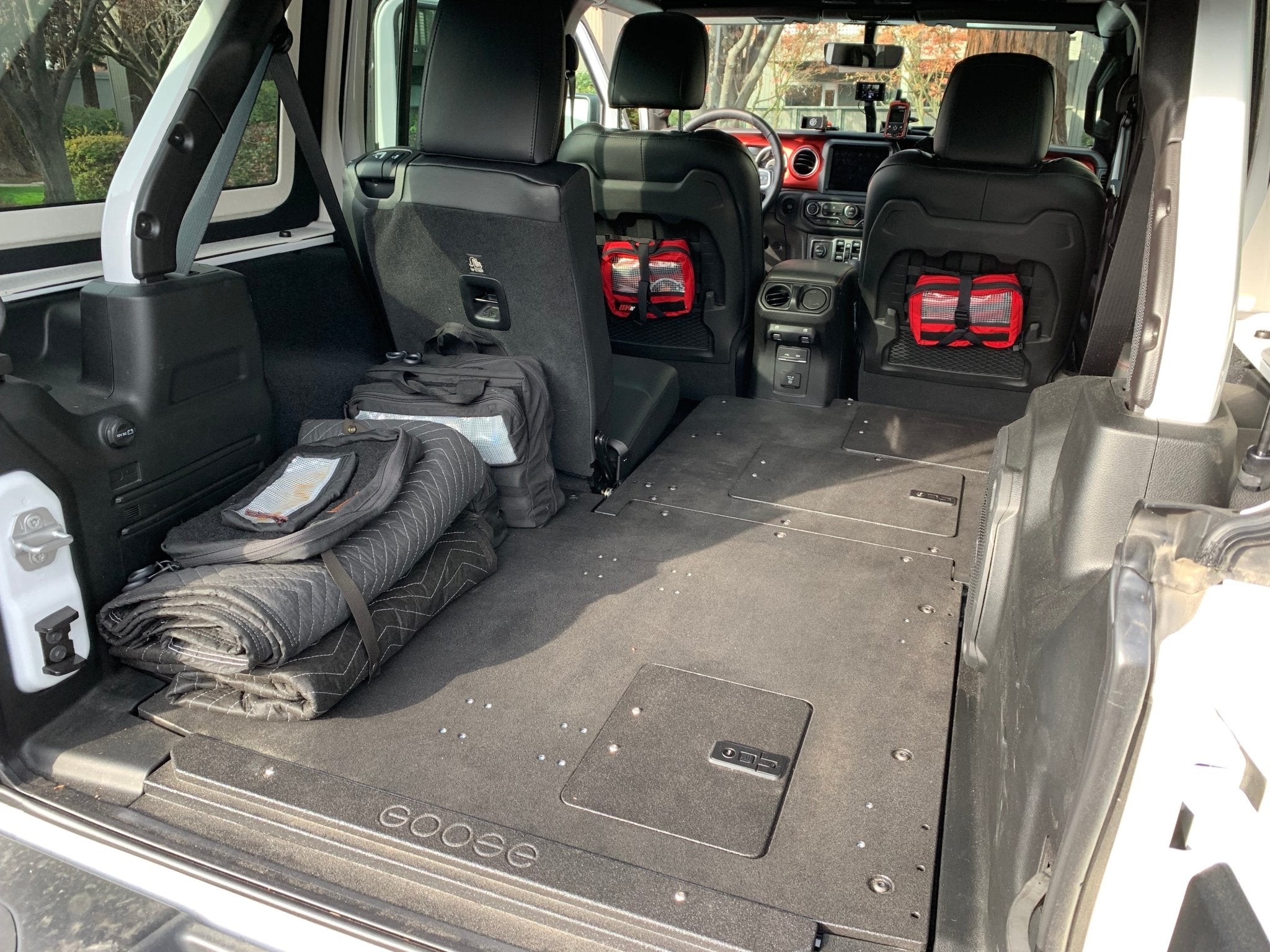
How to Remove Back Seats From a Four-Door Jeep wrangler
the general process for a four-door Wrangler Unlimited is to fold the rear seat, expose its mounting points, remove the required hardware, and lift the seat from the vehicle. The exact sequence differs between JK and JL models.
Step 1: Move the front seats forward
Slide the front seats forward to create working space. Open the rear doors and the tailgate if possible. Removing or lowering the rear head restraints may provide additional clearance, but do not force them if they are locked by the seat design.
Step 2: Fold the rear seatbacks
Use the release strap or lever at the top or side of each rear seatback. Fold the seatbacks forward according to the markings on the seat.
On a split rear bench, fold one side at a time if that gives you better access. Some Wrangler seats fold forward as a complete unit, while others have separate 60/40 sections.
Step 3: Tip or fold the seat cushion
Many Wrangler rear seats have a strap or release mechanism that allows the lower cushion to tip forward. Pull the designated strap or lever and move the cushion into its folded position.
Do not pull on the seat belt or an unidentified upholstery loop. A seat belt may look like a convenient handle, but using it to move the seat can damage the belt or its anchor.
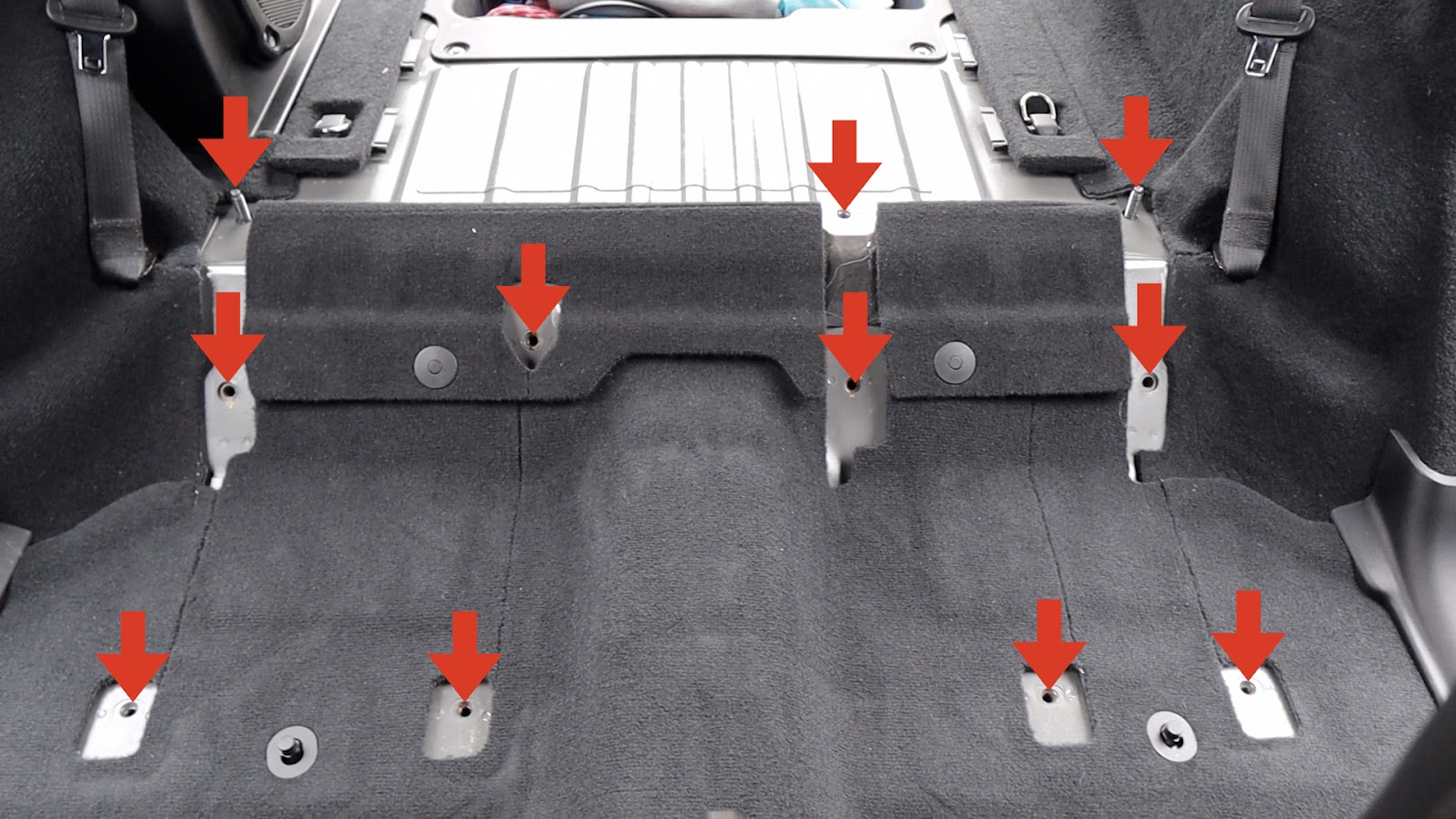
Step 4: Locate the floor mounts and covers
Look at the floor near the front and rear of the folded seat. Depending on the Wrangler, you may find:
- Exposed bolts
- Bolts beneath plastic covers
- Hinges or brackets
- Quick-release hooks
- A combination of fixed brackets and removable fasteners
Use a flashlight to inspect every mounting point. The seat should not be lifted until all required retaining hardware has been released.
Step 5: Remove the mounting hardware
Use the correct socket and keep steady downward pressure on the fastener while loosening it. This helps prevent rounding the bolt head.
If a plastic cover blocks access, release it carefully rather than prying aggressively. Set each bolt, washer, and spacer aside in a labeled container.
Do not use an impact tool on a stubborn seat fastener until you have confirmed that no wiring, fuel-system component, or thin floor section is directly beneath the location. If the bolt will not move, apply an appropriate penetrant where safe and seek service help if necessary.
Step 6: Release the remaining seat hooks or latches
After removing the bolts, check for hooks, rear pivots, or quick-release latches. Some Wrangler seats remain engaged at one end even after the visible bolts have been removed.
Lift or slide the seat in the direction indicated by the bracket design. Do not twist the seat sharply because the brackets can catch on the floor or the seat belt.
Step 7: Lift the seat out
With the seat fully released, lift it out through the rear door or tailgate. A four-door rear bench can be bulky, so use two people if the seat catches, feels unbalanced, or blocks your view.
Place the seat on a clean, dry surface with the upholstery protected. Avoid storing it where moisture, direct sunlight, or heavy objects can damage the foam or fabric.
Step 8: Store the hardware with the seat
Put the bolts, washers, covers, and any removable brackets in a sealed bag. Label the bag “rear seat hardware” and keep it with the seat.
If you intend to reinstall the seat later, photograph the bracket orientation before storing it. The photos can help you identify which end faces the front of the Jeep.

How to Remove Back Seats From a Two-Door Jeep Wrangler
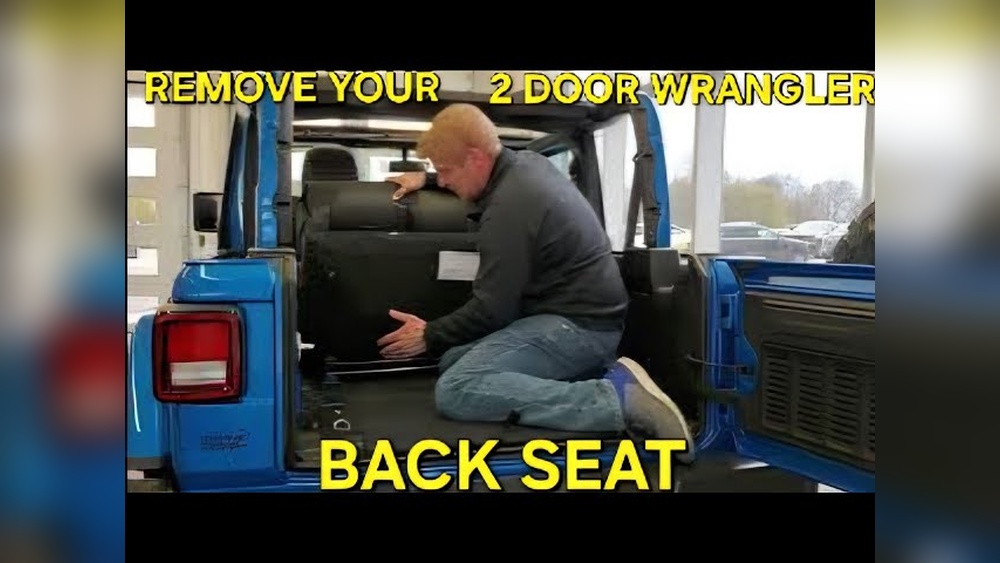
Two-door Wranglers have less interior space, so access is usually the main challenge. The rear seat may need to be folded or tilted before its retaining hardware can be reached.
General removal process
- Park on a level surface and apply the parking brake.
- Move the front passenger seat forward.
- Open the passenger door and tailgate.
- Fold the rear seatback using its release strap or lever.
- Tip the seat forward if the design provides a lower-cushion release.
- Find the floor bolts, hooks, or quick-release brackets.
- Remove or release every retaining point.
- Lift and rotate the seat through the tailgate or passenger-side door.
- Store the hardware with the seat.
A two-door rear bench may be easier to remove through the tailgate, but the best exit path depends on whether the Jeep has a soft top, hardtop, aftermarket roll-bar accessories, or a cargo enclosure.
If the seat will not come out
A seat that appears loose may still be caught by one of the following:
- A remaining bolt under a plastic cover
- A rear locating pin or hook
- A folded seatback that has not fully latched
- A seat-belt buckle trapped between the cushion and floor
- An aftermarket bracket or cargo accessory
- Carpet or trim caught around the mounting point
Do not force the seat upward. Move it slightly forward and backward while inspecting the brackets. Forcing it can bend the floor mount or damage the seat frame.

Model-Specific Differences: TJ, JK, and JL
Wrangler rear-seat designs are not interchangeable, so use the procedure that matches the vehicle rather than copying instructions for a different generation.
Jeep Wrangler TJ
The TJ is the two-door Wrangler sold in the United States from approximately 1997 through 2006. Its rear seat and mounting hardware are different from JK and JL seats.
A TJ rear seat may use a fold-and-release arrangement that allows the seat to tilt or lift after the appropriate retainers are released. Inspect the hinges and floor brackets carefully before removing hardware. If your TJ has aftermarket seat mounts, a replacement bench, or a modified interior, the factory procedure may no longer apply.
Jeep Wrangler JK and JK Unlimited
The JK was sold from 2007 through 2018, with the four-door Unlimited offering a larger rear bench.
The rear seat commonly folds forward to expose the mounting points. Depending on the exact seat design, removal may require releasing floor hardware, lifting from locating hooks, or separating sections of a split bench.
Do not assume that removing only the most visible bolts is enough. Inspect the front and rear of the folded seat for additional retainers.
Jeep Wrangler JL and JL Unlimited
The JL began production for the 2018 model year and uses a revised interior and seat-folding system.
A JL rear seat may have multiple release straps or levers for folding the seatback and tipping the cushion. After folding the seat, inspect the floor and brackets for all fasteners before lifting.
Because JL instructions can vary by trim and seat configuration, consult the model-specific owner’s manual or factory service information for:
- The correct release sequence
- Whether a seat section must be removed separately
- Required bolt-replacement guidance
- Fastener torque specifications
- Any electrical connector or restraint-system procedure
Why the model year matters
A procedure that works on a 2015 Wrangler JK may not work on a 2021 Wrangler JL. The seat may look similar while using different brackets, fasteners, or release points.
For that reason, the safest approach is:
- Identify the generation.
- Match the body style.
- Confirm the seat configuration.
- Follow the manual for the exact vehicle.
What to Do With the Seat Belts
Leave the rear seat belts installed unless the factory procedure specifically requires their removal. Removing the seat does not normally mean removing the belt retractors or cutting the belt webbing.
After the seat is removed:
- Keep belt buckles from being crushed under cargo.
- Do not allow belts to drag on the ground.
- Do not bolt a seat belt to an improvised location.
- Do not reinstall a belt with twisted webbing.
- Check that belt anchors remain tight and undamaged.
- Make sure the belts are accessible when the seat is reinstalled.
If a belt was accidentally pulled out too far, locked, or contaminated with oil or chemicals, do not disassemble the retractor. A qualified technician should inspect it.

Reinstalling the Jeep Wrangler Back Seats
Reinstallation is the reverse of removal, but the final checks matter as much as the removal steps.
Reinstall the seat
- Place the seat in the correct orientation.
- Engage the rear hooks, pivots, or locating pins first.
- Install all bolts and washers by hand.
- Confirm that the threads start smoothly.
- Tighten the hardware evenly.
- Use the factory torque specification for the exact Wrangler.
- Return the seatback and cushion to their normal position.
- Confirm that every latch locks fully.
Do not fully tighten one bolt while another mounting point is misaligned. Starting all fasteners by hand helps prevent cross-threading and allows the seat to settle into position.
Check for a secure installation
A correctly installed rear seat should:
- Sit evenly on its mounts
- Have no visible gap between the bracket and floor
- Lock firmly when folded or returned upright
- Resist movement when pulled by hand
- Allow the seat belts to operate normally
- Have no loose bolts, covers, or brackets
Apply firm hand pressure to the seatback and cushion. Do not use excessive force or bounce on the seat. If the seat shifts, rattles, or will not latch, remove it from service until the mounting problem is corrected.
Airbag and restraint warning lights
If a warning light appears after the seat has been removed or reinstalled, do not ignore it. The light may indicate a problem with a restraint-system component or connector.
Do not repeatedly unplug connectors or probe terminals. Check the owner’s manual and have the Jeep scanned and inspected by a qualified technician if the warning remains.

Common Problems and Solutions
The seat is folded but will not lift out
Likely causes:
- One bolt remains installed.
- A rear hook or locating pin is still engaged.
- A plastic cover hides another fastener.
- The seat belt or buckle is trapped.
- The release strap did not fully disengage the latch.
What to do:
Stop lifting and inspect the front, rear, and sides of the seat. Compare both sides of a split bench. Do not use a pry bar against the floor.
A seat bolt is seized
Rust, dirt, thread damage, or previous over-tightening can make seat hardware difficult to remove.
What to do:
- Confirm that you are turning the fastener in the correct direction.
- Use the correct six-point socket.
- Clean dirt from the bolt head.
- Apply a suitable penetrant where appropriate.
- Avoid heating areas near wiring, carpet, fuel-system components, or plastic.
- Stop if the bolt head begins to round.
A damaged seat fastener should be repaired properly rather than replaced with a random bolt.
The seat rattles after reinstallation
A rattle can result from a loose fastener, a missing washer, an unseated hook, or a plastic cover that is not clipped in place.
Remove cargo from the area and identify whether the movement comes from the seat, bracket, floor mount, or trim. Tighten the hardware to the factory specification and verify that all locating pins and latches are engaged.
The seat will not fold back into position
Check whether:
- The seat belt is routed across the cushion.
- The head restraint is interfering with the front seat.
- The release strap is caught beneath the seat.
- The floor hooks are misaligned.
- The seatback latch is blocked by cargo or trim.
Never force the seatback latch. A latch that does not engage may leave the seat unsecured.
The floor fastener spins but does not loosen
A spinning fastener may indicate damaged threads, a captive nut that has broken loose, or a damaged bracket. Continuing to turn it can enlarge the damage.
Stop and inspect the underside if accessible. If the captive nut or floor bracket is compromised, professional repair may be necessary before the seat can be safely installed again.
Can You Drive Without the Rear Seats?
You can operate a Wrangler without its removable rear seats when the seats are properly removed and no loose hardware or cargo can move around the cabin. However, removing the seats changes passenger capacity and cargo behavior.
Before driving:
- Keep all removed hardware secured.
- Restrain cargo so it cannot strike occupants.
- Do not carry passengers in a seat position that is no longer installed.
- Keep the remaining seat belts accessible.
- Follow applicable state requirements for passenger restraints and vehicle equipment.
- Check that no warning light or loose wiring remains.
The legal requirements can vary by state and by the vehicle’s seating configuration. If the Jeep is used to transport passengers, reinstall the correct seats and restraints before carrying anyone in those positions.
How Much Space Does Seat Removal Create?
Removing the rear seat creates a flatter and more open cargo area, but the usable space depends on the Wrangler’s body style, seat design, floor shape, and roof configuration.
A two-door Wrangler generally has less total cargo length than a four-door Wrangler Unlimited. Seat removal may improve access for:
- Camping equipment
- Work tools
- Pet crates
- Sports gear
- Storage bins
- Oversized but lightweight cargo
Measure the cargo area before transporting a large item. Also account for the roll bars, tailgate opening, wheel wells, and roof height. Do not exceed the vehicle’s payload limit, and keep heavy items low and secured near the front of the cargo area.

Frequently Asked Questions
Do I need to remove the front seats first?
Usually, no. Sliding the front seats forward normally provides enough working room. Removing a front seat is unnecessary for most rear-seat removal procedures and introduces additional hardware and restraint-system concerns.
Can I remove only one side of a split rear seat?
On many four-door Wranglers, the split rear bench can be folded or removed in sections. Whether one section can be completely detached depends on the seat design and mounting hardware. Inspect the section’s individual brackets and follow the vehicle-specific manual.
Do I need to disconnect the battery?
Do not disconnect the battery automatically. Some service procedures call for battery disconnection before handling specific electrical or restraint-system components, while unnecessary battery disconnection can erase settings or create additional issues. Follow the factory instructions for the exact Wrangler and connector involved.
What should I do if a seat-belt warning light appears?
Stop using the affected seating position until the restraint system is checked. Review the owner’s manual and have the Jeep scanned by a qualified technician. Do not bypass, splice, or randomly disconnect restraint-system wiring.
Can I replace the factory rear seat with an aftermarket seat?
An aftermarket seat should use a properly engineered, vehicle-compatible mounting system and maintain appropriate belt and restraint geometry. A homemade bracket or improvised bolt pattern can create serious injury risk in a crash. Verify compatibility, installation requirements, and any applicable regulations before making a conversion.
Key Takeaways
- Identify whether the Wrangler is a TJ, JK, or JL and whether it is a two-door or four-door model.
- Fold the rear seat before searching for mounting bolts, hooks, and release mechanisms.
- Remove every retaining point before lifting the seat.
- Do not pull on seat belts or disconnect restraint-system wiring without vehicle-specific instructions.
- Store the original hardware with the seat.
- Reinstall all fasteners using the factory torque specification.
- Do not carry passengers until the seat and latches are securely installed.
Conclusion
To take out Jeep Wrangler back seats, fold the seat into its removal position, expose the floor mounts, release all bolts or latches, and lift the seat out carefully. The exact steps vary among TJ, JK, and JL models, so the owner’s manual should control whenever the visible hardware or release method differs.
After removal, secure the seat and hardware, restrain cargo, and avoid using the empty seating area for passengers. When reinstalling the seat, confirm that every bracket, bolt, latch, and seat belt functions correctly before driving.