How To Change Battery In A Jeep Key Fob: Easy DIY Guide
 Reading Time: 10 minutes
 Introduction
For most Jeep vehicles sold in the United States, changing a key fob battery takes about five minutes and requires only a small flat-blade screwdriver or plastic pry tool. Many Jeep key fobs use a CR2032 lithium coin-cell battery, but the correct battery depends on the exact fob design and model year. Some older or less common Jeep remotes may use a CR2016 or CR2450 instead.
The safest approach is to confirm the battery number printed on the old cell, inside the key fob, or in the official owner’s manual for your U.S.-market Jeep. Then open the fob at its seam, replace the battery with the positive side facing the same direction, and snap the housing back together. In most cases, replacing the battery alone does not require key fob programming.

What You Need Before Replacing the Jeep Key Fob Battery
Gather these items before starting:
- The correct replacement coin-cell battery
- A small flat-blade screwdriver, plastic trim tool, or non-marring pry tool
- A clean, well-lit work surface
- The Jeep owner’s manual, if the battery type or fob design is uncertain
Confirm the battery type
Do not rely only on the Jeep model name. Battery specifications can vary by:
- Model year
- Trim level
- Key fob design
- Number of buttons
- Whether the vehicle uses a traditional ignition or push-button start
- Whether the fob is an original Mopar unit or an aftermarket replacement
Common batteries include:
| Battery | Typical use | Important consideration |
|---|---|---|
| CR2032 | Many modern Jeep key fobs | The most common size, but not universal |
| CR2016 | Some thinner or older remotes | Similar diameter to a CR2032 but lower thickness |
| CR2450 | Some larger electronic remotes | Do not substitute based on diameter alone |
A CR2016 and CR2032 are both 3-volt lithium batteries, but they are different thicknesses. Using the wrong size can cause poor contact, prevent the housing from closing correctly, or damage the battery holder.
Check the key fob design
Jeep key fobs commonly include:
- A removable emergency or mechanical key
- A release button for the emergency key
- A molded seam around the plastic housing
- A small notch intended for opening the case
- Lock, unlock, panic, and liftgate or remote-start buttons
The exact opening point differs between fobs. If the case does not separate with light pressure, stop and look for a release notch or hidden screw. Forcing the housing can break the retaining clips or damage the circuit board.
Step-by-Step: How to Change a Jeep Key Fob Battery
The following procedure applies to many U.S.-market Jeep fobs, including common designs used with the Wrangler, Grand Cherokee, Cherokee, Compass, Renegade, Gladiator, and other Jeep vehicles. Your fob may differ slightly, so use the vehicle manual when its instructions conflict with this general method.
1. Remove the emergency key
Press the small release button or slider on the back or side of the key fob. Pull out the emergency key, also called the mechanical key.
Removing this key usually exposes the seam or pry point needed to separate the two halves of the fob. Keep the key nearby because it may be needed to unlock the driver’s door if the vehicle battery or key fob battery is depleted.
2. Locate the case seam or pry notch
inspect the outer edge of the fob for:
- A narrow slot
- A molded indentation
- A gap near the emergency-key opening
- A seam running around the housing
Insert the tip of a small flat-blade screwdriver or plastic pry tool into the intended notch. A plastic tool is less likely to scratch the fob or mark the surrounding trim.
3. Separate the two halves carefully
Twist the tool gently rather than prying aggressively upward. Work around the seam if necessary until the housing separates.
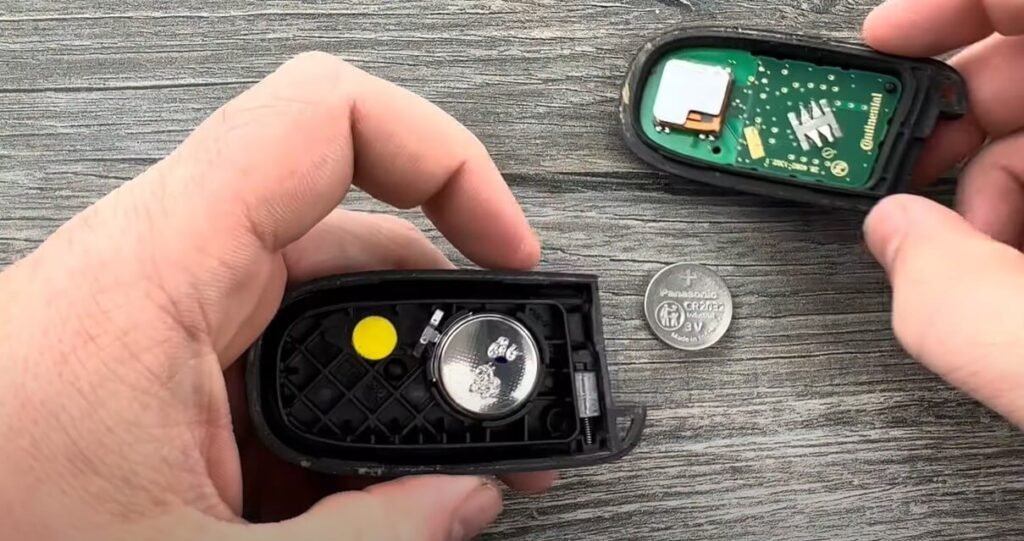
Keep the pressure controlled. Inside the case, you may find the battery, rubber button membrane, circuit board, and small retaining pieces. Opening the fob over a table or tray helps prevent parts from falling onto the ground.
4. Note the battery orientation
Before removing the old battery, observe which side faces up. In many Jeep fobs, the positive (+) side faces upward, but this is not universal.
Look for:
- A plus sign printed inside the housing
- A molded polarity symbol
- A metal battery clip
- The orientation of the old battery
Take a quick photo if needed. Battery orientation matters because installing a coin cell backward can prevent the fob from working.
5. Remove the old battery
Use a fingernail or a nonconductive plastic tool to release the battery from its holder. If using a metal screwdriver, avoid bridging the positive and negative surfaces or scraping the circuit board.
Do not bend the metal contact clips. They must maintain enough pressure against the new battery to provide a reliable electrical connection.
6. Install the new battery
Place the replacement battery into the holder in the same orientation as the old one. Usually, the side marked with the battery number and a plus sign faces upward.
Press it into place until it is seated securely. The battery should lie flat and should not move freely inside the holder.
7. Reassemble the key fob
Align the two housing halves and press them together around the edges. You should hear or feel the retaining clips snap into place.
Then slide the emergency key back into its slot. Check that:
- The case is fully closed
- No edge remains visibly separated
- The buttons move normally
- The emergency key locks into place
8. Test every function
Stand near the Jeep and test:
- Lock
- Unlock
- Panic alarm
- Remote start, if equipped
- Power liftgate or hatch release, if equipped
The vehicle does not need to be running for a basic lock or unlock test. If the fob works intermittently, reopen the case and check the battery type, polarity, seating, and contact clips.

How to Know the Jeep Key Fob Battery Replacement Worked
A successful replacement usually produces immediate results:
- The locks respond from a reasonable distance
- The buttons activate consistently
- The panic or remote-start button works, if equipped
- The vehicle recognizes the fob for push-button starting
- The low-battery warning disappears after normal vehicle operation, if the Jeep displays one
A weak signal before replacement and a normal signal afterward usually indicates that the battery was the problem. However, a new battery will not correct a damaged circuit board, broken button membrane, water intrusion, or a vehicle-side receiver problem.
Push-button-start Jeeps
On many Jeep vehicles with keyless ignition, the engine may still start when the fob battery is weak. The vehicle can often detect the transponder or emergency backup area even when the remote buttons no longer work normally.
If the Jeep displays a message such as “Key Fob Has Left the Vehicle,” “Key Not Detected,” or a similar warning, consult the owner’s manual for the backup starting procedure. The location may involve holding the fob against the START/STOP button or placing it in a designated backup pocket, depending on the model.
The precise procedure is model-specific. Do not assume that a method for a Wrangler also applies to a Grand Cherokee or Compass.
What to Do If the New Battery Does Not Work
If the Jeep key fob remains unresponsive, check the simplest and safest possibilities first.
1. Verify the battery number
Remove the new battery and compare it with the old one. A CR2032, CR2016, and CR2450 are not interchangeable merely because they are all coin-cell batteries.
Also check the expiration date and packaging. A battery that has been stored improperly or has been sitting for a long time may not provide full voltage.
2. Check the polarity
The positive side is usually marked with a “+” symbol. Compare its position with the polarity marking inside the fob.
A reversed battery may not damage the remote, but it will generally prevent operation.
3. Inspect the battery contacts
Look at the metal clips that touch the battery. They should be clean, aligned, and pressing firmly against the cell.
Do not aggressively bend them. If a contact is broken, loose, or pushed beneath the battery, the fob may need professional repair or replacement.
4. Reassemble the housing completely
Some fobs will not operate reliably if the halves are not fully snapped together. Confirm that the housing is closed along the entire seam and that the buttons are positioned correctly under the rubber membrane.
5. Test close to the vehicle
Stand beside the Jeep and press the lock or unlock button. If the fob works only when very close, the battery may be weak, the contacts may be poor, or the antenna or circuit board may be damaged.
6. Try the spare key fob
If the spare works normally, the problem is probably limited to the original fob. If both fobs fail at the same time, investigate the Jeep’s 12-volt vehicle battery, receiver, fuse, or related electrical system rather than replacing key fob batteries repeatedly.
7. Consider damage or programming issues
A battery replacement normally does not erase the key’s programming. If the fob stopped working after being dropped, submerged, crushed, or exposed to heat, the issue may be physical damage.
If the vehicle does not recognize a replacement or previously unused fob, programming may be required. Key programming procedures vary by Jeep model and may require a diagnostic tool or an authorized automotive locksmith or Jeep dealer.

Safety Precautions for Jeep Key Fob Batteries
Coin-cell batteries require careful handling, especially around children and pets.
- Keep new and used batteries away from children.
- Do not swallow or place a coin battery in your mouth.
- Contact emergency services or Poison Control immediately if a battery is swallowed or inserted into the body.
- Do not recharge, crush, puncture, disassemble, or burn a lithium coin cell.
- Do not place the battery in a pocket with loose metal objects such as keys or coins.
- Recycle or dispose of the old battery according to local U.S. requirements.
- Wash your hands after handling a leaking battery.
- Keep the circuit board dry and avoid touching electrical contacts unnecessarily.
A swallowed button battery can cause serious internal injury in a short period. Treat a missing battery as an emergency, even if the person initially appears well.
Common Mistakes to Avoid
Installing the wrong coin-cell size
The most common mistake is assuming every Jeep key fob uses a CR2032. Confirm the exact number before purchase.
Reversing the battery
A battery installed upside down will usually leave the fob completely nonfunctional. Always check the plus and minus markings.
Prying at the wrong location
Many fobs have a designated notch. Prying along an arbitrary edge can damage the clips, buttons, or circuit board.
Using excessive force
The case should separate with controlled pressure. If it will not open, check for a hidden screw, removable emergency key, or model-specific release point.
Losing the rubber button membrane
The rubber membrane can shift or fall out when the case opens. Reposition it carefully before closing the housing.
Assuming a new battery fixes every fault
A new battery cannot repair water damage, a cracked circuit board, broken contacts, worn buttons, a failed receiver, or a dead vehicle battery.
Throwing the old battery in a fire or household waste
Lithium coin cells can create a fire risk if shorted or damaged. Follow local recycling or household hazardous-waste guidance.

When to Use a Locksmith or Jeep Dealer
You can usually replace the battery yourself, but professional help is appropriate when:
- The fob case is damaged or will not open
- A contact clip or circuit board is broken
- The fob was submerged
- The Jeep does not recognize the fob after basic checks
- You need an additional programmed key fob
- All keys are lost
- The emergency key does not fit or operate the door lock
- The vehicle has an immobilizer or programming issue
An automotive locksmith may be able to diagnose or program a compatible fob, while a Jeep dealer can verify compatibility using the vehicle identification number and model-specific equipment. Bring proof of ownership when requesting key programming.
Frequently Asked Questions
How often should a Jeep key fob battery be replaced?
Replace it when the operating range decreases, buttons respond inconsistently, or the Jeep displays a low-battery warning. Battery life varies with use, storage conditions, and fob design, so a fixed replacement interval does not apply to every Jeep.
Does changing the Jeep key fob battery erase the programming?
Normally, no. Replacing the coin-cell battery does not usually erase the fob’s vehicle programming. If the fob remains unrecognized, check the battery type, orientation, contacts, and possible damage before assuming it needs programming.
Can I start my Jeep with a dead key fob battery?
Many push-button-start Jeep models include a backup method for recognizing a weak or dead fob battery. The exact method differs by model and year. Check the owner’s manual for the correct location and procedure.
Why does my Jeep key fob work only near the vehicle?
A short operating range can result from a weak or incorrectly installed battery, poor battery contact, electronic interference, or damage to the fob’s antenna or circuit board. Test with a correctly sized fresh battery and compare the spare fob if available.
Can I use a CR2032 instead of a CR2016 in my Jeep key fob?
Not automatically. Although both batteries are 3-volt lithium cells with the same diameter, a CR2032 is thicker than a CR2016. Use the size specified for your fob; forcing a thicker battery into the holder can damage the housing or contacts.
Do I need to replace the Jeep key fob if the buttons are worn out?
Not necessarily. A locksmith or electronics repair service may be able to replace the outer shell or button pad if the circuit board still works. If the board is damaged or the fob is not recognized, replacement and programming may be necessary.
Key Takeaways
- Confirm the exact battery number before opening the Jeep key fob.
- CR2032 is common, but CR2016 and CR2450 batteries are used in some designs.
- Remove the emergency key, open the housing at its intended seam, and note the original polarity.
- Install the replacement battery in the same orientation and snap the case closed.
- Test all buttons, including remote start or liftgate functions when equipped.
- A battery change normally does not require reprogramming.
- If the new battery fails, check size, polarity, contacts, housing alignment, and possible vehicle or fob damage.
- Keep coin-cell batteries away from children and dispose of the old battery safely.
Conclusion
Changing a Jeep key fob battery is generally a straightforward maintenance task for U.S.-market vehicles, but the battery size and opening procedure vary by model year and fob design. Confirm the battery specification, preserve the original orientation, avoid damaging the contacts, and test the remote after reassembly. If a correctly installed battery does not restore operation, the problem may involve the fob’s electronics, the Jeep’s receiver, vehicle battery, or key programming rather than the coin cell itself.